Abductive Reasoning: 13 Learning Benefits and 10 Real-World Use Cases With Cross-Domain Implications
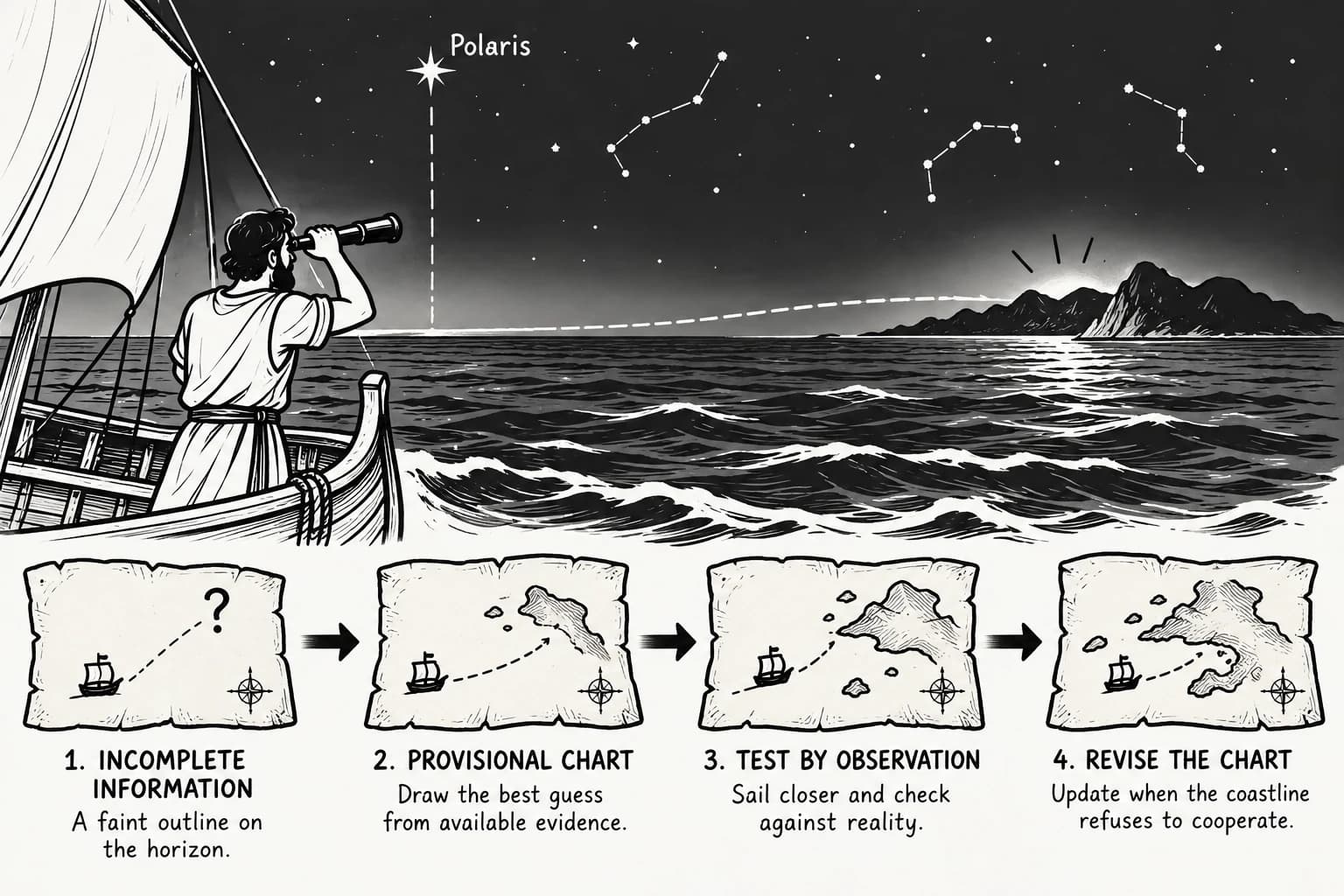
Navigators sailing between Ostia and Alexandria at the start of the millenium relied on familiar stars such as Polaris to maintain a northern reference and used the seasonal rising and setting of constellations to estimate direction, allowing them to cross open water long before accurate maps or precision instruments existed. Waiting for certainty often meant drifting forever and many sailor speculated on the identity of the faint dark outline on the horizon. Progress depended on drawing the best provisional chart from incomplete evidence, testing it by sailing closer, and revising it whenever the coastline refused to cooperate.
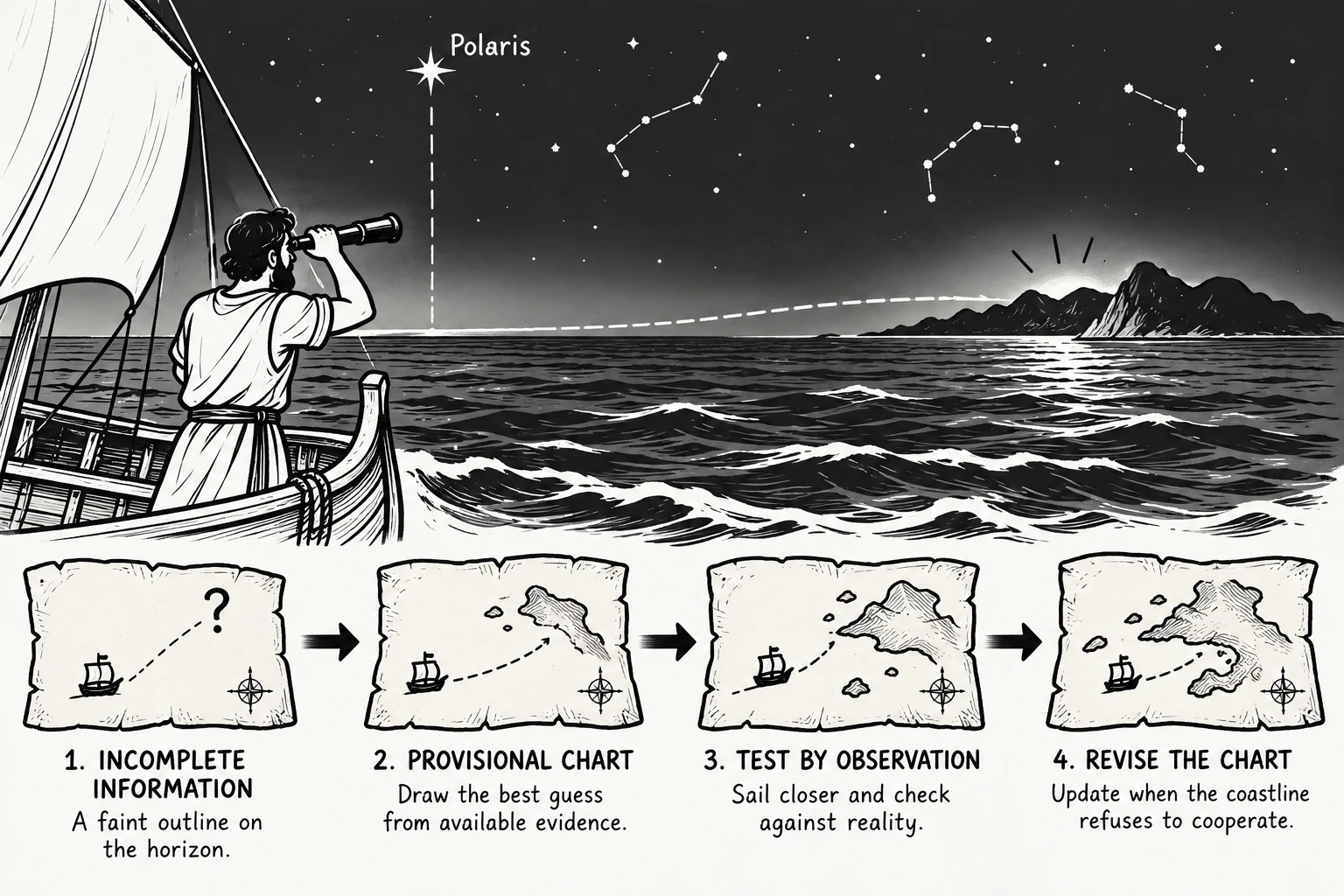 In 1878, Charles Sanders Peirce recognized that scientific reasoning follows the same voyage. Abductive reasoning begins when an observation no longer fits the map already stored in the mind. Rather than proving a conclusion, the brain proposes the best explanation, tests it against reality, and continuously redraws its mental chart. Peirce later integrated this process with deduction and induction, forming a complete cycle of inquiry in which discovery begins with explanation, continues through prediction, and matures through evidence.
Five Principles of Abductive Reasoning
What Is Abductive Reasoning?
A navigator spotting an unfamiliar coastline cannot immediately prove what lies ahead. The first task is to generate the most plausible hypothesis from incomplete evidence. Likewise, abductive reasoning—or Inference to the Best Explanation (IBE)—starts with a surprising observation and proposes the explanation that best accounts for it. A doctor looks for symptoms like fever and a cough before diagnosing pneumonia; a detective first finds footprints before identifying a suspect.
Occam's Razor: Choose the Simplest Chart First
Simplicity does not guarantee truth, but it reduces unnecessary complexity until evidence demands otherwise. A ship drifting suspiciously towards the west when it shouldn't requires examination. One explanation required believing the helmsman had repeatedly made unnoticed steering errors, the wind had shifted imperceptibly, and the sail trim was subtly wrong.
Another required only a single assumption: a strong ocean current was carrying the vessel sideways.
Deduction: Predict What the Map Should Reveal
Once a navigator concludes that the coastline is probably an island, deductive reasoning predicts what should appear next. The shoreline should eventually curve back toward open water. In science, deduction converts hypotheses into testable predictions. If bacteria cause the infection, antibiotics should improve the patient's condition. If the prediction fails, the hypothesis requires revision.
Induction: Improve the Map Through Repeated Voyages
Inductive reasoning generalizes from repeated observations, transforming individual experiences into broader knowledge. Meteorologists refine weather models from decades of atmospheric measurements, just as navigators spent millenia gently persuading maps to better resemble the coastline."
Abduction Completes the Cycle of Scientific Discovery
New coastlines, changing currents, and better instruments continually improve the map. Abductive reasoning plays the same role in science. It generates new hypotheses, deduction tests their predictions, and induction incorporates successful explanations into broader theories. Every discovery begins with uncertainty and ends with a better map rather than a perfect one.
Historical Development of Abductive Reasoning
| Year | Researcher | Historical Contribution | Key Concepts |
|---|---|---|---|
| 1878 | Charles Sanders Peirce | Introduced abductive reasoning as the logic of hypothesis formation, arguing that inquiry begins with the best explanation rather than proof. | Abductive reasoning, Inference to the Best Explanation, logical inference, hypothesis formation |
| 1901–1903 | Charles Sanders Peirce | Refined abduction into the first stage of the scientific method, followed by deduction and induction. | Scientific reasoning, fallibilism, economy of inquiry, scientific method |
| 1934 | Karl Popper | Argued that hypotheses gain credibility only by surviving attempts at falsification, strengthening Peirce's cycle of inquiry. | Falsifiability, empirical testing, scientific discovery |
| 1958 | Norwood Russell Hanson | Demonstrated that observation is theory-laden, showing that scientists interpret evidence through existing mental models. | Theory-ladenness, scientific explanation, model building |
| 1965 | Gilbert Harman | Popularized the term Inference to the Best Explanation (IBE), bringing Peirce's ideas into modern epistemology. | IBE, best explanation, explanatory reasoning |
| 1972 | Rescorla & Wagner | Linked learning to prediction error, providing a cognitive model for how hypotheses are revised through evidence. | Prediction error, learning theory, belief updating |
| 2009 | Itti & Baldi | Introduced Bayesian Surprise, quantifying how unexpected evidence drives belief revision. | Bayesian reasoning, Bayesian surprise, uncertainty reduction, belief revision |
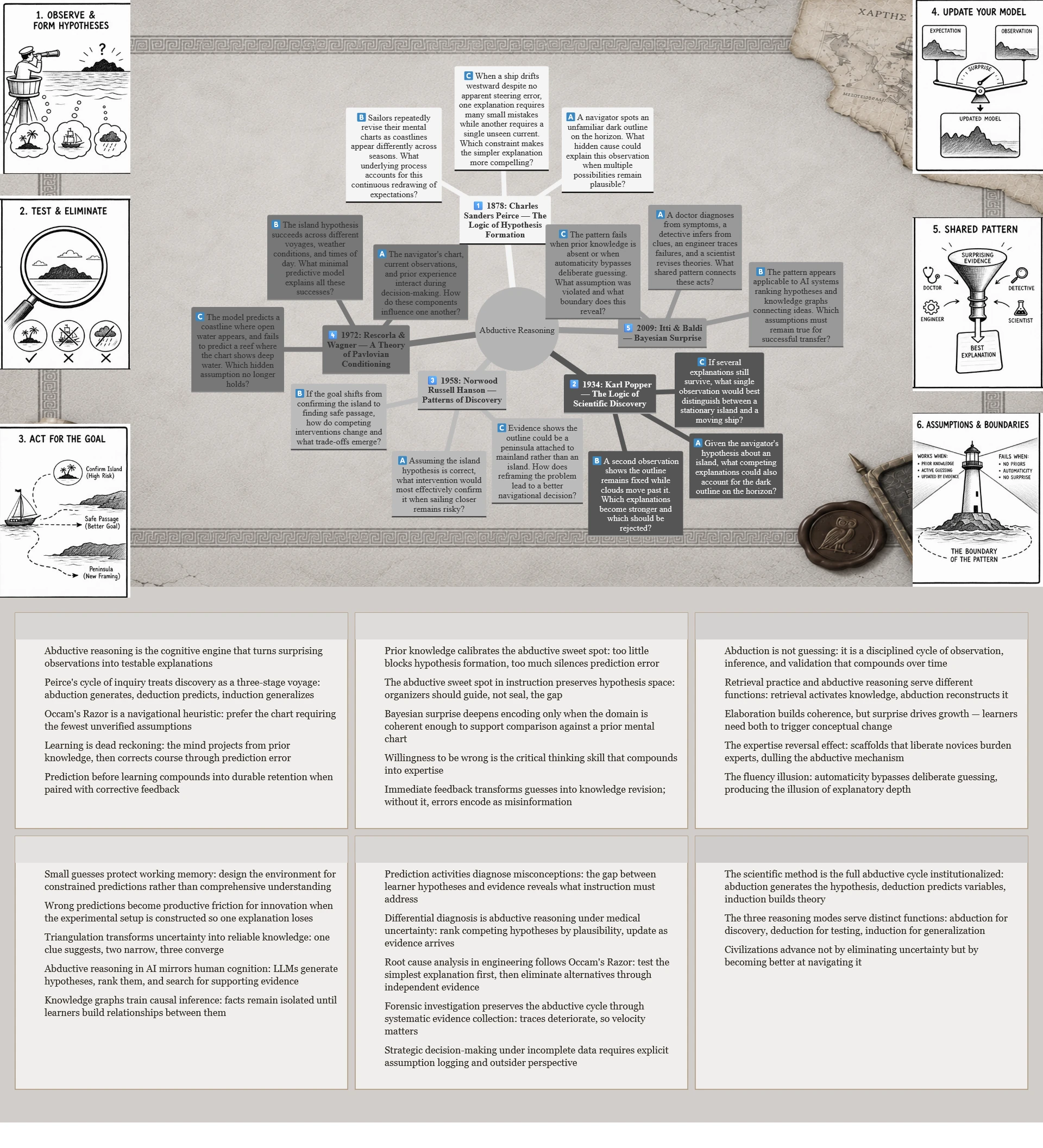
Ideas, Concepts and Research Behind Abductive Reasoning and it's Application in Learning Science
Long before sextants, radio beacons, and GPS transformed navigation into calculation, sailors relied on dead reckoning to estimate their position between observations, projecting a course from their last known location while accepting that every league sailed introduced fresh uncertainty. Learning follows the same discipline. Before new knowledge arrives, the mind constructs an advance organizer, activates prior knowledge through existing schemas, and sketches an initial explanation using abductive reasoning and prediction-based learning. Each new observation becomes a celestial sighting that either confirms the course or reveals prediction error, while Bayesian surprise marks the moment the coastline stubbornly refuses to appear where your chart insists it should.
True learning is an incremental process and involves endless iterations and revisions of existing knowledge. The goal is to strengthen memory with elaborative encoding, monitor progress through metacognition, and transform tentative hypotheses into durable understanding through generative learning, retrieval practice, desirable difficulties, and continuous feedback.
Does Prediction Before Learning Improve Retention? Abductive Reasoning Examples Explained
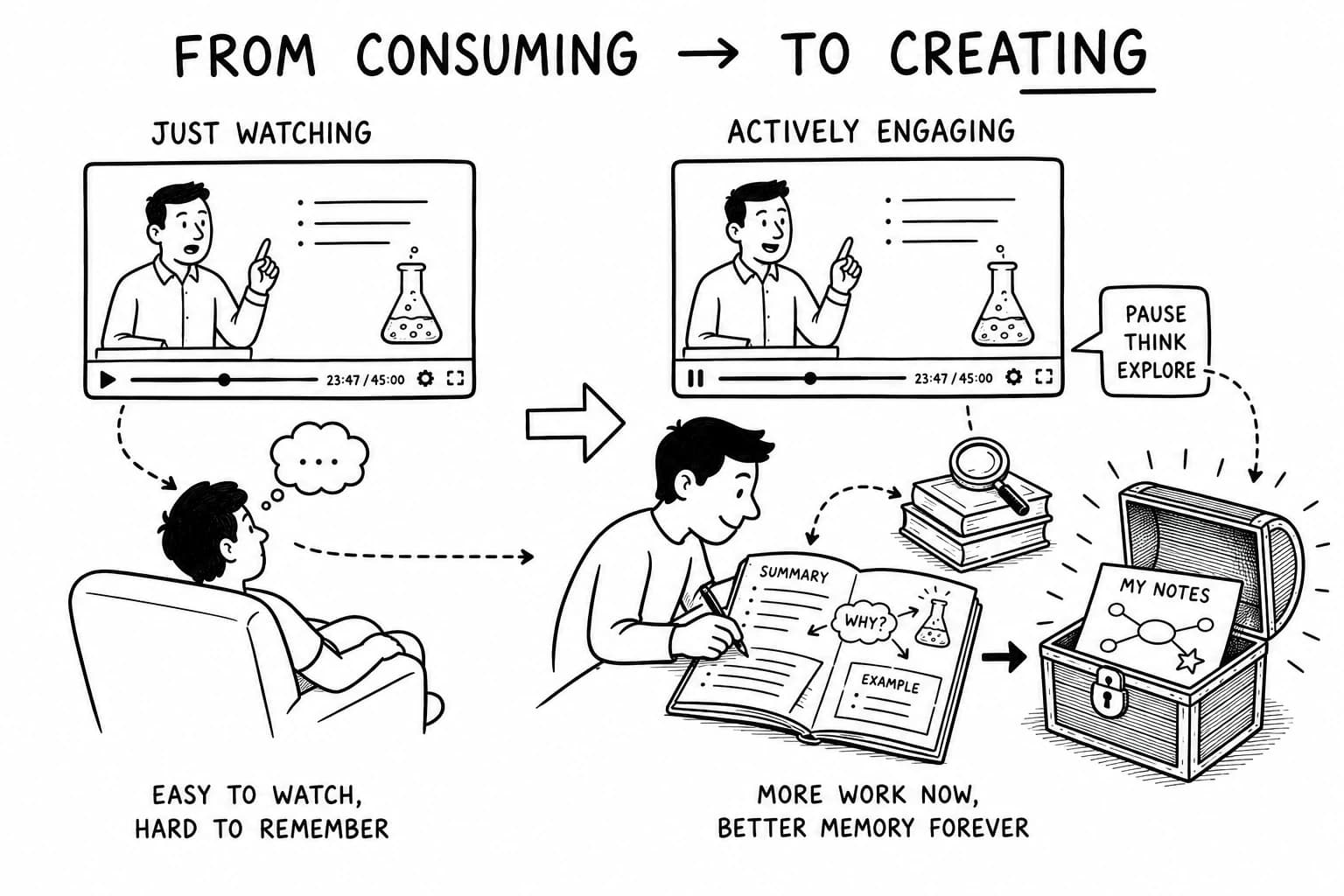
Prediction before learning improves immediate recall and delayed retention when the learner generates a plausible hypothesis and gets feedback. Unlike passive consumption, hypothesis generation as active learning has been known to be beneficial since small prediction habits keep the brain happy, and protect continuity better than intense cramming.
| Compounding System | Detail |
|---|---|
| Design for consistency | Michael Faraday, when confronted with an uncooperative galvanometer needle, did not dismiss the apparatus or pivot towards other endeavours. He kept observing, accumulating predictions and corrections in his notes and eventually went on to establish electromagnetic induction. |
| Skill compounds faster than motivation | He understood that dramatic bursts of inspiration were rarely rewarded and, instead, cultivated the “patience and labour of thought” and “sound self-applied discipline of mind” he considered essential to scientific inquiry. |
| Protect continuity | He continued investigating the discovery through 134 experiments between August 29 and November 4, 1831, turning one surprising observation into a sustained research programme |
| Build confidence from progress | Faraday's confidence in electromagnetic induction grew through successive experiments that confirmed and refined his initial discovery. |
| Evidence | Kornell, Hays and Bjork (2008) and Fiorella and Mayer (2016) found moderate improvements visible when using active prediction for learning |
Why Prior Knowledge Makes or Breaks Abductive Reasoning in Psychology
Cognitive psychology shows abduction depends on mental models, schema theory, pattern recognition, and System 1 intuition checked by System 2 (Daniel Kahneman, 2011). Moderate prior knowledge yields the most plausible theories and sets plausibility; very low knowledge blocks abduction while very high knowledge shrinks prediction error signals.
| Habit Formation | Detail |
|---|---|
| Turn abduction into a habit loop | Darwin’s habit loop of observing, hypothesizing, and seeking further evidence continually expanded his knowledge giving him a framework for interpreting the unruly Galápagos mockingbirds who refused to fit neatly into established species categories. |
| Cross the activation threshold | After returning from the Beagle in 1836, he started filling notebooks with thrilling questions about plant hybridization, a specimen catalogue, dry comparisons, and possible explanations, allowing one manageable observation to lead to the next |
| Enjoyment follows competence | Darwin’s study of orchids turned knowledge into a series of satisfying puzzles: the more he learned about a flower’s strange structure, the more clearly he could imagine the pollinator that might explain it |
| Correct, don't just persist | Darwin’s prior knowledge gave him hypotheses to test, but anomalies forced him to revise those models. |
| Evidence and entities | Prediction-before-learning shows moderate, well-established benefits when learners receive corrective feedback. The effect is supported by Kornell et al. (2009) and aligns with Piaget's accommodation, Vygotsky's scaffolding, and Anderson's schema activation. |
How Much Guidance Helps Learning
The abductive sweet spot is moderate organizer specificity that preserves hypothesis space for abductive reasoning in education. ZPD-matched advance organizers leave room to guess, while excessive detail seals the gap and breeds passivity and confirmation bias.
| Identity Build | Detail |
|---|---|
| Stack small daily wins | Socrates had a habit of making the next question small enough to answer transformed an intimidating proof into a trail of manageable insights, each one leaving the next stone conveniently within reach. |
| Reinforce excellence | When Meno’s slave confidently proposed that doubling a square’s side would double its area, where a lesser man may have chided the boy's lack of ability, Socrates let the geometry expose the error |
| Use external validation wisely | Socrates refused to play the part of an overhelpful donkey and used questions, diagrams, and carefully timed feedback to illuminate the solution without carrying the learner to the destination |
| Sharpen error correction | The mistaken square becomes productive because the contradiction become visible, prompting the learner to revise the model rather than defend the first guess thus avoiding confirmation bias and anchoring |
How Bayesian Surprise and Prediction Error Deepen Learning
High surprise deepens encoding when the domain is coherent enough to support evidential reasoning and probabilistic reasoning. Bayesian surprise (Itti & Baldi) quantifies how unexpected evidence drives belief revision, the core of the Bayesian brain and predictive processing / active inference (Karl Friston). Larger error deepens encoding only if learners can compare new evidence to a prior mental chart.
| Feedback Loops | Detail |
|---|---|
| Activate a schema before predicting | Maxwell began with a mechanical model of gas particles in motion. That prior model gave him a basis for predicting how collisions should produce pressure, temperature, and other observable properties |
| Engineer the loop | When presented with the stubborn problem of connecting invisible molecular motion to observable pressure and temperature, he retested and revised the schema until the observed temperature matched the expected |
| Densify feedback | Mathematical derivations allowed Maxwell to generate and check consequences quickly, while laboratory measurements supplied corrective constraints |
| Evidence and debate | Studies by Itti & Baldi (2009) and Posner et al. (1982) suggest that prediction followed by informative feedback promotes conceptual updating. |
Why Willingness to Be Wrong Is a Critical Thinking Skill
Abduction requires risking error under reasoning under uncertainty, a core critical thinking and problem solving skill. High anxiety suppresses guessing and causes skipping, while willingness to list 3-5 expectations preserves decision making and metacognition. Progress creates confidence more reliably than confidence creates progress.
| Long-Term Growth | Detail |
|---|---|
| Every prediction you make trains tomorrow's expectations | Albert Einstein, when Mercury’s stubborn orbital precession refused to fit Newtonian gravity, risked being wrong by proposing a revised model, comparing its predictions with observation, and correcting the mathematics through successive attempts, allowing the prediction–error–revision loop to build toward general relativity’s successful explanation of Mercury’s orbit. |
| Compound low risk bets | He treated each provisional calculation as a manageable bet, letting errors refine the next attempt and gradually turning uncertainty into a more coherent theory of gravity. |
| Measure progress, not effort | Had Einstein settled for good enough and defended his activity log, we would today celebrate the productivity instead of breakthroughs. |
| Evidence | Low-risk mistakes create desirable difficulties (Bjork, 1994), while reducing overconfidence and motivated reasoning, making belief revision more likely. |
Why Immediate Feedback Turns Guesses Into Knowledge Revision
Immediate feedback sharpens revision by forcing predictions to meet context through diagnostic reasoning and evidence evaluation. Without a verification phase, uncorrected errors encode misinformation and hindsight bias sets in. Effective learners revise through knowledge revision, elaborative encoding, and continuous feedback.
| Effort Quality | Detail |
|---|---|
| Prioritize frequency over duration | Ignaz Semmelweis connected cadaver exposure with puerperal fever and repeatedly compared mortality outcomes across the maternity clinics. |
| Time invested without adaptation is maintenance | Rather than explaining away initial inconsistent results he revised his understanding of how infectious material was being transmitted. |
| Protect schema fidelity before increasing test volume | The first schema identified cadaveric contamination as a source and unwashed physicians’ hands as a likely vehicle, but it was too narrow about the sources of infectious material. The second schema showed that transmission could also occur from living patients, prompting Semmelweis to broaden the hypothesis and require disinfection between examinations. |
| Evidence | Computational models of prefrontal cortex–basal ganglia gating indicate that effective learning is limited by the quality of evidence selection and updating, supporting accurate schema formation over raw throughput (Hazy, Frank & O'Reilly, 2010) |
Is Abductive Reasoning Just Guessing?
Unlike a guess, the abduction cycle includes observation, inference, and validation. Furthermore, attention activation without abduction (guessing) does not compound.
| Sustainable Performance | Detail |
|---|---|
| Never abandon the system | When pitchblende’s radioactivity exceeded what its uranium content could explain, Marie Curie could have bashfully hid behind the apparatus with a smile on her face. Instead, she kept the observation–hypothesis–verification cycle alive, investigating whether unknown radioactive substances were present. |
| Multiply time with depth | Rather than attempting to cram possible solutions into an afternoon, Curie spent more than three years—from 1898 to 1902—repeatedly measuring, chemically separating, comparing, and refining her findings, allowing each modest result to compound into the discovery of Polonium and Radium. Mere guesswork wouldn't create such results. |
| Recover to learn tomorrow | _“The feeling of discouragement which sometimes came after some unsuccessful toil did not last long and gave way to renewed activity. We had happy moments devoted to a quiet discussion of our work, walking around our shed.” |
Abductive Reasoning vs Retrieval Practice: Which Drives Retention?
Retrieval activates existing knowledge; abductive reasoning reconstructs it. If retrieval accuracy (spaced repetition, encoding specificity) alone predicts learning, recall is sufficient. If learning scales with prediction error beyond retrieval success, the deeper mechanism is explaining why expectations failed. The upskilling move is to combine both: retrieve, predict, and work towards analogical reasoning and eventually pattern recognition and tranfering learning across domains.
| Calibration | Detail |
|---|---|
| Calibrate before you grind | Dmitry Mendeleev designed the periodic table in such a way that properties of neighboring elements became a relational pattern for inferring the behavior of an unknown element. |
| Track the moving bottleneck | For an unknown element, he used neighboring elements in the same period and analogous elements in the same group, effectively asking whether several relational clues converged on the same answer. |
| Diagnose every failure | KeMendeleev also challenged accepted atomic weights and positions when they conflicted with the periodic law, including his revision of uranium's atomic weight and valence. |
| Evidence | Kornell (2009) discomfort predicts adaptation only when paired with success |
Elaboration vs Bayesian Surprise: What Really Makes Pre-Thinking Work?
Elaboration says pre-thinking creates coherence through constructivism and analogical transfer. No doubt coherence-building has it's benefits but surprise and error prediction drive growth. Learners should build coherence and track surprise to trigger conceptual change. In the early 1600s, Kepler noticed a a persistent discrepancy of roughly 8 arcminutes while reconciling Brahe's observations of Mars' orbit.
| Prediction-error architecture | Kepler's learning episode |
|---|---|
| Load the system | The discrepancy created cognitive friction, that inconvinient feeling that drives growth and pushes one out of their comfort zone. |
| Surprise becomes information | The ≈8-arcminute mismatch was too persistent to sweep under the rug |
| Do higher-order work | Kepler investigated whether the error belonged to the observations, the assumptions, or the mathematical model. |
| Revise the causal/model representation | He abandoned circular planetary orbits in favor of elliptical orbits with the Sun at one focus. |
| Generate a new prediction | The revised model produced substantially more accurate predictions of planetary positions. |
| Durable learning | The resulting laws became part of the foundation of modern celestial mechanics. |
When Expertise Hurts: Expertise Reversal Effect in Diagnostic Reasoning
Novices benefit from outline-triggered theories, while experts' predictions land too cleanly and dull the mechanism — the expertise reversal effect. Support that liberates novices burdens experts (Herbert Simon, John Anderson). The compounding fix: novices get scaffolds; experts remove scaffolds and seek novel diagnostic reasoning claims and edge cases.
| Your abstraction ladder | Fleming's case |
|---|---|
| Connect facts through exposure | Fleming had extensive experience with bacterial cultures and recognized what a normal bacterial plate should look like. |
| Chunk to get smarter | His expertise supplied the useful category: contamination, bacterial growth, culture behavior, inhibition. |
| The danger of the chunk | A lesser man would have been content leaving the mold in the safe and familiar "contaminent" bucket and terminating the investigation |
| Break the classification | Instead, the anomalous spatial relationship became the object of investigation: why does bacterial growth stop around this particular mold? |
| Ground the abstraction | Fleming went ahead and did the tedious legwork. He examined the mold, its effect on bacteria, and the substance diffusing from it. |
| Create the new branch | “Contaminated culture” became evidence for an antibacterial phenomenon, eventually opening the path toward penicillin. |
The Fluency Illusion: Why Automaticity Bypasses Good Reasoning
Knowledge compilation creates automatic routines that bypass deliberate guessing, producing the fluency illusion and illusion of explanatory depth. When deliberate guessing is still required, abduction works; when automaticity takes over, learners stop generating logical inference alternatives. The upskilling antidote is forced hypothesis generation rates and dual process theory checks: slow down System 1 with System 2 verification. That bit of extra cognitive effort can help navigate knowledge asymmetries effectively.
| Your framework | John Snow's investigation |
|---|---|
| Lean on competence | Snow possessed the prevailing medical knowledge, yet did not allow the established disease explanation to determine what evidence he looked for. |
| Generate alternatives | Instead of following the consensus and going with their explanations of miasma, he asked what other mechanism could produce the geographical distribution observed during a cholera outbreak in Soho in 1854. |
| Validate authority | The dominant medical explanation had considerable intellectual fluency and institutional authority; Snow tested its predictions against the messy distribution of actual cases. |
| Learn bottom-up | Individual households, deaths, addresses, water sources, and geographic clustering became the raw material for reconstructing the causal explanation. |
| System 1 → System 2 | The intuitive explanation was atmospheric contamination; the slower move was to map cases, compare exposure patterns, investigate water sources, and test whether the distribution made sense under competing hypotheses. |
| Abductive reasoning | The strongest explanation that of (contaminated water) became the one capable of accounting for the otherwise puzzling spatial pattern. |
How to Use Small Guesses Without Overloading Working Memory
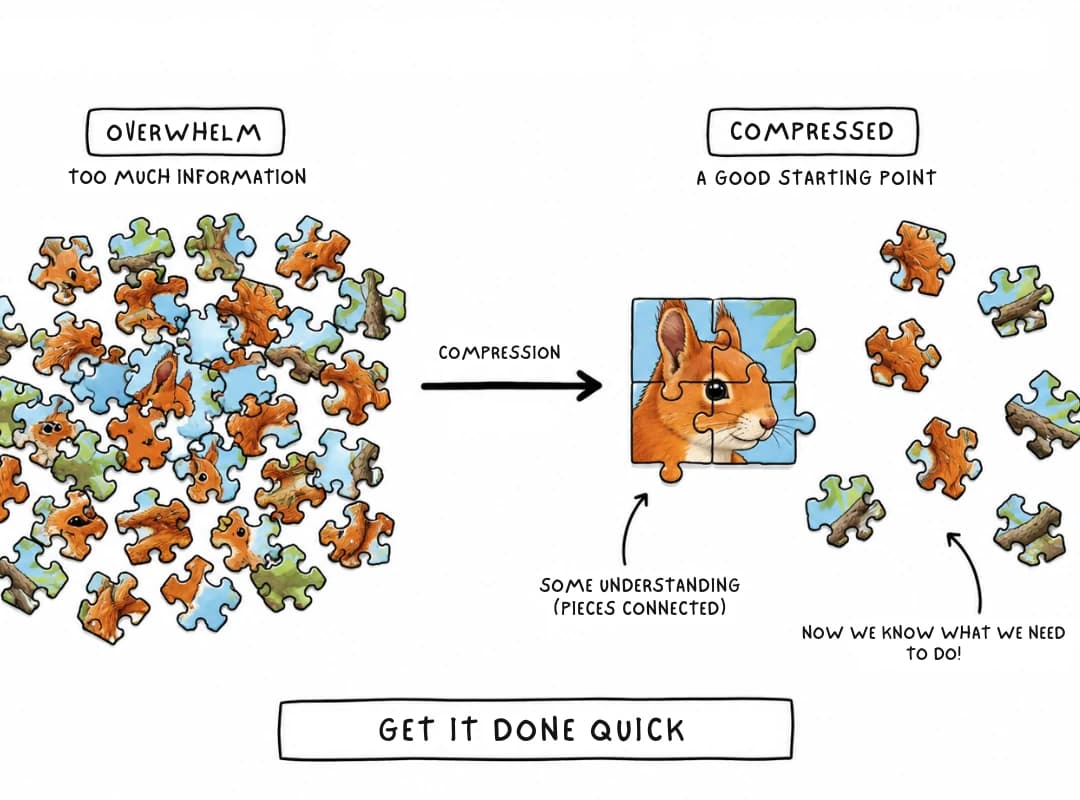
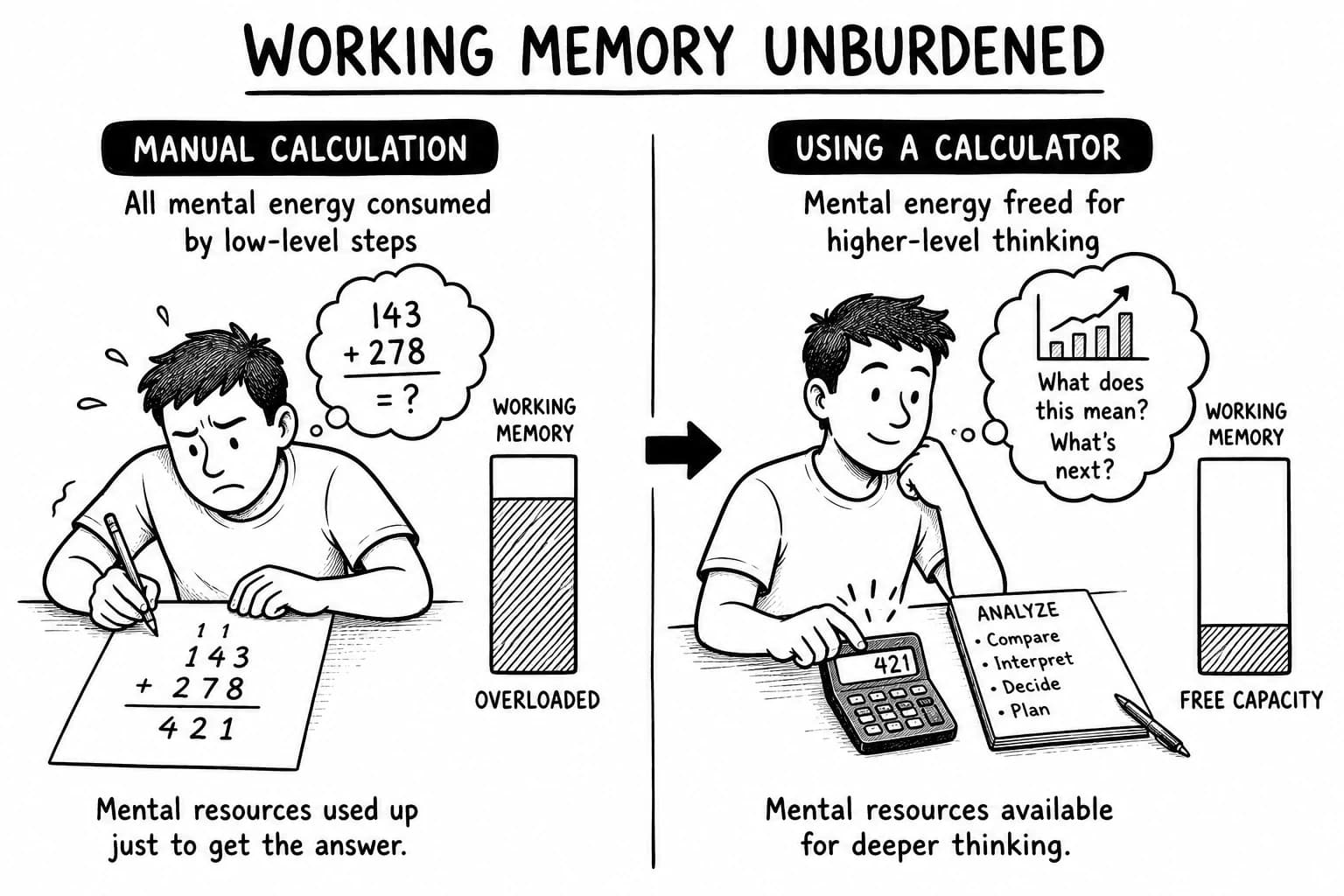
Consistency is an environmental property — design the environment for small guesses. For example, uisng an advance organizer/scaffoldling (Vygotsky) can help protect working memory and executive function and promote the natural tendency of the brain to connect the dots when viewing a lecture. Instead of passively consuming content, the brain actively fills in the blanks, leading to better learning outcomes.
| Instruction-design principle | Tesla's learning environment |
|---|---|
| Sequence for progression | Rome wasn't built in a day. The problem was decomposed into relationships among alternating currents, coils, magnetic fields, and mechanical motion. |
| Protect working memory | Physical apparatus externalized relationships that would otherwise have to be held mentally: current → magnetic field → rotation. |
| Small guesses | Each configuration effectively asked a constrained prediction about what the magnetic field or rotor should do. |
| 70% productive practice | Progress depended on repeatedly constructing, modifying, observing, and testing electrical arrangements. |
| Retrieval through implications | The useful question becomes “If the phase relationship changes, what should happen to the field?” rather than “What is a rotating magnetic field?” |
| Edge cases | Variations in coil arrangement, current phase, and motor construction exposed where the conceptual model worked and where it required refinement. |
Advantages of Abductive Reasoning: Turning Productive Friction Into Innovation
Wrong predictions become productive friction for creative thinking, problem solving, innovation, and rapid decision making under uncertainty. Advantages include exploration, diagnosis, and faster orientation when decision making must precede complete information.
| Memory ownership principle | Pasteur's investigation |
|---|---|
| Retrieve to preserve | Each experiment required Pasteur to reconstruct environments and variables and their interactions |
| Practice remembering as a skill | The relevant knowledge was operational: if spontaneous generation is true, what should happen under these conditions? |
| Don't prevent thinking | The answer could not be safely assumed before the environmental conditions were controlled. |
| Productive friction | Unexpected microbial growth became useful only when Pasteur asked what causal condition could account for it. |
| Competing explanations | Spontaneous generation and environmental contamination made different predictions under controlled conditions. |
| Refutation | The experimental setup was constructed so that one explanation would lose explanatory power when its predicted outcome failed to appear. |
Abductive Reasoning in Practice: Triangulating Better Explanations
Dead reckoning could carry a ship across open ocean, but no experienced navigator trusted a single estimate for long. By the eighteenth century, mariners increasingly relied on triangulation—combining bearings from multiple landmarks, celestial observations, and later increasingly accurate chronometers—to converge on the ship's true position. One lighthouse suggested a direction. Two narrowed the possibilities. Three independent observations transformed uncertainty into a reliable chart. The voyage did not become safer because any single clue was decisive. It became safer because every new observation constrained competing explanations until one best fit the evidence.
Abductive reasoning follows the same discipline. A learner begins with a hypothesis, an engineer investigates a system failure, a physician constructs a differential diagnosis, or a scientist confronts an unexpected result. Each starts with Inference to the Best Explanation, then continuously evaluates evidence, revises mental models through prediction error, and integrates independent observations into a more accurate understanding. Modern instructional design, AI-assisted learning, learning analytics, and knowledge management simply provide better instruments for an ancient navigational habit: replacing confident guesses with increasingly well-triangulated explanations.
What Is Abductive Reasoning in Simple Terms?
Lost keys, car won't start, child crying, phone battery dead — and you start making inferences from available data to explain the phenomenon. Students and teachers in schools, universities, and LMS often use advance organizers that leave deliberate hypothesis gaps to trigger an Inference to the Best Explanation (IBE).
| Retention system | Archimedes' problem |
|---|---|
| Review on schedule | The principle of density becomes useful when it is can actually be used to solved real world problems. |
| Use cliffhangers | King Hiero II asked Archimedes to determine if a crown was pure gold without cutting it |
| Activate prior knowledge | Archimedes could connect known relationships among mass, volume, density, and water displacement to the unfamiliar problem. |
| Make review feel hard | The learner has to generate a mechanism before receiving the solution: What measurable consequence would distinguish pure gold from adulterated gold? |
| Prediction-based learning | The crucial step is predicting what should happen under the “pure gold” hypothesis before comparing it with the observation. |
| IBE | A gold object of the same mass should displace the same volume of water. A mismatch would indicate that the crown contains material less dense than gold. |
| Durability | The principle becomes reusable because the learner has encountered it as a causal relationship rather than as isolated terminology. |
How Does Abductive Reasoning Work in AI? LLMs, RAG and Agentic AI
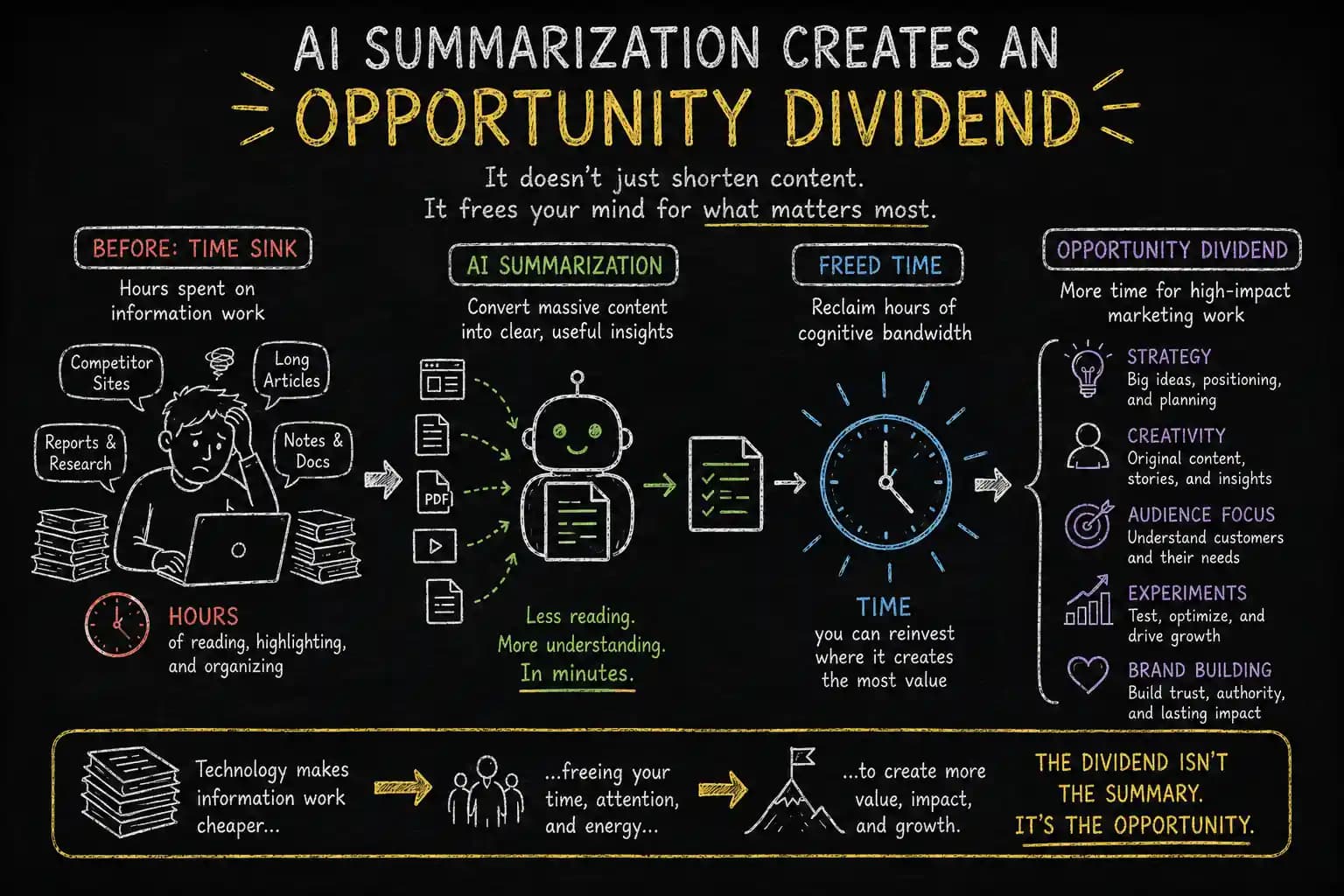
Expert systems, Bayesian networks, knowledge graphs, probabilistic inference, and causal inference engines. Modern LLMs and Generative AI use chain of thought and probabilistic inference to generate hypotheses, rank them, and search for supporting evidence (RAG) and use the right tools (agentic AI). Professionals drowning in PDFs, lectures, and videos use AI learning summaries to cope with the load. However, summary quality is very important. Here at y2map, our summaries can act as both an advance organizer as well as a a comprehensive note of the lecture/video/chapter complete with quotes and data points.
| Active learning in AI | Turing's approach |
|---|---|
| Create to prevent decay | Turing converted an abstract question: "can machines think?" into a concrete experimental procedure |
| Construct a provisional model | The imitation game provided an operational model of what “intelligent behavior” could mean |
| Expose understanding through production | The machine had to produce behavior; its output became the object of evaluation. |
| Generate test cases | The interrogator's questions functioned as probes designed to expose weaknesses, inconsistencies, or distinguishing characteristics. |
| Preserve uncertainty | Turing explicitly framed the problem around an operational test rather than claiming that passing the imitation game would settle every philosophical question about consciousness or thought. |
| Artifact library | The broader computational tradition Turing helped establish turns reasoning into executable procedures that can be rerun, modified, and tested. |
Why Knowledge Graphs Train Causal Inference and Explanatory Reasoning
Facts remain isolated until learners build relationships through concept maps and knowledge graphs. Displaying tentative causal links trains causal inference,analogical mapping, and systems thinking. Researchers confirm or revise links as evidence accumulates, improving pattern recognition and cross domain transfer.
| Opportunity spotting | Leonardo's working method |
|---|---|
| Prepare to compound | His notebooks accumulated observations that could later be connected across projects and domains |
| Train recognition first | He repeatedly looked for recurring structures—flow, pressure, leverage, branching, proportion, motion, resistance—within apparently different phenomena. |
| Notice missing links | An observation frequently generated questions about what mechanism connected it to another observable effect. |
| Test hypotheses | Drawings, measurements, dissections, machines, and geometric constructions became ways of testing whether a proposed relationship actually held. |
| Analogical mapping | Similar structural patterns could be investigated across anatomy, hydraulics, mechanics, and natural forms. |
| Systems thinking | Individual components were increasingly understood through their position within a larger interacting system. |
| Cross-domain transfer | A relationship discovered in one physical system could become a candidate explanation in another. |
How Teachers Diagnose Misconceptions With Prediction Activities
Knowledge gap analysis can help compare learner hypotheses against evidence, logging prediction error, Bayesian surprise, and belief revision rates.
| Diagnostic leverage | Eric Mazur's Peer Instruction |
|---|---|
| Expand leverage continuously | Each cycle of individual prediction, peer discussion and revised answers exposes misconceptions that inform subsequent instruction. |
| AI can surface opportunities | Conceptual questions reveal gaps hidden by successful problem-solving; AI can compare hypotheses against evidence and identify unresolved contradictions. |
| Stack skills | Individual prediction → peer discussion → revised prediction → targeted remediation → re-prediction on unfamiliar cases. |
| Outcome | Improved conceptual understanding and problem-solving, with visible changes in student responses and opportunities to assess durable learning through delayed retrieval and transfer tests. |
Abductive Reasoning in Medicine: How Doctors Do Differential Diagnosis
Multiple diseases explain identical symptoms, so physicians perform clinical reasoning and build a differential diagnosis. They study the symptoms and rank competing hypotheses by plausibility and update probabilities as lab tests arrive, using Bayesian diagnosis and evidence-based medicine. This reduces uncertainity and diagnostic error and speeds safer diagnosis.
| Integrated diagnosis | William Osler's Bedside Clinical Reasoning |
|---|---|
| Strengthen connected capabilities | Each patient encounter connected symptom interpretation, physical examination, competing diagnoses and pathological evidence, strengthening clinical judgment through repeated exposure to real cases. |
| Avoid bottlenecks | Bedside teaching and longitudinal patient observation connected students, physicians and clinical findings, allowing successive observations to refine the working diagnosis rather than treating symptoms in isolation. |
| Model and communicate | Osler organized clinical observations into differential diagnoses, comparing competing explanations against examination findings and pathological evidence. Modern Bayesian diagnosis extends this approach through explicit probabilities and diagnostic test evaluation. |
| Outcome | Systematic differential diagnosis, stronger clinical reasoning and medical education grounded in direct observation, evidence and the continuous revision of diagnostic hypotheses. |
Abductive Reasoning in Business and Engineering: Root Cause Analysis Under Uncertainty
Complex systems produce ambiguous symptoms — a production failure, bug, or sales dip. Engineers and operations teams test the simplest explanation first using Occam's Razor, then eliminate alternatives through independent evidence. Executives use the same move for business decision making: root cause analysis, decision analysis, scenario analysis, risk assessment, forecasting, and strategic planning under uncertainty, from mechanic to CEO to software debugging and incident response.
| Fix the Weak Link | Taiichi Ohno's Five Whys |
|---|---|
| Expose weaknesses early | Ohno traced visible symptoms through mechanical failures to underlying process weaknesses before choosing corrective actions. |
| Respect the cap | A blown fuse revealed a deeper lubrication failure caused by a missing oil strainer. Replacing the fuse alone would leave the system vulnerable to recurring breakdowns. |
| Balance depth with foundations | Ohno combined detailed knowledge of manufacturing equipment with transferable causal reasoning, direct observation and standardized problem-solving to improve processes throughout Toyota. |
| Outcome | Faster fault isolation, systematic elimination of recurring causes and a repeatable problem-solving method that became integral to the Toyota Production System. |
Detective Work as Abduction: From Sherlock Holmes to Cyber Threat Hunting
Detectives, journalists, firefighters, and security analysts start from clues, footprints, telemetry and other circumstantial evidence or alerts and infer the most plausible attack path or suspect.
| Preserve Velocity | Edmond Locard's Forensic Investigations |
|---|---|
| Maintain the habit | Locard emphasized immediate evidence collection because physical traces deteriorate or disappear over time. His laboratory systematically examined fingerprints, clothing dust and other clues before valuable evidence was lost. |
| Accelerate to create time | Repeated forensic investigations refined his techniques for collecting and comparing traces, turning accumulated experience into increasingly systematic investigative procedures. |
| Shape the environment | Locard established a dedicated police laboratory where investigators could combine observation, scientific instruments and comparative analysis to test competing explanations against physical evidence. |
| Outcome | More systematic crime reconstruction, earlier preservation of evidence and repeatable forensic methods that helped establish modern scientific criminal investigation. |
How CEOs Use Abductive Reasoning for Strategy When Data Is Incomplete
Executives use strategic decision briefs that record assumptions, competing explanations, confidence levels, and evidence for each scenario. This is abductive reasoning in business: market analysis, customer behavior, sales signals, and product development bets made through scenario planning and explicit belief revision.
| Strategic Transformation | Andy Grove's Intel Strategy |
|---|---|
| Transform capability into identity | Grove and Moore challenged Intel's identity as a memory-chip manufacturer, comparing its deteriorating DRAM business with the emerging opportunity in microprocessors before committing to a new strategic direction. |
| Choose sustainable over heroic | Intel's existing investments in microprocessors provided an alternative to repeatedly defending its declining memory business. The company redirected resources toward an established capability with different growth prospects. |
| Avoid overconfidence and motivated reasoning | Grove's hypothetical replacement-CEO question exposed the influence of historical commitments. Reconsidering the decision from an outsider's perspective helped the leadership team revise assumptions that had previously constrained its strategy. |
| Outcome | Intel exited DRAM manufacturing in 1985 and concentrated on microprocessors, establishing a strategic direction that shaped its subsequent growth and position in the personal-computer industry. |
Abductive Reasoning in Philosophy and Science: From Aristotle to Popper, Kuhn and Lipton
Abductive reasoning in philosophy anchors epistemology, logic, analytic philosophy, and scientific realism vs anti-realism. Beyond Peirce: Aristotle, Bacon, Hume, Mill, Popper (falsifiability), Kuhn, Lakatos, Quine, Harman (IBE), and Lipton debated inference, rationality, justification, truth, knowledge, and belief.
In the scientific method, abduction generates the hypothesis, deduction predicts variables and controls, induction builds theory through observation, experimentation, replication, and peer review.
| Meta Principle in Action | Thomas Francis Jr.'s Polio Vaccine Evaluation |
|---|---|
| Let consistency compound | Francis coordinated standardized procedures across a nationwide trial, combining controlled comparisons with systematic data collection to evaluate Salk's hypothesis. Independent evaluation made the vaccine's effectiveness open to empirical criticism rather than relying on promising laboratory results. |
| Expand solvable problems | The hypothesis that an inactivated-virus vaccine could prevent polio became a measurable research question. Comparing vaccinated children with controls allowed investigators to distinguish genuine protection from coincidental differences in disease incidence. |
| Protect progress without motivation | Francis directed an independent evaluation involving more than 1.8 million children, including randomized, blinded, placebo-controlled trials. Standardized procedures and statistical analysis helped protect scientific conclusions from enthusiasm, expectation and uncontrolled observations. |
| Outcome | The 1955 results established strong evidence for the vaccine's effectiveness, supporting its widespread adoption and demonstrating how independent testing can turn a promising scientific hypothesis into an evidence-based public-health intervention. |
Abductive vs Deductive vs Inductive Reasoning: Table, Examples and When to Use Each
Abduction generates hypotheses, deduction proves consequences, induction generalizes. Use abduction for diagnosis and discovery, deduction for testing, induction for laws. This also covers abductive reasoning in law — attorneys, judges, juries weigh legal inference, evidentiary reasoning, burden of proof, precedent, and circumstantial evidence — plus everyday life: dating, shopping, social interaction, software debugging, data analysis.
| Type | Starts With | Output | Certainty | When to Use |
|---|---|---|---|---|
| Abductive (IBE) | Surprising observation, incomplete evidence | Best explanation / hypothesis generation | Plausible, revisable | Doctor, detective, mechanic, lawyer, CEO debugging under uncertainty |
| Deductive | General rule + premises | Guaranteed conclusion / proof | Certain if premises true | Math, logic, testing predictions from a hypothesis |
| Inductive | Repeated observations | Generalization / probability | Probable, strengthens with replication | Science models, forecasting, induction from trials |
Conclusion
While the blank corners of the world map are filled, the human mind remains an enigma. Captain James Cook's Pacific voyages are remembered for discovering coastlines, but just as important were the coastlines he redrew. Doctors call it differential diagnosis. Engineers call it root cause analysis. Detectives call it following the evidence. Scientists call it hypothesis testing. Executives call it strategy. Researchers call it inquiry. Parents, mechanics, teachers, software developers, and anyone wondering why the Wi-Fi has mysteriously stopped working usually just call it Tuesday.
Modern tools have changed the instruments, not the voyage. Knowledge graphs connect ideas instead of coastlines. AI systems rank hypotheses before humans inspect them. Learning analytics measure prediction errors instead of dead reckoning. Yet beneath the expensive silicon and elaborate mathematics lies an old maritime instinct: observe carefully, explain cautiously, test relentlessly, and redraw the map whenever reality refuses to cooperate.
Perhaps that explains why abductive reasoning has survived from Peirce to predictive AI, from wooden sextants to neural networks. Civilizations do not advance because they finally eliminate uncertainty. They advance because they become better at navigating it.
A good navigator never expected the sea to agree with the map. They simply packed a pencil.