AI Research Paper Summarizer: Summarize Papers and Create Research Mind Maps
In 1620, Francis Bacon argued that knowledge advances through disciplined observation and comparison. An AI research paper summarizer applies a practical version of this principle by extracting a paper’s research question, methods, findings, and limitations into a structured overview. The resulting summary helps researchers navigate dense literature while keeping their attention on the evidence.
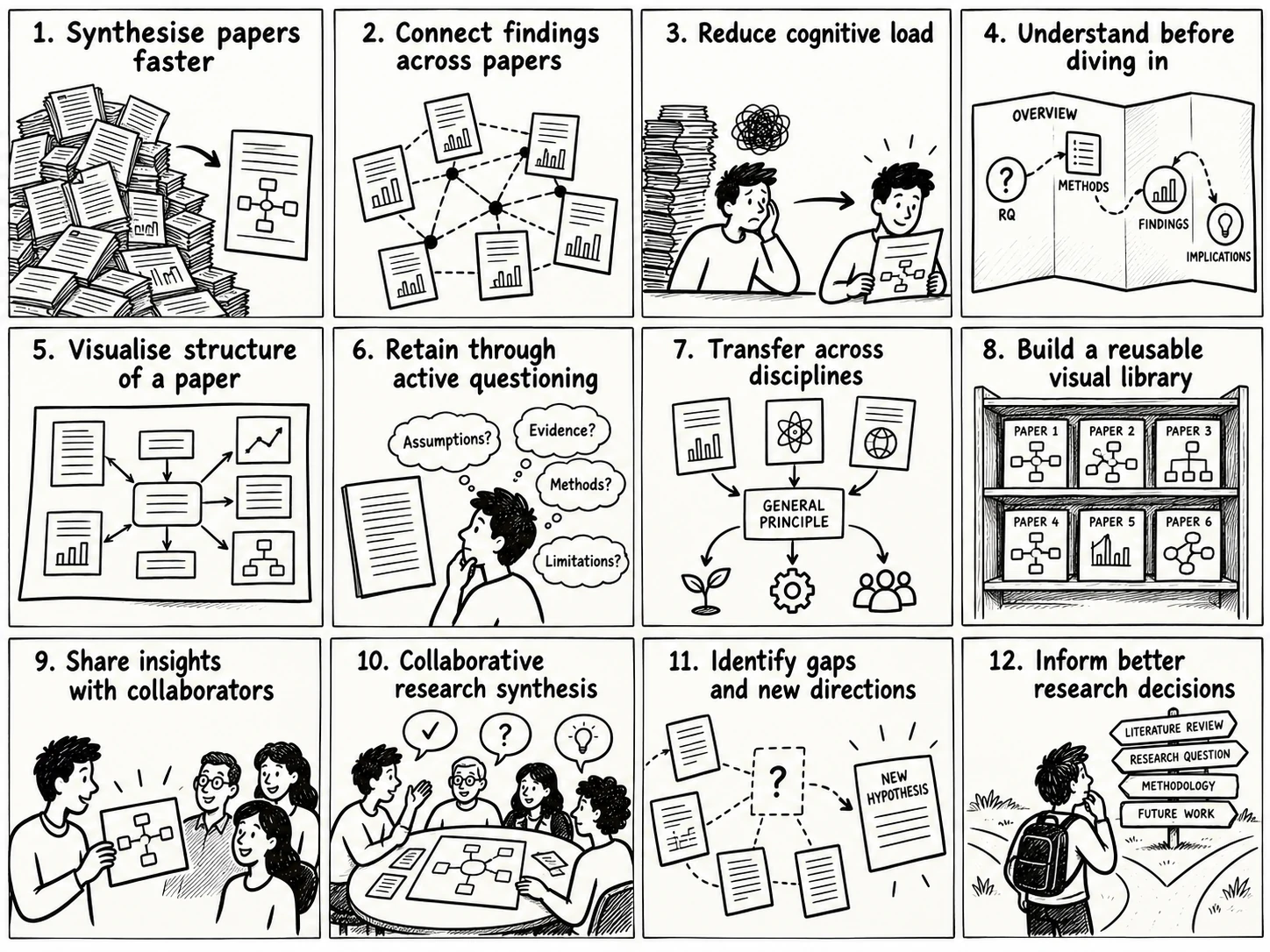
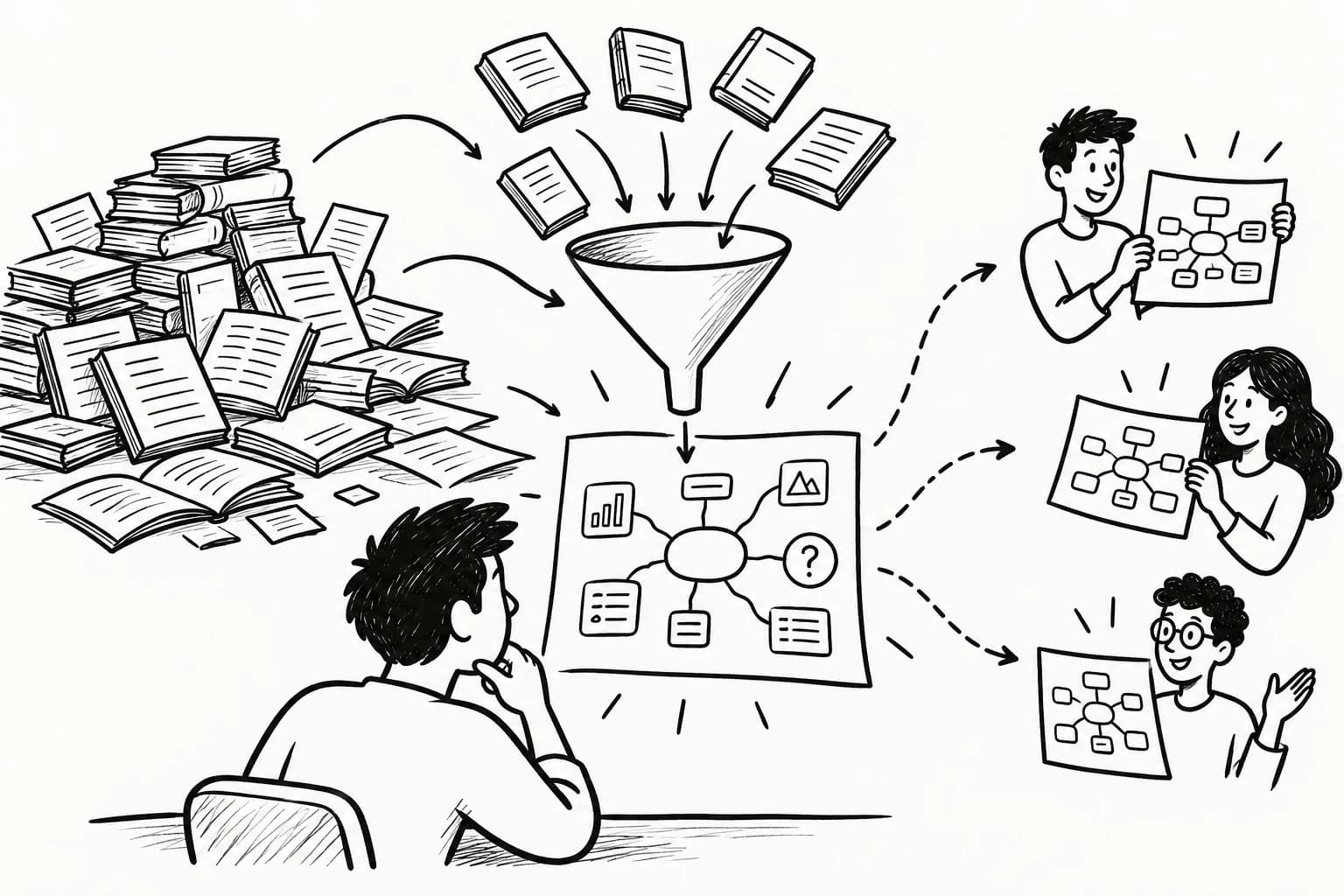
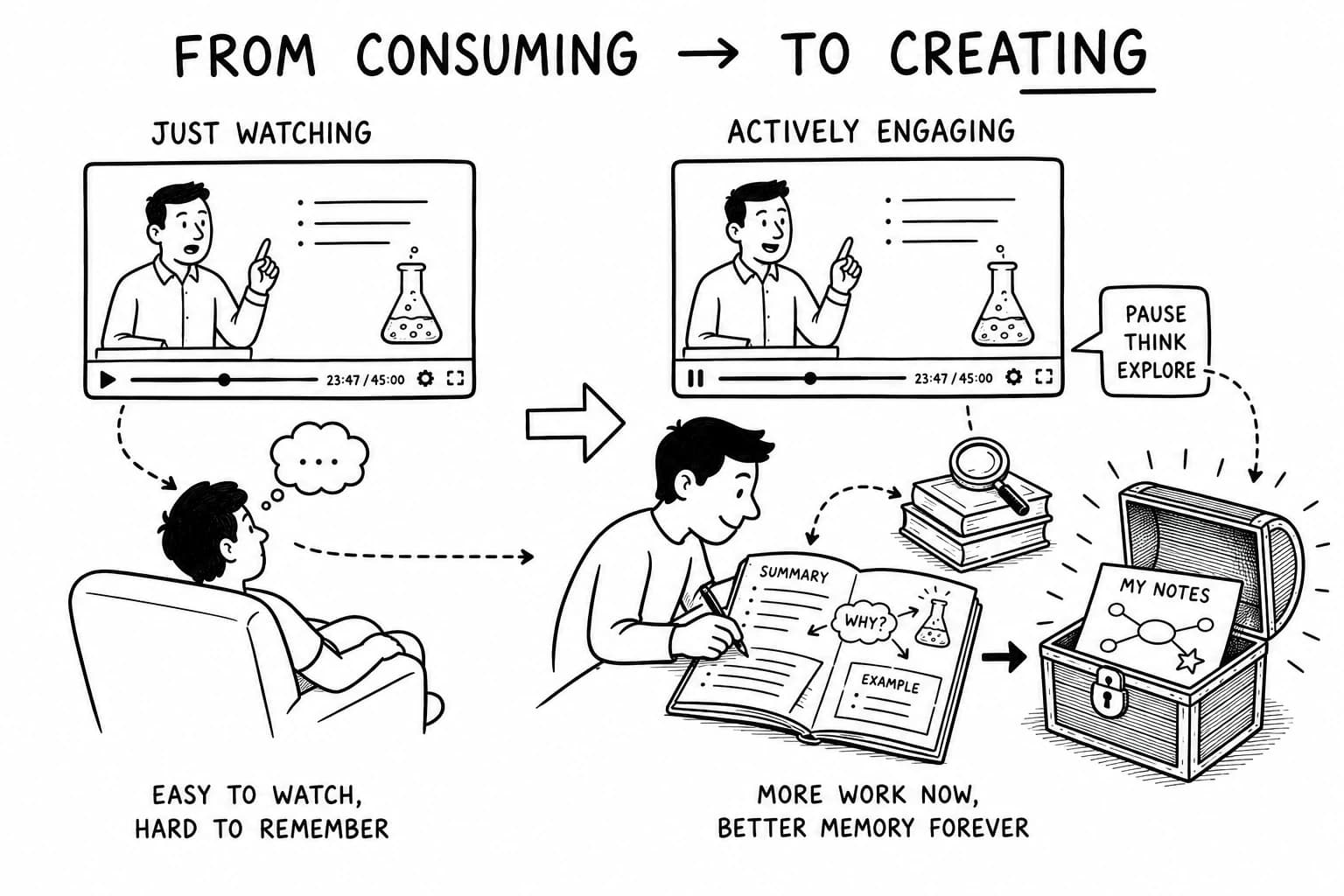
y2map connects research summarization with visual knowledge mapping: an executive brief establishes the essentials, while an interactive mind map reveals how the concepts relate. Together, they create a working model of the research for analysis, synthesis, and application.
An AI research paper summarizer uses artificial intelligence to organize academic papers into structured summaries. Depending on the tool, it may also answer questions about a document, compare multiple studies, and organize concepts visually. The original paper remains the authoritative record of what its authors reported.
The workflow connects six activities:
Summarize → Analyze → Map → Verify → Apply → Retain
Summarize Research Papers with AI
A research paper develops an argument through its research question, methodology, results, discussion, and conclusion. AI summarization compresses this structure into a format that supports screening, detailed reading, and revision.
Turn Research Papers into Clear, Concise Summaries
A useful research paper summary preserves the central question, the method used to investigate it, the principal findings, and the limitations governing its interpretation.
The appropriate level of detail depends on the task. A 100-word screening note helps determine whether a paper deserves further attention; a critical summary preserves the study design, sample, statistical results, and qualifications needed to assess its conclusions.
For example, a clinical study may require its population, intervention, and primary outcome, while a computer science paper may require its algorithm, benchmark, dataset, and failure cases.
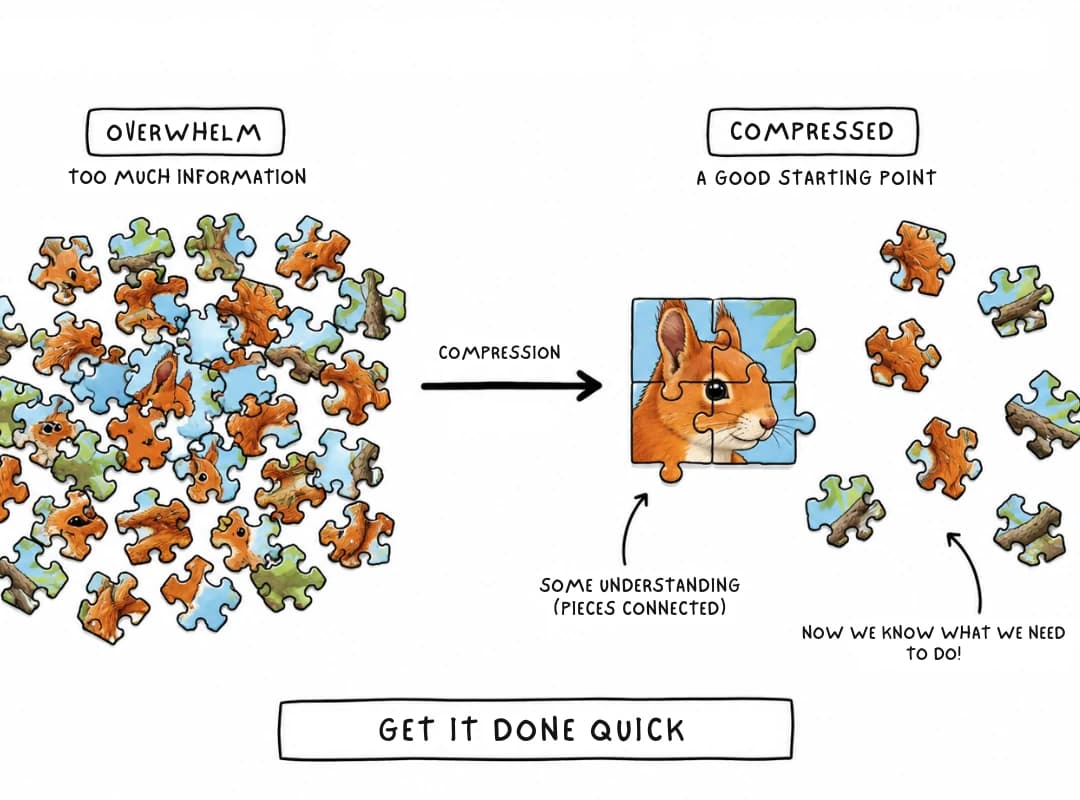
How y2map supports this process: The executive brief condenses the paper into its main argument, concepts, and evidence, giving readers an initial orientation before they investigate the details.
Extract Key Findings, Methods, Results, and Conclusions
A structured extraction makes the paper’s argument easier to inspect and helps reveal whether the conclusions follow from the evidence.
| Research element | What to extract | Why it matters |
|---|---|---|
| Research question | The problem being investigated | Defines the study’s target |
| Objectives and hypotheses | Expected outcomes or relationships | Makes the proposed test explicit |
| Methodology | Design, sample, instruments, and procedures | Shows how the evidence was produced |
| Results | Observations, estimates, and statistical findings | Establishes what the study reported |
| Discussion | Interpretation and comparison with prior research | Explains the authors’ reading of the results |
| Limitations | Constraints, uncertainty, and potential bias | Defines the boundaries of the conclusion |
| Conclusion | Principal takeaway | States the research contribution |
A reliable summary distinguishes reported results from the authors’ interpretation and the reader’s own inference. It preserves uncertainty, avoids turning correlation into causation, and leaves missing statistics explicitly unreported.
Summarize Research Papers Section by Section
Section-by-section summarization preserves the logic of a paper and exposes information that an abstract may omit.
- Introduction: Background, existing knowledge, problem statement, and objectives.
- Methods: Study design, data sources, participants, instruments, and analysis.
- Results: Findings, statistical estimates, tables, and figures.
- Discussion: Interpretation, comparison with earlier studies, implications, and limitations.
- Conclusion: Main contribution and proposed future research.
Research disciplines use different structures, so the summary should follow the source’s actual organization. Technical details and qualifications deserve particular attention when they determine whether a result can be reproduced or generalized.
Explain Complex Research Papers in Simple Language
Plain-language explanations make unfamiliar terminology and technical arguments easier to understand. Ask the AI to define specialized terms, explain the logic behind a method, and illustrate an abstract concept with an example.
For technical subjects, retain equations, assumptions, units, and boundary conditions. For empirical studies, preserve the difference between the observed outcome and the explanation proposed by the authors.
Simplification is useful when it preserves the distinctions that make the research accurate.
Summarize Research Papers for Free
Free AI research paper summarizers can support occasional reading and preliminary literature screening. Available features may depend on document length, usage limits, file formats, and access to advanced analysis.
Before choosing a tool, check whether it processes the full paper, supports scanned PDFs, handles tables and figures, and permits follow-up questions. Free access is useful when the document and workload fit the available limits.
Analyze Research and Organize Evidence
A summary establishes what a paper says; evidence analysis establishes what its findings support. This distinction is central to critical reading, literature reviews, and research decisions.
Identify Arguments, Evidence, and Key Claims
A research argument connects a claim to the reasoning and evidence offered in its support. Extracting these elements separately makes the structure visible.
For each major claim, identify:
- Claim: What the authors assert.
- Evidence: The observations, data, or prior research supporting it.
- Reasoning: How the evidence is used to support the claim.
- Assumptions: Conditions the argument takes for granted.
- Qualifications: Circumstances that restrict the conclusion.
The analysis should distinguish three levels of knowledge: the finding reported by the researchers, the interpretation proposed by the authors, and a reasonable conclusion that a reader may infer. Keeping these levels separate makes scientific reasoning more precise.
Evaluate Sources and Understand Research Findings
The credibility of a conclusion depends on the quality of the evidence supporting it. Examine the study design, sample selection, measurement methods, statistical uncertainty, and relevance of the evidence to the research question.
A statistically significant result does not automatically establish practical importance, and an association does not by itself demonstrate causation. Interpret findings within the limits of the method and the population studied.
For important claims, return to the relevant results, figures, tables, and methodological details. A summary provides orientation; the original evidence supports the judgment.
Analyze Research Methodology and Study Design
Methodological analysis explains how researchers produced their findings and which conclusions the design can support.
Check whether the sample represents the population of interest, whether the measurements capture the intended variables, and whether the analytical method fits the research question. Consider confounding variables, selection effects, measurement error, and alternative explanations where relevant.
For experimental studies, examine the comparison conditions and assignment procedures. For observational research, investigate potential confounding and the limits of causal inference. For computational research, inspect the dataset, benchmark, evaluation procedure, and reproducibility information.
Identify Limitations, Biases, and Research Gaps
Limitations define the boundaries of a study’s contribution. They may arise from sample size, population coverage, measurement quality, study duration, assumptions, or the analytical method.
A research gap emerges when existing evidence leaves an important question unresolved. Gaps may involve underrepresented populations, inconsistent results, untested mechanisms, limited methods, or conditions that previous studies have not examined.
Treat AI-generated gap suggestions as hypotheses for further investigation. Establish novelty by examining the relevant literature and tracing the proposed gap to actual evidence.
Compare Evidence Across Research Papers
Multi-paper analysis examines how different studies address a shared question. A comparison matrix makes methodological differences and substantive disagreements easier to inspect.
| Comparison dimension | Questions to investigate |
|---|---|
| Research question | Are the studies investigating the same underlying problem? |
| Population or dataset | Do the samples and data sources differ? |
| Methodology | Are the designs and measurements comparable? |
| Findings | Do the results converge, diverge, or address different outcomes? |
| Limitations | Which constraints affect each conclusion? |
| Interpretation | Do the authors explain the evidence differently? |
Preserve each paper’s identity and retain disagreements that affect the interpretation. Similar conclusions from different methods may strengthen a pattern, while apparently conflicting results may reflect differences in populations, measurements, or boundary conditions.
Convert Research Papers into AI Mind Maps
An AI research mind map organizes a paper’s central question, concepts, methods, findings, and implications into a visual structure. It helps readers inspect the relationships that a linear summary presents sequentially.
Generate Mind Maps from Research Papers and PDFs
A research paper mind map can begin with the central research question and branch into background, methodology, findings, limitations, and implications.
A useful map preserves meaningful relationships between branches. A method should connect to the question it investigates, findings should connect to the evidence supporting them, and limitations should indicate where conclusions require qualification.
With y2map, readers can combine an executive brief with an interactive mind map to orient themselves and explore the paper’s conceptual structure.
Create Mind Maps from Research Text
Research text, abstracts, and existing notes can provide starting material for a visual map. The completeness of the source determines the completeness of the resulting structure.
A map generated from an abstract may omit methodological qualifications and detailed results available only in the full paper. Label partial-source maps accordingly and consult the original document when the missing detail affects interpretation.
After generation, review the hierarchy, correct inaccurate relationships, and retain important definitions and source references.
Explore Research Mind Map Examples
Different research questions produce different useful map structures.
A machine-learning paper might connect the research problem to the proposed model, training data, evaluation metrics, results, and failure cases. An education study might connect an instructional intervention to its theoretical mechanism, study design, learning outcomes, and limitations.
These structures help readers identify the chain of reasoning that supports a conclusion and locate the assumptions on which it depends.
Organize Research Findings into Visual Knowledge Structures
A visual knowledge structure arranges information by conceptual importance and relationship. The central node represents the main research question or thesis, while subordinate branches represent supporting concepts and evidence.
A well-organized map can show causal hypotheses, methodological dependencies, competing explanations, and unresolved questions. Label relationships explicitly when their meaning matters, and preserve uncertainty where the evidence remains inconclusive.
Generate Mind Maps from Multiple Research Papers
A multi-paper research map synthesizes a body of literature while preserving the identity of its sources. This task has different requirements from mapping a single paper because each source may use different methods, populations, definitions, and interpretations.
Organize the map around a shared research question or theme, then connect each study to its methods, findings, and limitations. Use source labels or citations on relevant branches so readers can trace each claim to its originating paper.
Shared findings can form common branches, while disagreements should remain visible as competing results or interpretations. The map becomes a model of the literature’s structure and uncertainty.
Customize Mind Map Branches, Nodes, and Relationships
Editing improves a generated map by aligning its structure with the research question. Group related concepts, separate evidence from interpretation, and make important dependencies explicit.
Remove redundant nodes, restore omitted qualifications, and preserve relationships that explain the paper’s contribution. For multi-paper maps, check that each branch retains the correct source attribution.
The map should make the research easier to understand, investigate, and revise.
Key Features of an AI Research Paper Summarizer
The most useful AI research paper summarizer combines document handling, structured extraction, source-grounded question answering, editable outputs, and reliable verification.
Summarize PDFs, Documents, and Academic Articles
Document support determines which research materials can enter the workflow. Check compatibility with PDF files, text documents, and other supported formats before uploading a paper.
Scanned PDFs may require optical character recognition (OCR). Tables, equations, figures, footnotes, and complex layouts can also introduce extraction errors. Verify that the tool has access to the information needed for the task.
For unpublished research, confidential documents, or sensitive participant data, review the service’s data-handling and retention terms before uploading.
Extract Key Findings and Important Concepts
Concept extraction identifies the central claims, definitions, methods, findings, and relationships within a paper. Structured outputs are easier to compare across studies and can support research matrices and visual maps.
Useful extraction should preserve numerical results, methodological conditions, limitations, and uncertainty. When the paper does not report a requested detail, the system should identify the information as unavailable.
Customize Summaries for Different Research Needs
The intended task determines the summary format.
| Research task | Useful output |
|---|---|
| Preliminary screening | Short summary of the question, findings, and relevance |
| Critical appraisal | Detailed account of the design, methods, evidence, and limitations |
| Literature review | Consistent extraction fields across multiple studies |
| Technical implementation | Methods, assumptions, parameters, results, and failure cases |
| Academic writing | Source-linked claims, supporting evidence, and qualifications |
| Learning and revision | Executive brief, conceptual map, and recall questions |
Specify the audience, purpose, depth, and required fields before generating the output.
Generate and Edit AI Mind Maps
Mind map support allows readers to reorganize extracted concepts and inspect their relationships visually. Look for editable nodes, meaningful hierarchy, and ways to preserve source information.
Review the map for missing concepts, unsupported links, and misplaced relationships. Use the mapping workflow described above for detailed guidance on single-paper and multi-paper structures.
Organize, Export, and Revisit Research Notes
Export options help turn temporary analysis into a reusable research resource. Check whether the tool preserves headings, citations, links, and formatting in its supported output formats.
Store the summary and map with the paper’s bibliographic information. A research matrix can track authors, publication year, methods, findings, limitations, and relevance across a larger project.
Ask Questions About Research Papers Using AI
Question-driven exploration helps readers investigate specific claims and locate information that a summary may leave unresolved.
Useful questions include:
- What was the primary research question?
- How many participants or observations were included?
- Which statistical method was used?
- What limitations did the authors acknowledge?
- Which results support the main conclusion?
- What alternative explanations remain plausible?
Prefer answers that identify the relevant page or passage. If the paper does not report a requested detail, the answer should say so.
Verify AI-Generated Summaries Against Original Research
AI-generated summaries can omit qualifications, misread technical language, or introduce unsupported claims. The US National Institute of Standards and Technology discusses confidently presented errors in generative AI systems in its Generative AI Risk Management Profile.
Check consequential claims against the source, especially numerical results, populations, methods, quotations, citations, and conclusions. Confirm that the summary preserves the difference between the reported finding, the authors’ interpretation, and the reader’s inference.
The executive brief and mind map help organize what needs checking; the original paper establishes whether the interpretation is supported.
How to Summarize a Research Paper with AI
A reliable workflow combines structured extraction, evidence checking, visual organization, and application. Each stage produces a usable research artifact that supports the next.
1. Select and Prepare the Research Paper
Choose the paper and confirm that the selected tool supports its file format. Check scanned pages, figures, tables, and other elements that may be difficult to extract accurately.
For confidential or unpublished research, review the service’s data-handling terms before uploading the document.
2. Generate a Structured Research Summary
Use a prompt that specifies the information to extract and the standards for handling uncertainty.
Summarize this research paper using these sections: research question, objectives, study design, sample or dataset, methodology, key findings, statistical results, limitations, and conclusions. Distinguish reported facts from the authors’ interpretations. Do not invent missing information. Identify details that require verification against the original paper.
A consistent prompt makes summaries easier to compare across a collection of studies.
With y2map: Use the executive brief to identify the central question, essential claims, and principal evidence before examining the finer details.
3. Review Findings and Supporting Evidence
Compare the summary with the paper’s results and methodology. Inspect the tables, figures, statistical estimates, and qualifications that determine how the findings should be interpreted.
Record unresolved discrepancies and identify conclusions that depend on assumptions or restricted conditions.
With y2map: Use the brief to establish orientation and the interactive mind map to organize relationships among claims, methods, findings, and limitations.
4. Convert the Summary into a Research Mind Map
Place the research question at the centre and organize the supporting concepts into branches for background, methods, findings, limitations, and implications.
For multi-paper projects, retain each paper’s title or citation and preserve differences in methods and conclusions.
With y2map: Trace how methods relate to the research question, how findings support the conclusion, and which assumptions shape the interpretation.
5. Interrogate the Model and Identify Gaps
Test the initial summary and map with questions about assumptions, mechanisms, evidence, and alternative explanations.
Ask which evidence supports each important relationship, under what conditions the conclusion might change, and which questions remain unresolved. Treat suggested research gaps as leads for further reading and verify them against the source and wider literature.
With y2map: Use question-driven exploration to investigate unclear branches and identify concepts that deserve closer examination.
6. Apply Research Insights to a New Problem
Transfer becomes possible when the underlying mechanism can be recognized in another context. Identify the relationship that produced the original result and examine whether the new setting shares the relevant conditions, constraints, and measurements.
For example, a study of feedback in education may suggest that timely information influences performance. Applying that principle to workplace training requires examining feedback quality, incentives, and the learning environment.
With y2map: Compare the relationships in the research map with those in the new problem. Separate reusable principles from context-specific details and revise the model when the boundary conditions differ.
7. Export and Organize Your Research
Save the summary, mind map, and bibliographic details together. Record the authors, title, publication year, and DOI or stable URL where available.
For larger projects, maintain a research matrix with one row per paper and fields for methods, findings, limitations, and relevance. This creates a traceable knowledge base for literature reviews, writing, and future investigation.
8. Test Understanding Through Recall
Close the summary and mind map, then reconstruct the research question, method, findings, and limitations from memory. Reopen the materials to identify missing connections and correct misunderstandings.
Roediger and Karpicke’s 2006 experiments found that repeated retrieval improved delayed retention compared with repeated study under the tested conditions (Roediger & Karpicke, 2006).
The map organizes the knowledge; retrieval practice tests whether you can reconstruct and use it.
Benefits for Students and Researchers
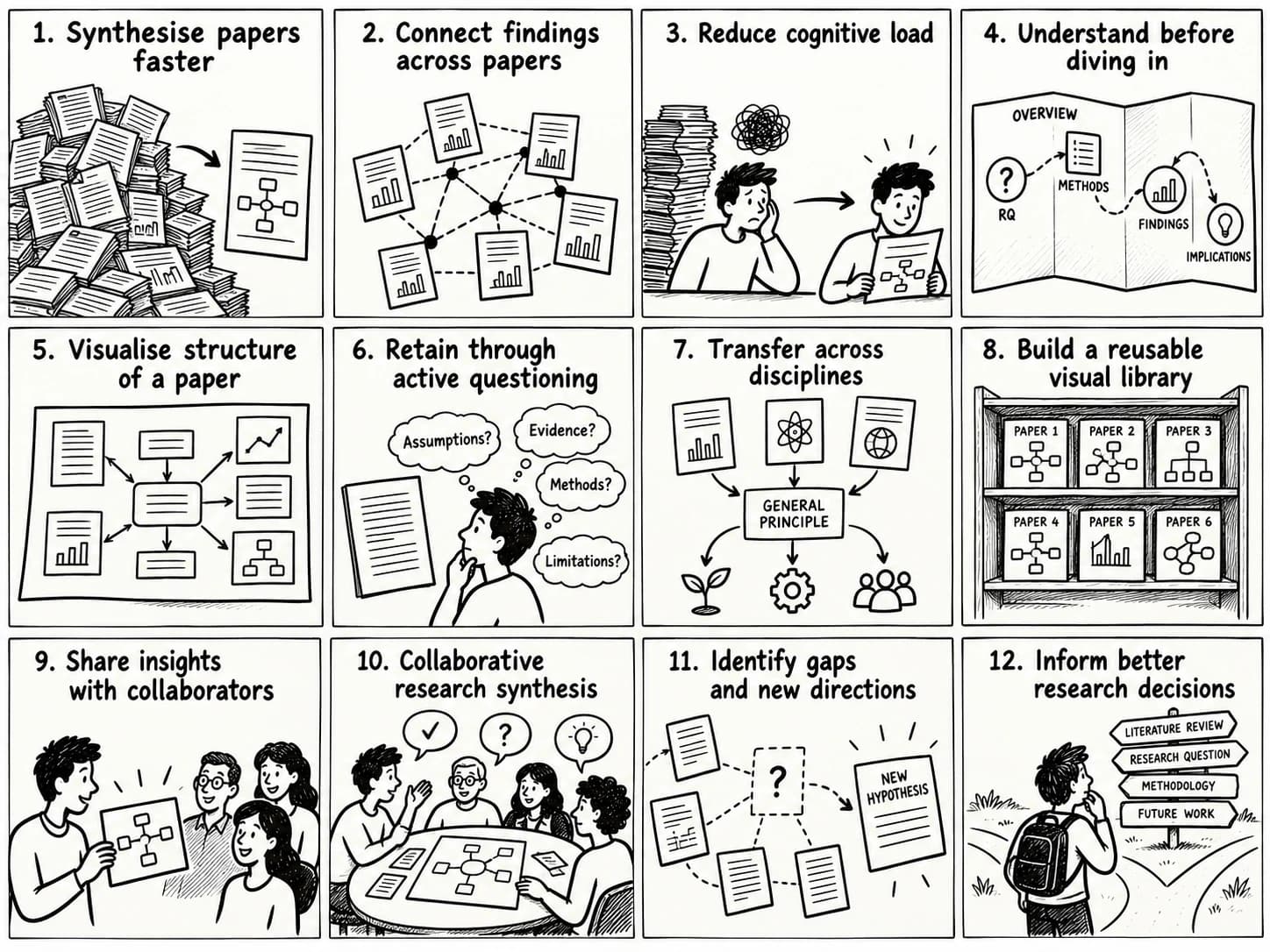
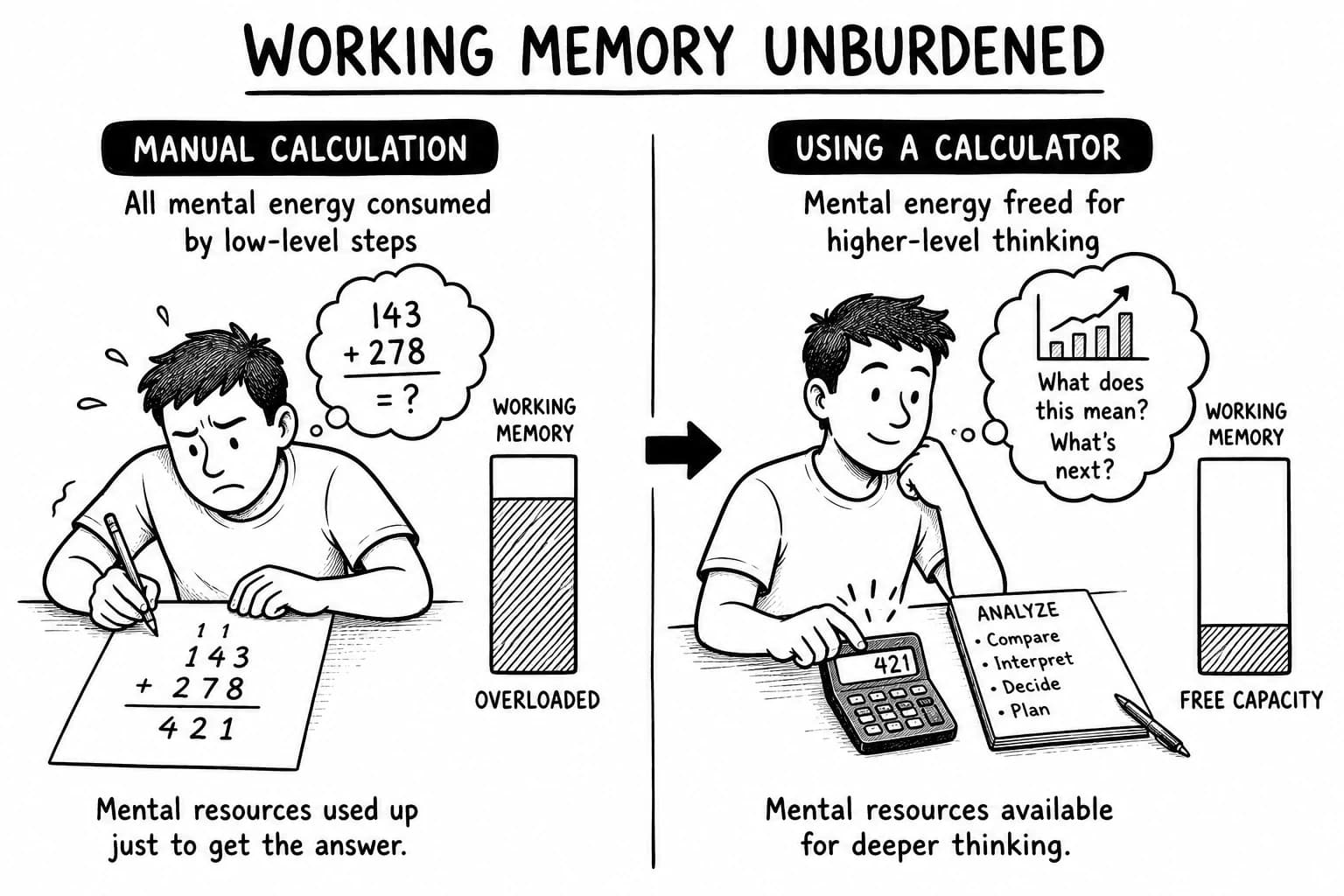
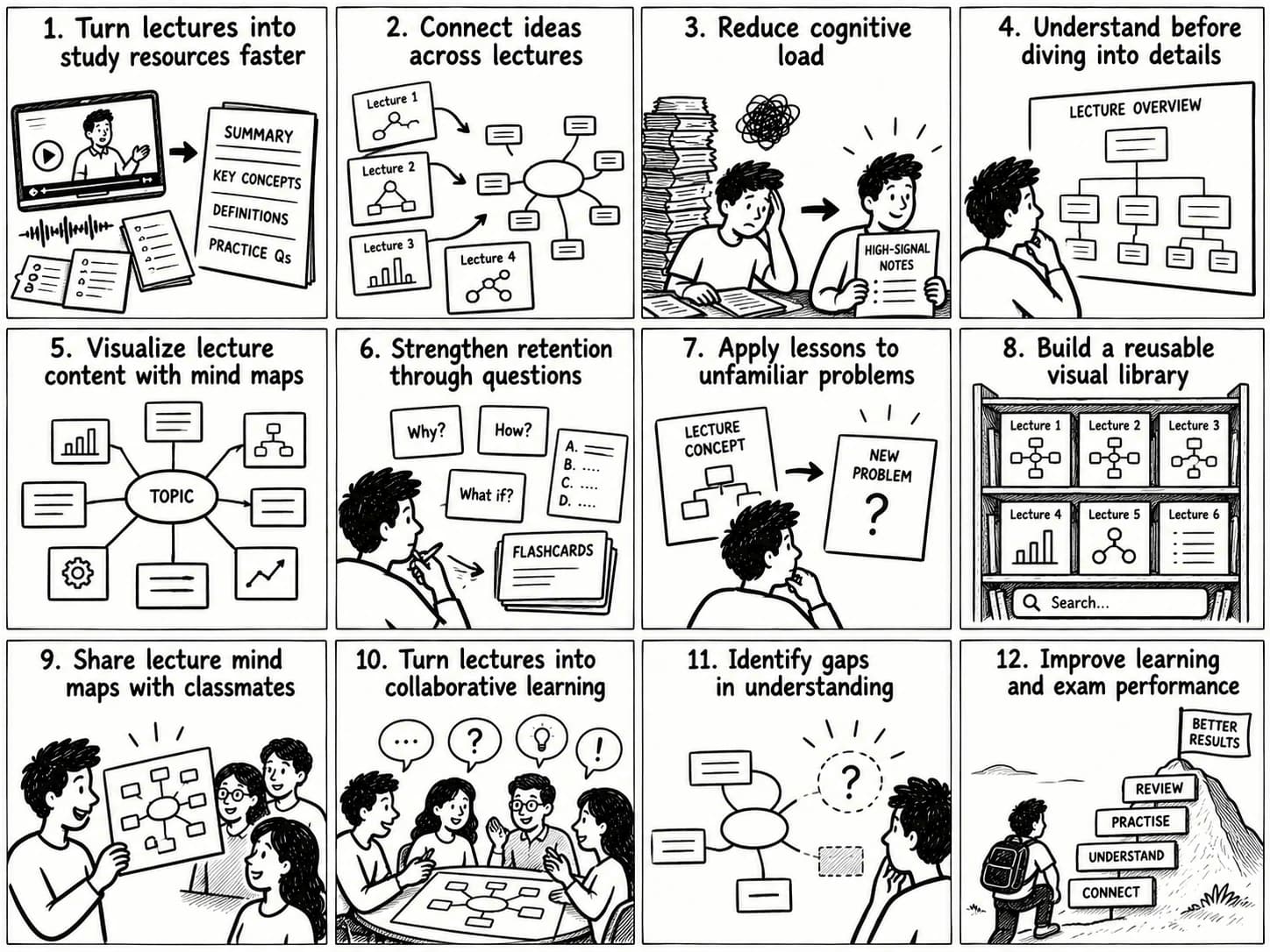
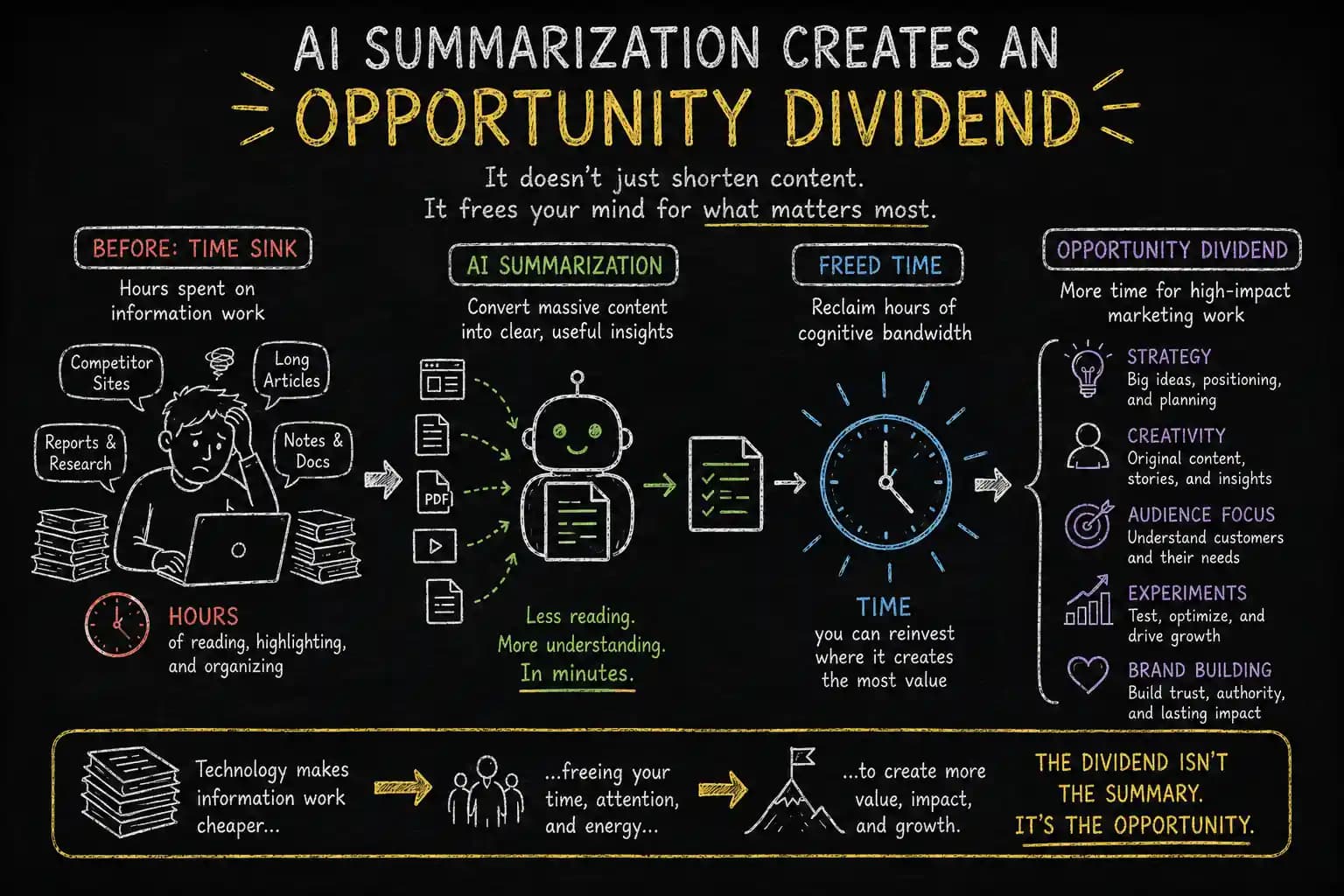
AI-assisted summarization reduces repetitive extraction and makes dense research easier to navigate. Its value comes from the resulting capacity to evaluate evidence, organize relationships, and reuse knowledge.
Understand Complex Research Papers Faster
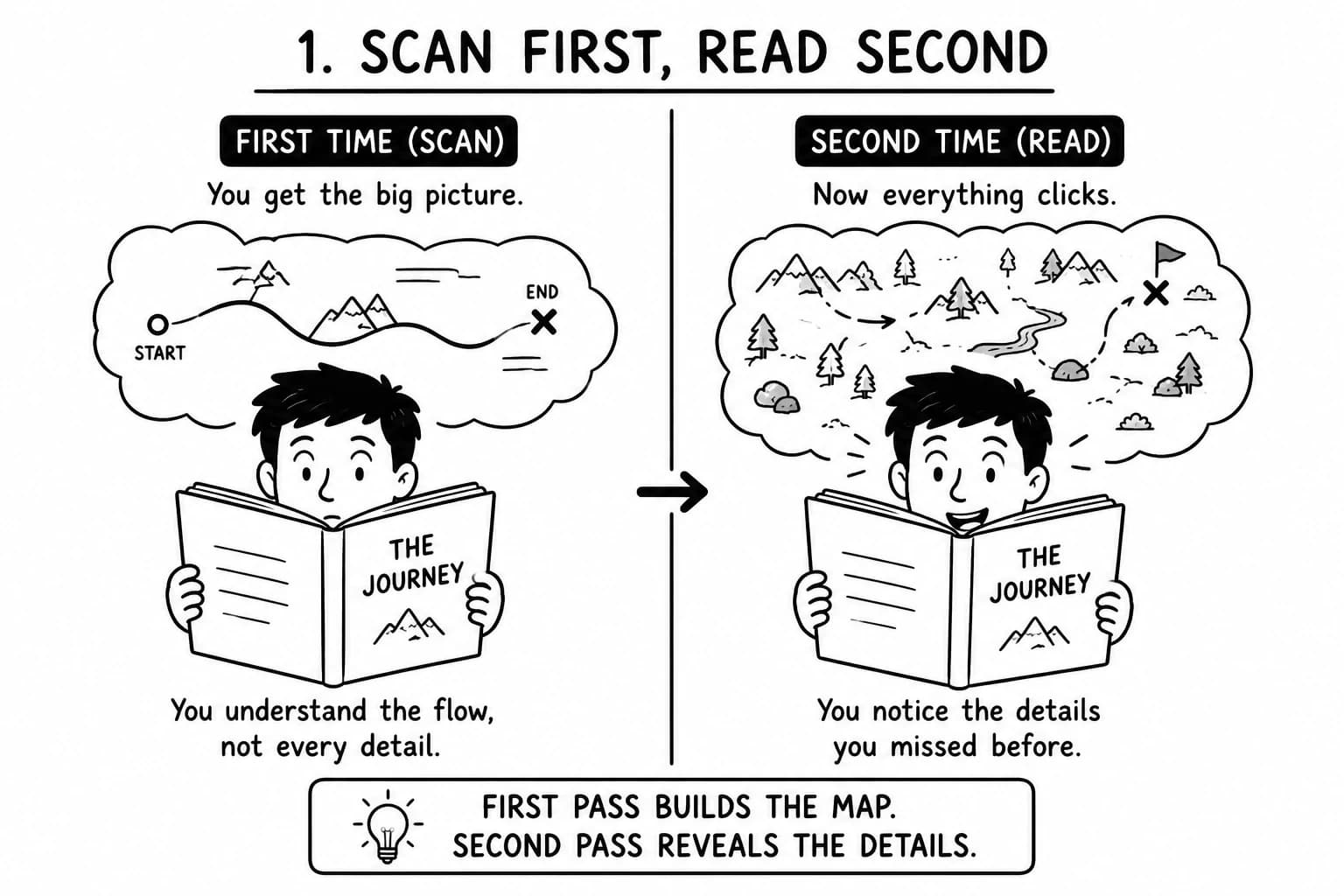
A structured overview helps readers identify a paper’s purpose, methods, and principal findings before detailed reading. This supports preliminary screening and orientation in unfamiliar fields.
The executive brief establishes the essentials, while the interactive mind map provides a conceptual overview that directs attention toward important details and relationships.
Simplify Literature Reviews and Research Preparation
Consistent summaries help researchers screen publications, compare methods, and organize findings across a body of literature. A research matrix or multi-paper map can group studies by theme, population, method, or conclusion.
Preserving source identity and disagreement keeps the final synthesis grounded in the underlying evidence.
Connect Ideas Across Multiple Sources
Research maps reveal recurring concepts, contrasting findings, and different methods used to address a shared question. Source labels keep each relationship traceable to the relevant publication.
Interactive knowledge mapping supports cross-source investigation while retaining the differences that shape the interpretation.
Improve Evidence-Based Academic Writing
Organized notes make supporting evidence easier to retrieve when drafting essays, dissertations, and research reports. For each important claim, retain its source, supporting result, and relevant qualification.
The executive brief provides a compact account of the argument, while the map helps locate related concepts and relationships when structuring the final analysis.
Retain and Recall Important Research Concepts
A visual map supports revision by making relationships among concepts explicit. Closing the map and explaining the connections from memory turns review into a test of understanding.
Roediger and Karpicke’s 2006 research supports retrieval practice as a method for improving delayed retention in the conditions they studied. Reconstructing the argument reveals whether the learner can retrieve and explain the knowledge independently.
Improve Critical Reading and Scientific Reasoning
Structured extraction encourages readers to evaluate research design, evidence quality, uncertainty, and alternative explanations. Distinguishing reported findings from author interpretation makes the limits of an argument easier to recognize.
Question-driven exploration helps identify assumptions and unresolved relationships that warrant further investigation.
Recognize Patterns and Transfer Knowledge Across Domains
Reusable understanding develops through recognition of recurring structures such as causal mechanisms, feedback loops, constraints, hierarchies, and trade-offs. A pattern transfers when its mechanism and boundary conditions fit the new problem.
Visual knowledge maps help compare relationships across domains and distinguish general principles from study-specific details.
Frequently Asked Questions
What Is the Best AI Research Paper Summarizer?
The best tool fits your workflow. Compare document support, summary structure, source traceability, multi-paper analysis, mind mapping, privacy, and cost. Test candidate tools on the same paper and verify their outputs against the source.
Is There a Free AI Research Paper Summarizer?
Some tools offer free summarization with limits on document size, usage, or advanced features. Check current plan details before relying on a tool for a large research project.
Can AI Summarize Research Papers from PDFs?
Yes. Compatible tools can extract and summarize PDF text. Accuracy depends on document quality and how well the tool handles scanned pages, tables, figures, equations, and complex layouts.
How Accurate Are AI Research Paper Summaries?
Accuracy varies with the tool, document quality, and technical complexity. AI summaries may omit context or misinterpret results, so verify consequential claims, numbers, methods, and limitations against the original paper.
Can AI Summarize Multiple Research Papers at Once?
Some tools support multi-document summarization and comparison. Preserve each paper’s identity, account for differences in methods and populations, and verify conclusions against individual sources.
Can AI Turn a Research Paper into a Mind Map?
Yes. A compatible tool can organize extracted concepts into a visual hierarchy. Review the branches, correct inaccurate relationships, and retain source references so the map remains useful for research.
How Is an AI Research Summary Different from an Abstract?
An abstract is part of the published paper. An AI-generated summary is created from supplied content and can reorganize the material around a particular research task. Both provide orientation, while detailed evaluation may require the full paper.
What Is the Difference Between an AI Research Paper Summarizer and an AI Mind Map Generator?
A summarizer condenses a paper’s arguments, methods, findings, and limitations into text. A mind map generator organizes concepts visually so readers can inspect their relationships.
y2map combines these representations through an executive brief and an interactive mind map: the brief establishes the essentials, while the map supports conceptual exploration and synthesis.
Explore Related AI Research Tools
Different research tasks benefit from specialized tools. Choose the resource that supports the next stage of the workflow.
AI Literature Review Generator
An AI literature review generator helps organize themes and findings across multiple sources. A literature review synthesizes a body of research, while a paper summarizer primarily explains one document.
Related resource: AI Literature Review Generator
AI Research Assistant
An AI research assistant supports question answering, source exploration, concept clarification, and research planning. Verify consequential answers against original publications.
Related resource: AI Research Assistant
AI Reference Manager
Reference management tools organize bibliographic records, citations, and research libraries, keeping source details connected to notes and findings.
Related resource: AI Reference Manager
Research Title Generator
A research title generator suggests titles that reflect a study’s topic, scope, and question. Treat suggestions as drafts and check that the final title represents the work accurately.
Related resource: Research Title Generator
AI Mind Map Generator
An AI mind map generator turns text or extracted concepts into visual structures for research organization, revision, and knowledge exploration. Preserve methods, findings, limitations, and source references when mapping academic papers.
Related resource: AI Mind Map Generator
AI Research Gap Finder
An AI research gap finder can surface unanswered questions, inconsistent findings, and underexplored topics across papers. Verify suggested gaps against the current literature before treating them as novel.
Related resource: AI Research Gap Finder
Conclusion
An AI research paper summarizer turns dense academic papers into structured summaries and searchable notes. Evidence analysis establishes what the findings support, while interactive knowledge mapping makes relationships visible for further investigation.
y2map connects summarization with visual knowledge mapping. The executive brief establishes the essentials; the mind map supports question-driven exploration, research synthesis, and knowledge reuse.
A strong workflow follows six stages:
- Summarize: Identify the central argument and essential evidence.
- Analyze: Examine claims, methods, assumptions, and limitations.
- Map: Organize concepts and relationships into a visual structure.
- Verify: Check consequential claims against the original evidence.
- Apply: Transfer principles to new problems while accounting for context.
- Retain: Reconstruct the argument from memory and test understanding.
The result is a reusable research model that supports faster orientation, more disciplined interpretation, and clearer connections across studies.
Understand the essentials. See how the ideas connect. Apply what you learn.