Expertise Reversal Effect: Why Good Instruction Hurts Experts
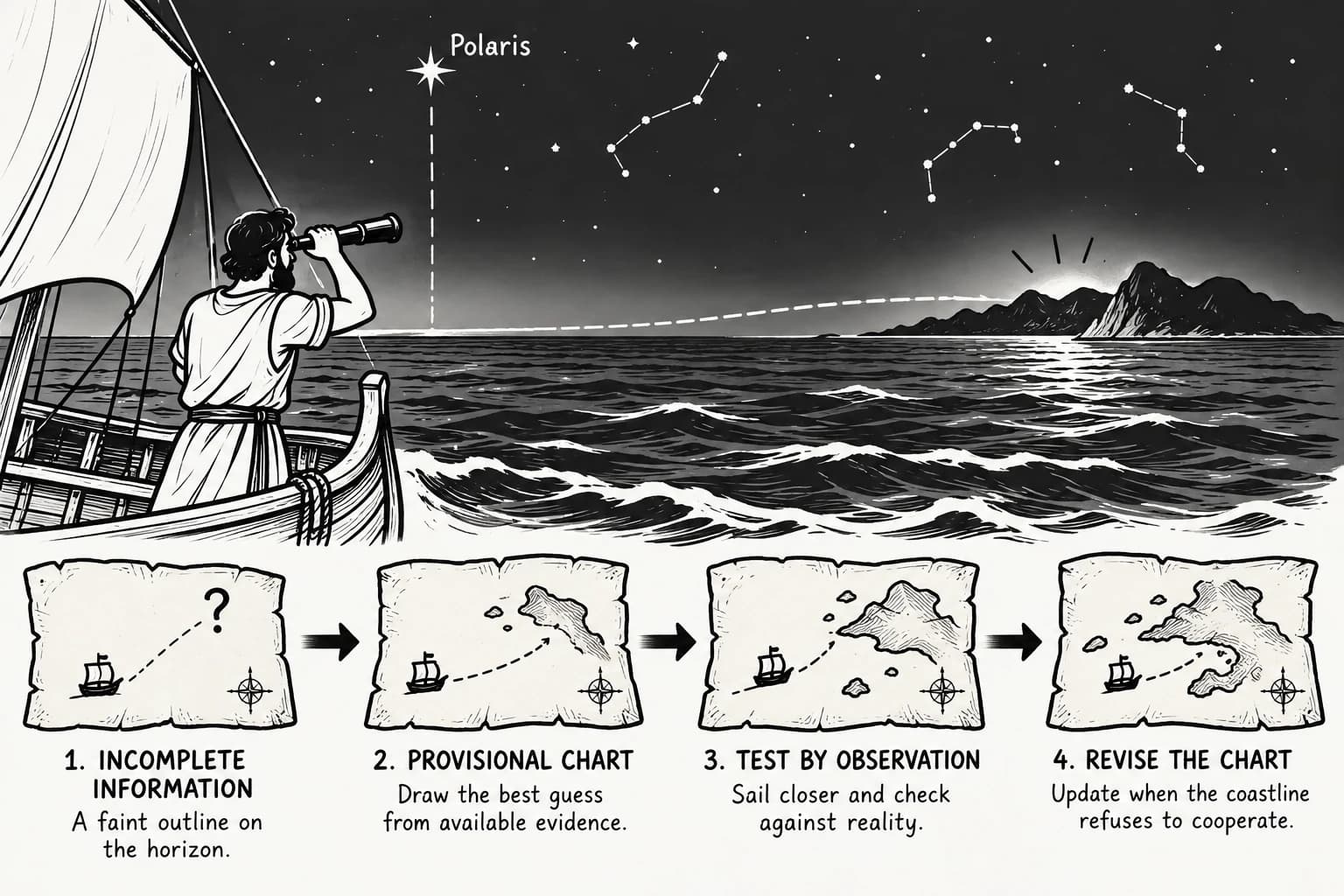
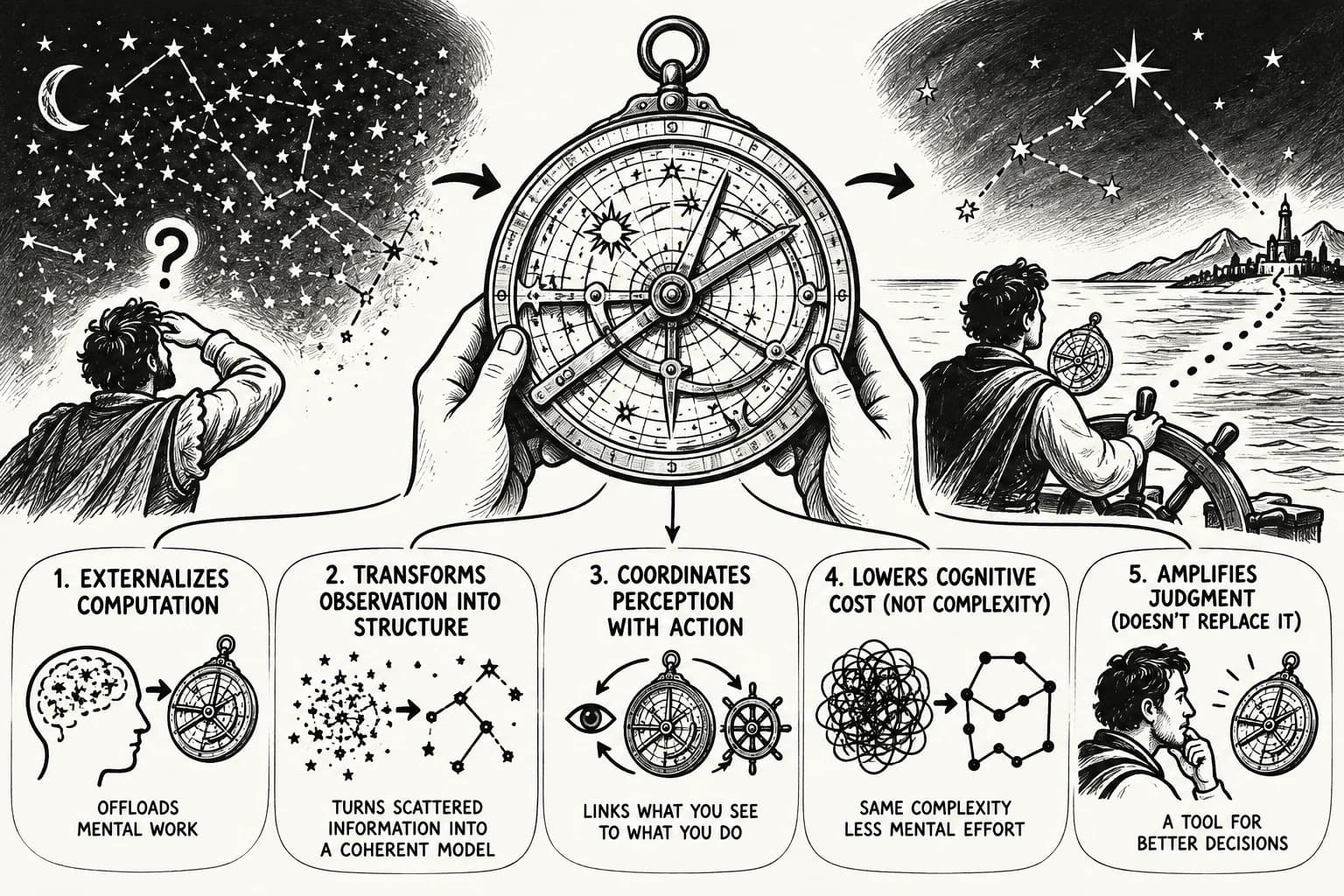
Long before psychologists measured the expertise reversal effect with laboratory experiments, London's legendary cab drivers revealed it on the streets. A novice welcomed every spoken direction because each instruction became another brick in a growing mental map, while a veteran who had already internalized 25,000 streets found the same guidance interrupting fluent judgment. In educational psychology, the pattern is identical: the more prior knowledge a learner possesses, the less instructional guidance they require. What begins as indispensable instructional scaffolding gradually becomes unnecessary repetition, explaining why the very lessons that accelerate beginners can slow experts. This guide follows that reversal from its roots in Cognitive Load Theory through modern adaptive instruction, tracing how researchers discovered that effective teaching depends as much on the learner as on the lesson itself.
-
Return to London's black cabs, where every winding street foreshadowed modern adaptive instruction. Like apprentice stonemasons learning beneath a cathedral master, novices relied on detailed demonstrations to build schema acquisition, while experienced drivers navigated from deeply automated schemas stored in long-term memory. The journey introduces the expertise reversal definition, explains why experts need less guidance, explores novice vs expert learning, and shows when instructional support becomes harmful as expertise transforms explanation into redundancy.
-
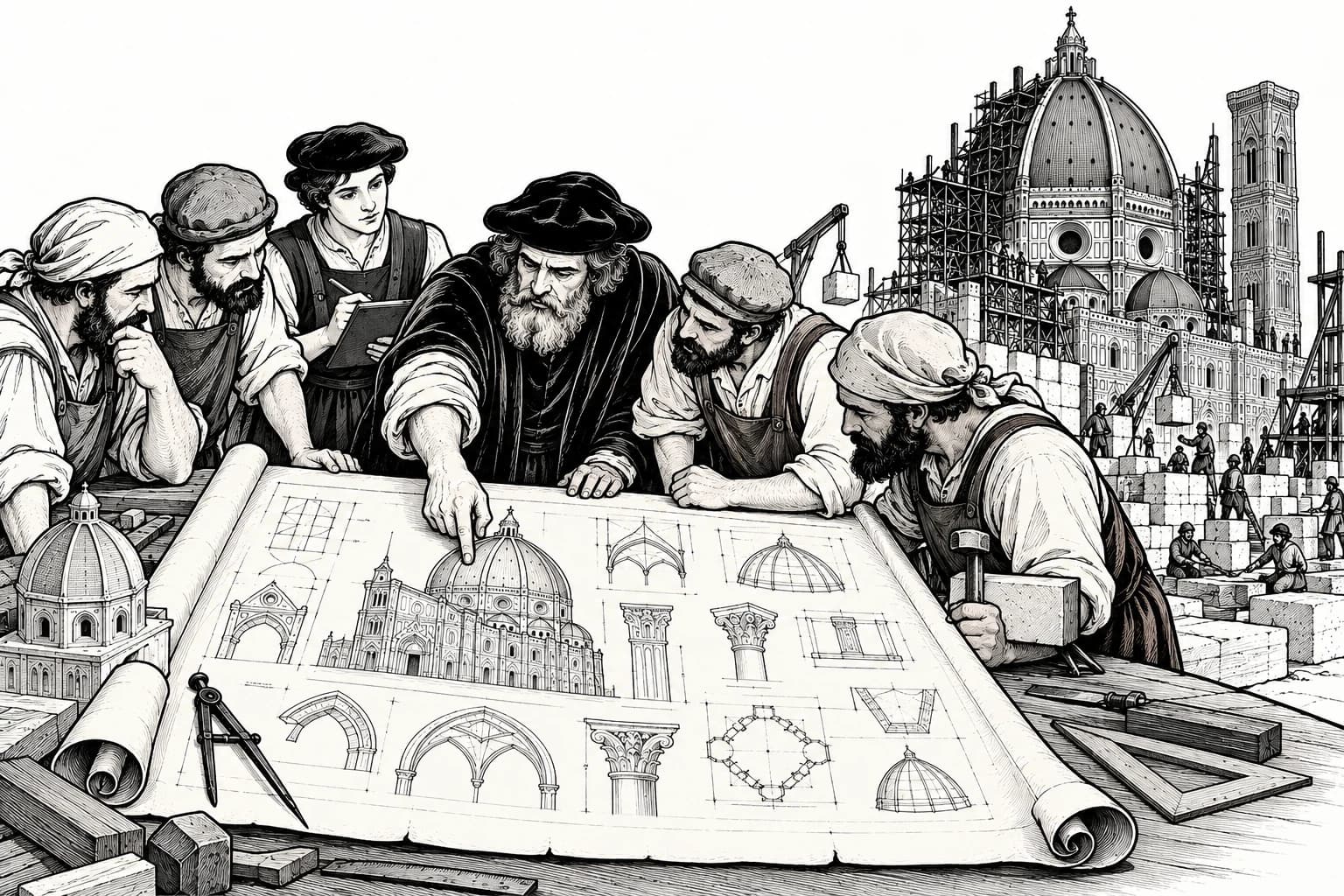
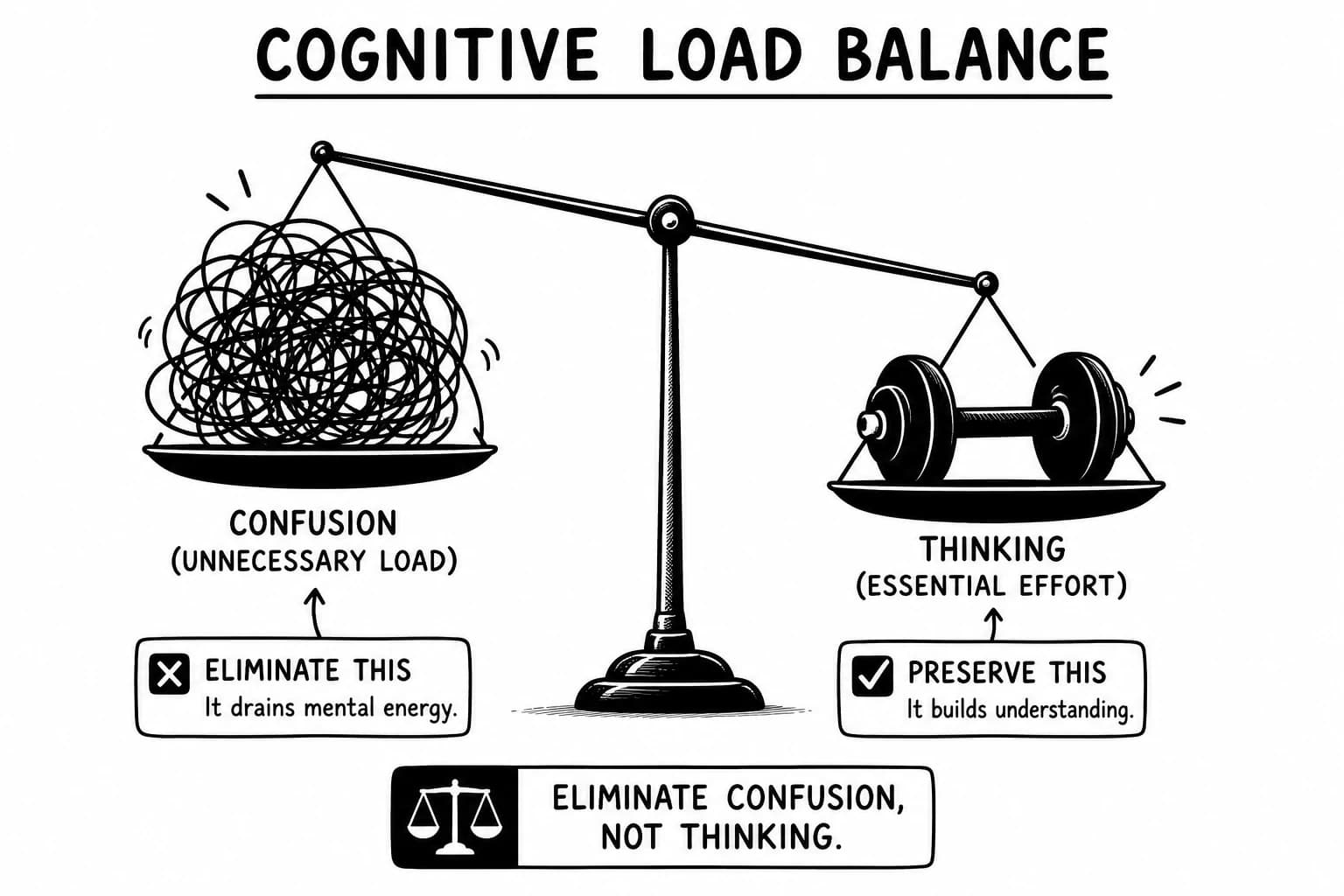
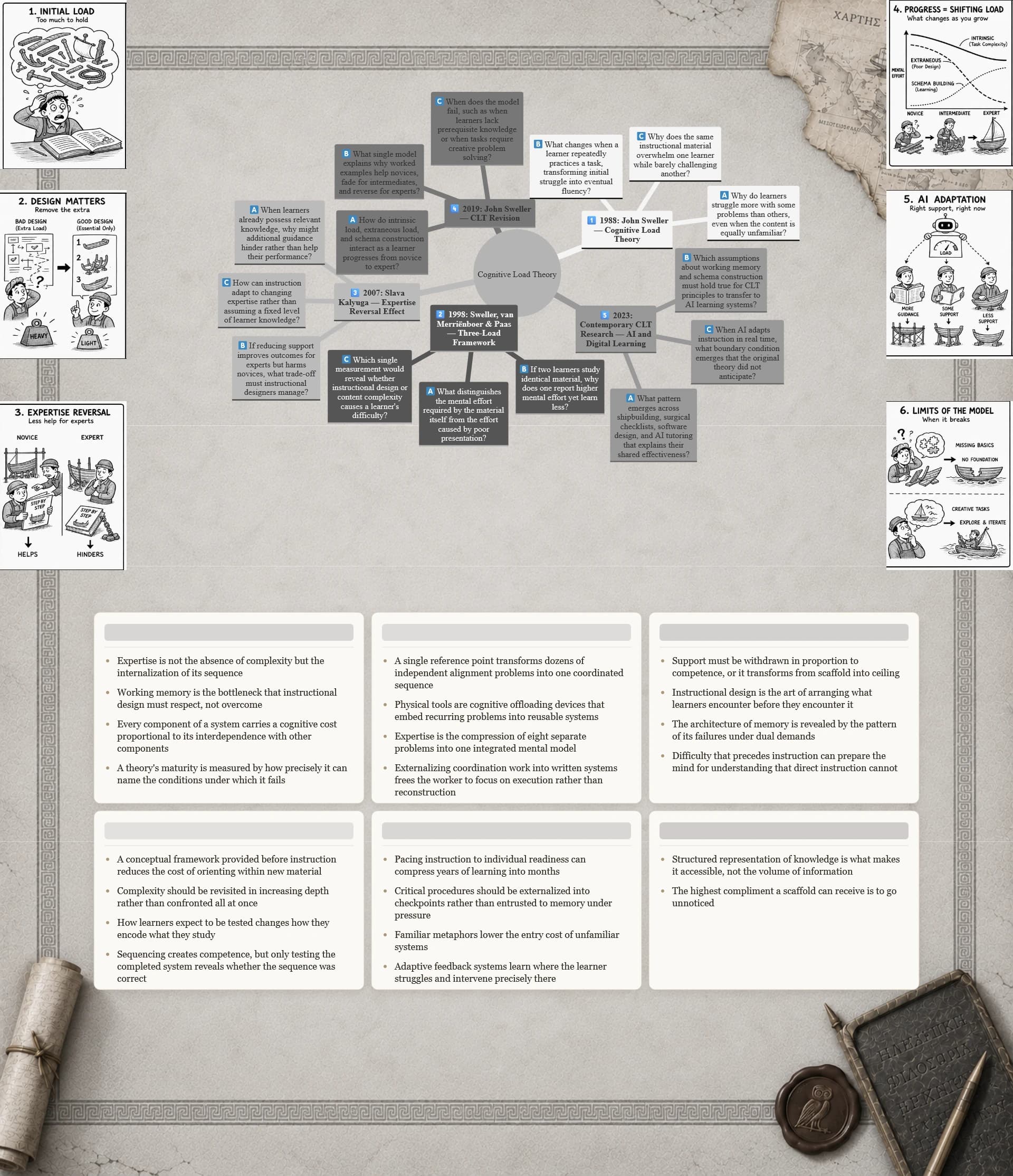
Follow the architects of Cognitive Load Theory, where John Sweller, Slava Kalyuga, and their collaborators treated instruction like the construction of a medieval cathedral whose scaffolding disappears once the arches can stand alone. Here the story connects intrinsic cognitive load, extraneous cognitive load, germane cognitive load, schema construction, schema automation, element interactivity, working memory, instructional efficiency, and the worked example effect, revealing how guidance that once strengthened learning eventually competes with knowledge already stored.
-
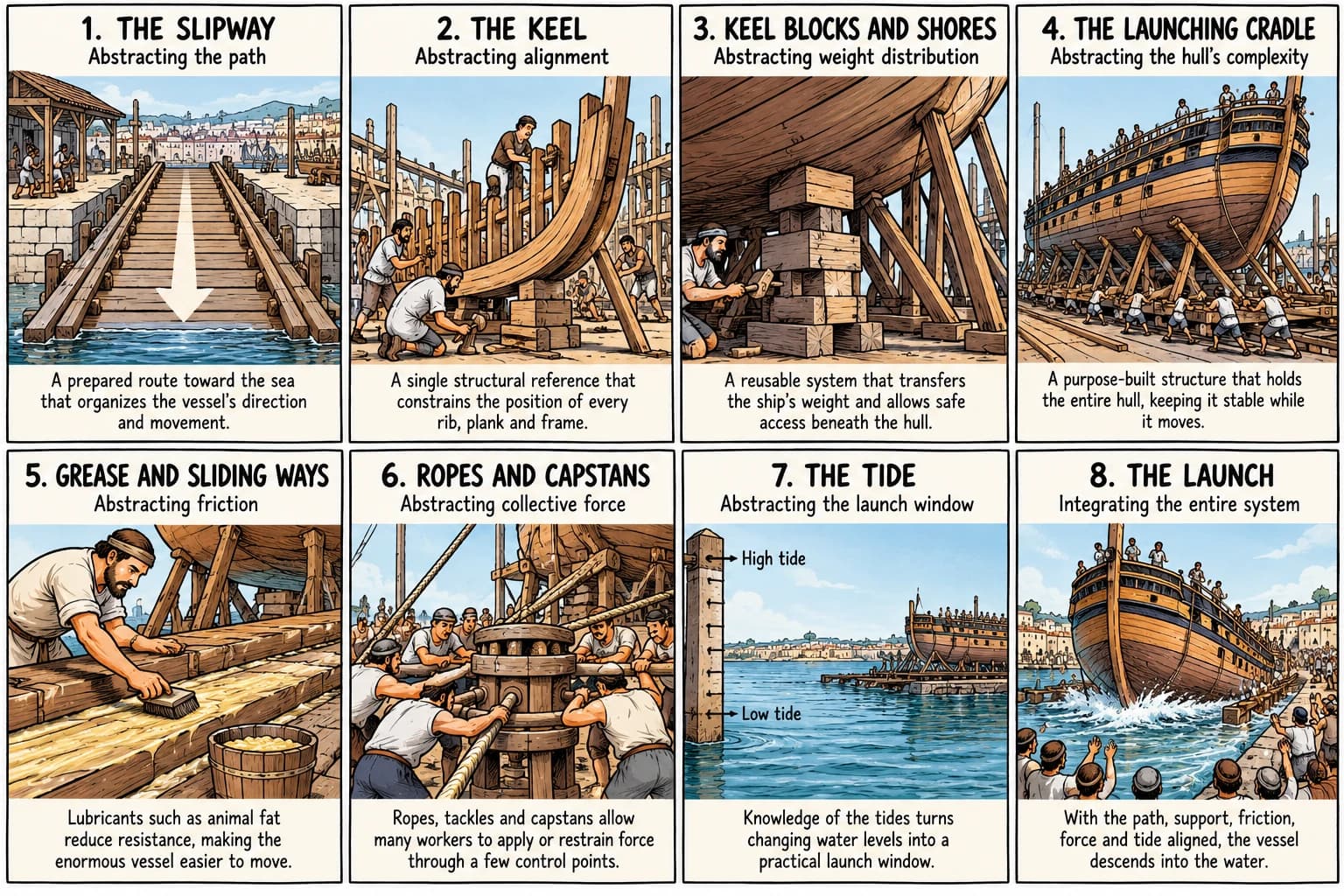
Walk through decades of experiments as laboratories became workshops testing increasingly sophisticated teaching methods. From worked examples and multimedia learning to computer-based learning, technical training, mathematics instruction, programming education, medical education, and engineering education, researchers repeatedly observed the same reversal. Along the way, concepts such as redundancy, the split-attention effect, example fading, adaptive fading, knowledge compilation, automation of expertise, and learner expertise emerged as practical design principles.
-
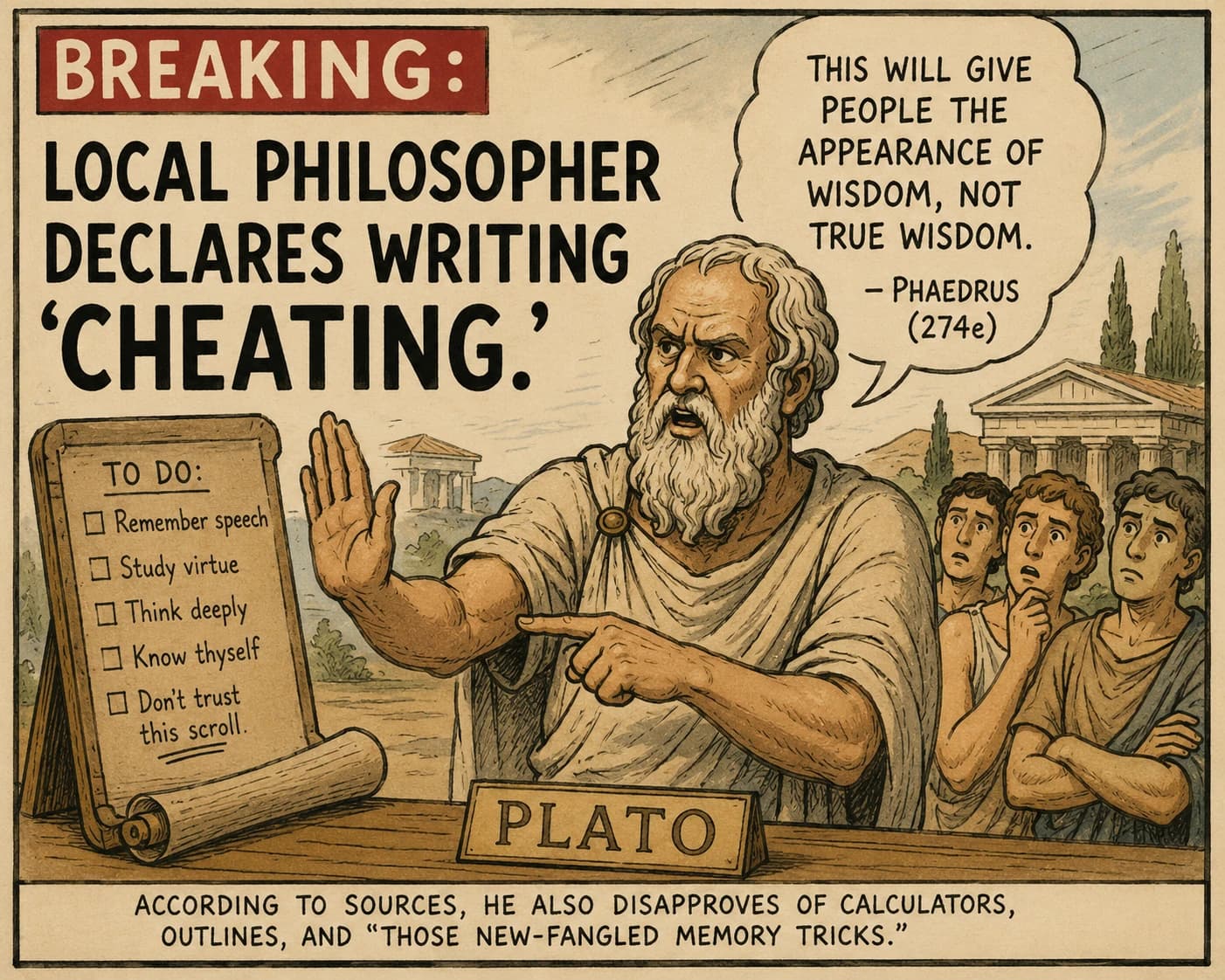
Stand beside the debate that followed, where scholars argued over whether declining performance reflected overloaded information processing or declining motivation. Competing explanations involving mental effort, working memory overload, multimedia redundancy, individual differences, aptitude-treatment interaction (ATI), instructional adaptation, and the question of why redundancy hurts experts reshaped instructional design, shifting attention from universal teaching methods toward guidance that adapts as learners grow.
-
Bring the story into the age of AI, where every summary, diagram, and tutor faces the same ancient dilemma. Intelligent systems promise adaptive instruction, instructional adaptation, and personalized educational psychology, yet every fixed explanation risks becoming redundant for experienced learners. The challenge is no longer building better lessons, but deciding when to fade support.
Historical Timeline of the Expertise Reversal Effect
| Year | Research | Key Concepts |
|---|---|---|
| 1977 | Cronbach & Snow — Aptitude-Treatment Interaction (ATI) | Aptitude-treatment interaction (ATI), individual differences, learner characteristics, instructional matching, adaptive teaching foundations |
| 1985 | Sweller & Cooper | Worked example effect, schema acquisition, novice problem solving, instructional guidance, reduced search |
| 1994 | John Sweller | Cognitive Load Theory, redundancy principle, working memory, long-term memory, instructional efficiency, schema-based learning |
| 1998 | Kalyuga, Chandler & Sweller | First demonstrations of the expertise reversal effect, technical training, expert cognitive processing, novice cognitive processing, redundant worked examples |
| 1998 | Sweller, van Merriënboer & Paas | Intrinsic cognitive load, extraneous cognitive load, germane cognitive load, element interactivity, cognitive architecture |
| 2000 | Kalyuga, Chandler & Sweller | Multimedia redundancy, split-attention effect, redundant on-screen text, working memory overload, instructional efficiency |
| 2001 | Cooper et al. | Mental practice versus worked examples, schema automation, expertise-dependent instructional benefits |
| 2003 | Kalyuga, Ayres, Chandler & Sweller | Formal definition of the expertise reversal effect, prior knowledge, instructional scaffolding, learner expertise, adaptive instruction, interaction effect sizes |
| 2003 | Renkl & Atkinson | Example fading, adaptive fading, gradual removal of guidance, transition from worked examples to independent problem solving |
| 2005 | Paas et al. | Motivation as an alternative explanation, mental effort, learner engagement, instructional adaptation |
| 2007 | Slava Kalyuga | Comprehensive review of the expertise reversal effect, instructional adaptation, expertise measurement, educational applications |
| 2008 | Salden et al. | Intelligent tutoring systems, adaptive fading, personalized guidance, dynamic expertise estimation |
| 2009 | Kalyuga | Knowledge compilation, automation of expertise, expertise development, adaptive instructional sequencing |
| 2010 | Schnotz | Motivational interpretation alongside Cognitive Load Theory, learner engagement, competing explanations for expertise reversal |
| 2011 | Spanjers et al. | Animated instruction, segmentation, multimedia expertise effects, adaptive multimedia design |
| 2012 | Kalyuga, Rikers & Paas | Extension to medical education, engineering education, sensorimotor skills, expertise development across domains |
| Current | AI tutoring, adaptive learning systems, educational analytics | Adaptive instruction, instructional adaptation, AI tutors, expertise estimation, personalized learning pathways, dynamic guidance fading, learner modeling, intelligent educational systems, evidence-based instructional design |
How Large Is the Expertise Reversal Effect? Magnitude and Replication
Like the flying buttresses of a medieval cathedral, the expertise reversal effect has remained standing because each generation of researchers tested it from a different angle and found the same structure beneath. Across worked examples, multimedia learning, split-attention materials, redundant text-and-narration, animation, imagination exercises, and computer-based learning, the direction rarely changes: detailed guidance consistently helps novices yet can become neutral—or actively harmful—for experts. The guidance × prior-knowledge interaction typically falls between d = 0.4–0.9, with the strongest reversals appearing in domains rich in element interactivity such as mathematics, physics, programming, engineering, and technical troubleshooting, where redundant instruction competes directly with well-developed schemas. These are interaction effects, measuring how guidance changes across levels of expertise rather than the average benefit of guidance itself, so meaningful interpretation depends on moderator variables such as instructional format, domain complexity, learner expertise, and confidence intervals, which remain wide because expertise groups are often small.
The evidence is unusually broad by educational psychology standards, even against the backdrop of the wider replication crisis. Instead of relying on a single headline meta-analysis, the field is supported by converging systematic reviews, independent laboratories, and repeated demonstrations across instructional formats. At the same time, the boundaries deserve equal attention. Laboratory studies offer strong internal validity, while evidence from semester-long classrooms provides more limited external validity; sample size within individual expertise groups frequently remains below thirty learners, measurement limitations persist around self-reported cognitive load, and expertise itself is often reduced to a simple pre-test score that almost certainly underestimates genuine differences in schema automation. No universal threshold marks the exact moment when helpful guidance becomes harmful—it shifts with prior knowledge, instructional redundancy, domain structure, and working memory capacity. That uncertainty does not weaken the central conclusion. It strengthens the case for adaptive instruction, because a single fixed curriculum can simultaneously accelerate one learner while slowing the person sitting beside them.
Factors, Rivals, and Evidence at a Glance
Well-established findings: the crossover itself, its load-theoretic explanation, and replication across formats. What follows pairs each factor with its workflow so theory and upskilling stay together.
What Is the Expertise Reversal Effect? Simple Definition, Easy Examples, and Why Novices Need More Guidance [Beginner Guide]
In 2016, Donggil Song of Indiana University studied 121 Korean fifth-graders learning English words and grammar in sequential versus concurrent online lessons, separating learners by prior knowledge. The result directly demonstrated expertise reversal: sequential instruction worked better for higher-knowledge learners, while concurrent presentation worked better for lower-knowledge learners, showing that instructional format can change value as schemas develop.
| Audience / Industry / Use Case | Research Finding → Your Next Rep |
|---|---|
| Corporate onboarding | Higher-prior-knowledge learners performed better when vocabulary and grammar were presented sequentially, whereas lower-prior-knowledge learners benefited from concurrent presentation; prior knowledge, sequencing, and working-memory load interacted, supporting density calibration. |
| Language-learning platforms | The same 2×2 instructional system produced opposite sequencing preferences across knowledge levels, demonstrating an expertise threshold in which previously separate information can become easier to integrate; route learners through a brief knowledge check before choosing sequential or integrated lessons. |
| K–12 digital curriculum | The interaction occurred within the same fifth-grade population rather than between different educational systems, showing that learner differences can emerge inside one classroom cohort; adaptive instruction can use pretests to determine presentation structure and compare subsequent comprehension. |
Why Does Too Much Teaching Reduce Learning? Why Over-Explaining Hurts Experts [Benefits vs Disadvantages]
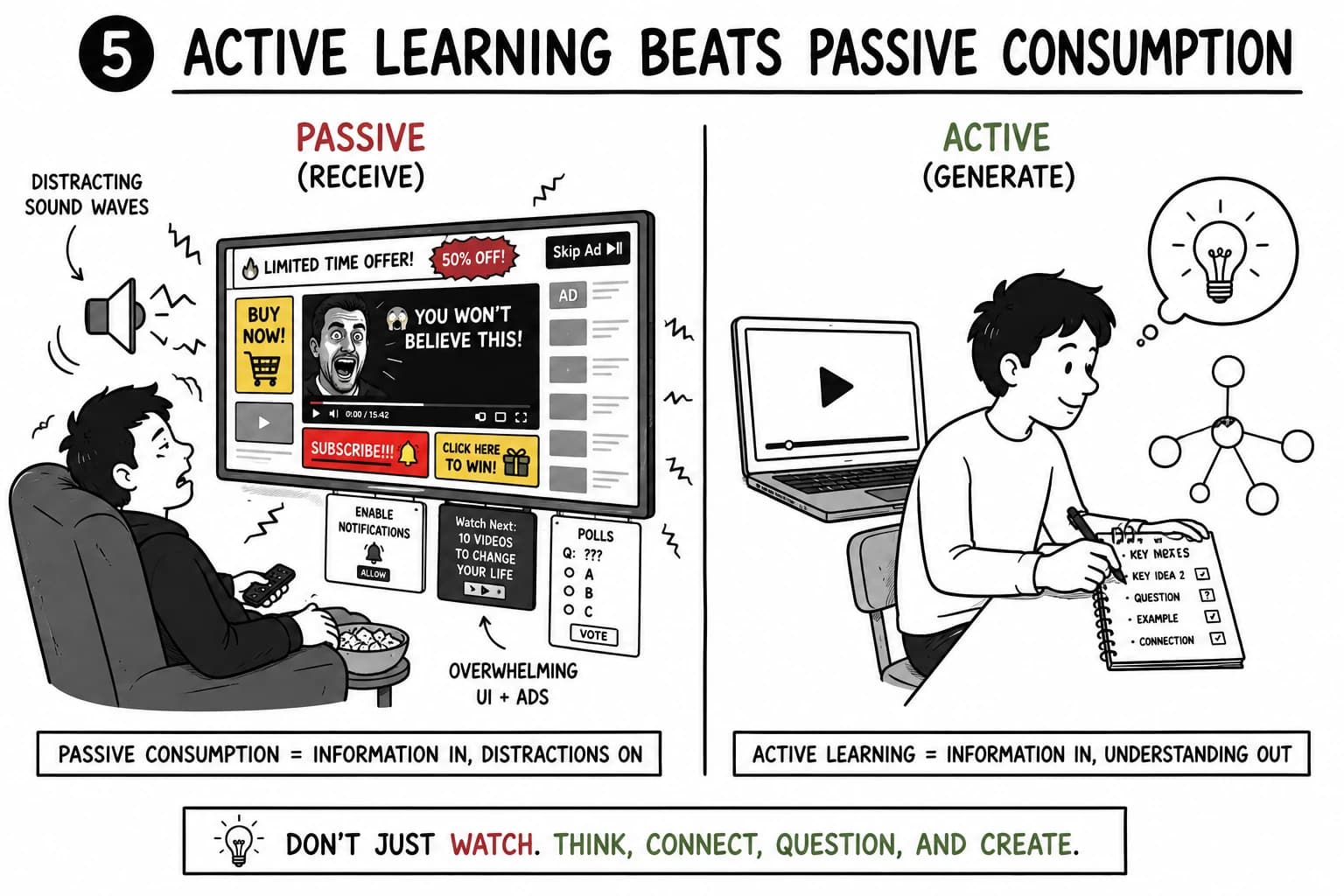
In 2012, Jimmie Leppink and colleagues at Maastricht University tested 130 first-year psychology and health-science students learning statistics through reading, open questions, argument construction, or worked examples. Low-prior-knowledge learners gained most conceptually from worked examples, whereas high-prior-knowledge learners benefited most from formulating arguments, demonstrating that guidance can become redundant as knowledge structures mature.
| Audience / Industry / Use Case | Research Finding → Your Next Rep |
|---|---|
| University statistics courses | Worked examples produced the strongest conceptual understanding among lower-knowledge learners, consistent with schema construction, cognitive load, and worked-example guidance; begin with explicit solution structures before shifting learners toward argument generation and independent reasoning. |
| Professional analytics training | Higher-knowledge learners profited more from constructing arguments than from receiving completed arguments, showing that self-explanation becomes more productive once prerequisite schemas exist; replace repeated demonstrations with justification tasks after learners can reliably identify the underlying statistical relationships. |
| Advanced certification programs | Prior knowledge predicted propositional knowledge while instructional method affected cognitive load and conceptual understanding differently across groups; measure both knowledge acquisition and conceptual transfer before interpreting faster completion or lower effort as evidence that an instructional format is working. |
How to Measure and Assess Learner Expertise Before Instruction? Prior Knowledge Profile Checklist [Framework + Diagram]
In 2009, Franck Amadieu and colleagues studied 24 adults learning an HIV infection process through hierarchical or network concept maps, combining prior-knowledge measures with cognitive-load ratings, navigation data, and eye tracking. Low-prior-knowledge learners gained more conceptual knowledge and experienced less disorientation with hierarchical maps, while higher-prior-knowledge learners showed smaller structural disadvantages.
| Audience / Industry / Use Case | Research Finding → Your Next Rep |
|---|---|
| Medical eLearning | Hierarchical maps produced greater conceptual knowledge for lower-prior-knowledge learners and reduced their disorientation, linking prior knowledge, concept maps, and cognitive load to observable learning differences; use a short diagnostic before exposing novices to nonlinear clinical knowledge networks. |
| LMS analytics teams | Low-knowledge learners showed greater sensitivity to map structure, while high-knowledge learners were less affected by structural differences; combine knowledge tests, navigation behavior, and eye-tracking or interaction traces when available. |
| University STEM placement | Both groups invested less mental effort processing the hierarchical structure, while factual and conceptual outcomes varied by prior knowledge; use adaptive testing to identify whether a learner needs organizational support or can navigate a less structured representation without measurable comprehension loss. |
Worked Examples vs Problem Solving: Fading Logic for Schools, MOOCs, and Product Onboarding [Comparison Table]
In 1985, John Sweller and Graham Cooper at the University of New South Wales conducted five algebra experiments involving Year 9, Year 11, and university mathematics students, comparing conventional problem solving with worked examples. Worked examples required substantially less processing time, accelerated subsequent solution of structurally similar problems, and reduced mathematical errors, although the benefit was strongest for problems sharing the studied structure.
| Audience / Industry / Use Case | Research Finding → Your Next Rep |
|---|---|
| Secondary-school mathematics | Worked examples reduced learning-sequence time and later solution time while also reducing errors on structurally matched problems, illustrating schema acquisition, worked examples, and cognitive load reduction; use demonstrations heavily when learners are first acquiring a problem type. |
| Programming bootcamps | The advantage was strongest when subsequent problems preserved the initial structure, showing that examples initially build problem schemas rather than automatically creating broad transfer; pair worked examples with varied problems before declaring a programming pattern mastered. |
| Technical software onboarding | Conventional problem solving consumed more time during initial acquisition, while worked examples accelerated matched follow-up performance; use example–problem sequencing during unfamiliar workflows, then introduce structural variation to test whether the resulting schema transfers beyond the demonstration. |
Best Practices for Adaptive Instruction in STEM, Programming, and Medical Education: Implementation Checklist
In 2020, David Warner and colleagues at Mayo Clinic randomized 114 U.S. anesthesiology residents to online perioperative tobacco-control modules varying prior-knowledge adaptation and learner interactivity. Adaptive instruction produced similar post-test knowledge to non-adaptive instruction, shortened completion time by about seven minutes, and increased knowledge gained per unit time, demonstrating an efficiency benefit without a corresponding raw-score advantage.
| Audience / Industry / Use Case | Research Finding → Your Next Rep |
|---|---|
| Medical residency education | Adaptive modules produced comparable knowledge scores while reducing completion time by approximately seven minutes, making adaptive instruction, prior-knowledge calibration, and instructional efficiency operational rather than purely theoretical; route learners through prerequisite-sensitive content when time is a meaningful constraint. |
| Corporate compliance training | Knowledge outcomes were similar across adaptive and non-adaptive formats, so personalization primarily improved efficiency rather than mastery; measure completion time, knowledge efficiency, and post-training performance. |
| Professional certification platforms | The 2×2 design also manipulated interactivity, allowing instructional adaptation to be evaluated independently from question-based engagement; separate scaffolding, interactivity, and prior knowledge in analytics so a faster course is not mistakenly credited to the wrong mechanism. |
Is the Expertise Reversal Effect Real or Just Boredom? Criticisms, Limitations, and Conflicting Evidence
In 2025, Leonard Tetzlaff, Bianca Simonsmeier, Tabea Peters, and Garvin Brod synthesized 176 effect sizes from 60 experiments involving 5,924 participants across instructional domains. Low-prior-knowledge learners favored high assistance at d = 0.505, high-prior-knowledge learners favored low assistance at d = −0.428, while educational status and content domain moderated the pattern, establishing substantial variation rather than a universal rule.
| Audience / Industry / Use Case | Research Finding → Your Next Rep |
|---|---|
| Learning-science researchers | Across 60 experiments, high assistance helped low-prior-knowledge learners while low assistance helped high-prior-knowledge learners, supporting the expertise reversal effect beyond isolated laboratory studies; test cognitive load, motivation, and instructional efficiency as competing explanations rather than treating one mechanism as settled. |
| Enterprise learning teams | The novice effect was larger in magnitude than the expert-withholding effect, indicating an asymmetrical adaptation problem: insufficient guidance carries substantial novice cost while excess guidance carries a smaller average expert cost; prioritize accurate prior-knowledge assessment before aggressive guidance removal. |
| Multidomain EdTech platforms | Educational status and content domain moderated the effects, with weaker evidence in younger learners and some humanities/language contexts; validate boundary conditions, individual differences, and domain complexity before applying a universal fading threshold across courses. |
Expertise Reversal vs Aptitude-Treatment Interaction vs Zone of Proximal Development: What's the Difference?
In 1984, Annemarie Palincsar and Ann Brown at the University of Illinois studied seventh-grade poor comprehenders using reciprocal teaching built around summarizing, questioning, clarifying, and predicting. Compared with typical classroom instruction, reciprocal teaching produced larger comprehension gains, maintained those gains, generalized to classroom tests, transferred to novel tasks, and improved standardized comprehension scores.
| Audience / Industry / Use Case | Research Finding → Your Next Rep |
|---|---|
| Middle-school literacy | Reciprocal teaching combined scaffolding, dialogue, formative assessment, and gradually shared responsibility, producing stronger comprehension and maintenance than typical instruction; the measurable outcome was improved comprehension rather than simply greater participation. |
| Teacher-development programs | Learners progressively assumed responsibility for summarizing, questioning, clarifying, and predicting while the tutor guided the dialogue, demonstrating a practical zone of proximal development structure in which assistance moves with learner capability. |
| Adult professional learning | Transfer to novel tasks showed that guided participation can develop reusable comprehension strategies rather than only improve performance on trained material; evaluate knowledge transfer with unfamiliar cases after scaffolding is reduced. |
How to Vary Advance Organizers and Fade Scaffolding Without Abandoning Learners? [Classroom Examples + Frameworks]
In 1976, David Wood, Jerome Bruner, and Gail Ross at the Universities of Nottingham, Oxford, and Harvard observed 30 children aged three to five learning to construct a three-dimensional block structure with contingent tutoring. Direct hands-on assistance declined from a median of 12 instances at age three to 6 at age four and 3 at age five, while independent completion rose from 64.5% to 87.5%.
| Audience / Industry / Use Case | Research Finding → Your Next Rep |
|---|---|
| Early-childhood education | Direct help declined sharply with age while independent completion increased, illustrating scaffolding, progressive fading, and competency-based support; calibrate intervention to observed performance. |
| Teacher training | Three-year-olds required more recruitment and demonstration, four-year-olds required more verbal correction, and five-year-olds more often needed confirmation; the zone of proximal development shifts even within a narrow age range, making diagnostic observation more useful than fixed support levels. |
| Workplace apprenticeship | The tutoring process included recruitment, reduction of task freedom, direction maintenance, marking critical features, frustration control, and demonstration; convert these scaffolding functions into contingent support that targets the current bottleneck and disappears as independent execution becomes reliable. |
AI Tutors, LMS, and eLearning: Integrated Adaptive Module for Corporate Training and Universities [Implementation + Case Study]
In 2011, Zachary Pardos, Matthew Dailey, and Neil Heffernan at Worcester Polytechnic Institute analyzed 11 experiment datasets from a web-based mathematics tutoring system using Bayesian knowledge-tracing methods and learning-gain analysis. The two approaches agreed on which tutorial help produced the highest learning rate in 10 of 11 datasets, showing that tutoring logs can support evidence-based personalization.
| Audience / Industry / Use Case | Research Finding → Your Next Rep |
|---|---|
| AI tutoring platforms | Bayesian knowledge-tracing analysis identified the most effective tutorial help in agreement with conventional learning-gain analysis in 10 of 11 datasets, linking knowledge tracing, adaptive feedback, and learning analytics to experimentally grounded intervention selection. |
| Enterprise LMS teams | The analysis extracted instructional evidence from thousands of individually randomized tutoring interactions, showing how learner analytics can evaluate feedback without requiring a new RCT for every content decision; instrument help requests, feedback types, subsequent performance, and mastery transitions. |
| AI coaching systems | The research compared competing ways of inferring which tutorial interventions worked rather than merely predicting learner performance, establishing a useful distinction between student modeling and intervention evaluation; optimize AI explanations against subsequent learning gains rather than conversation satisfaction alone. |
From Novice to Expert: Stages of Expertise, Dreyfus Model, and Deliberate Practice Explained [Expertise Development]
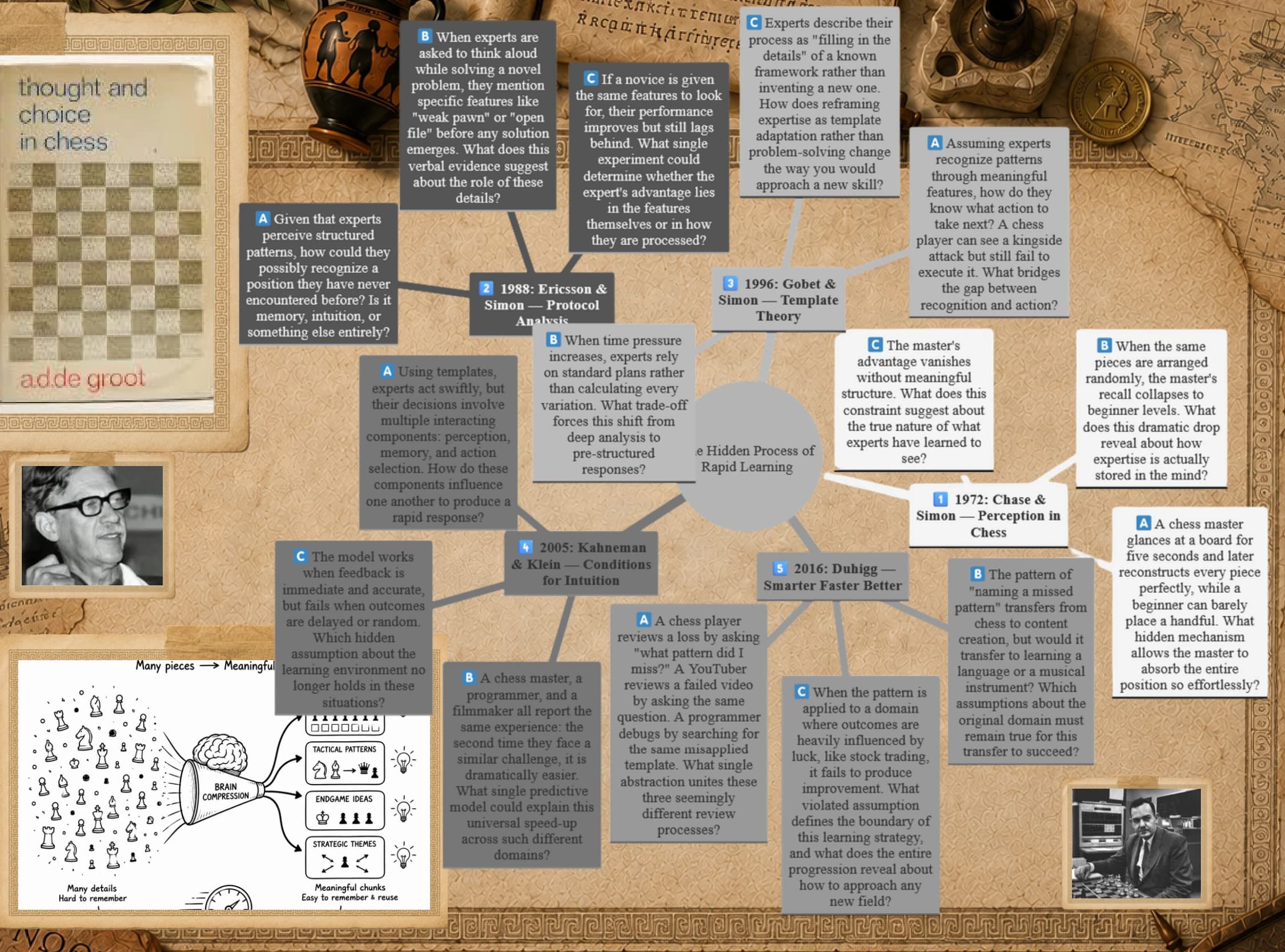
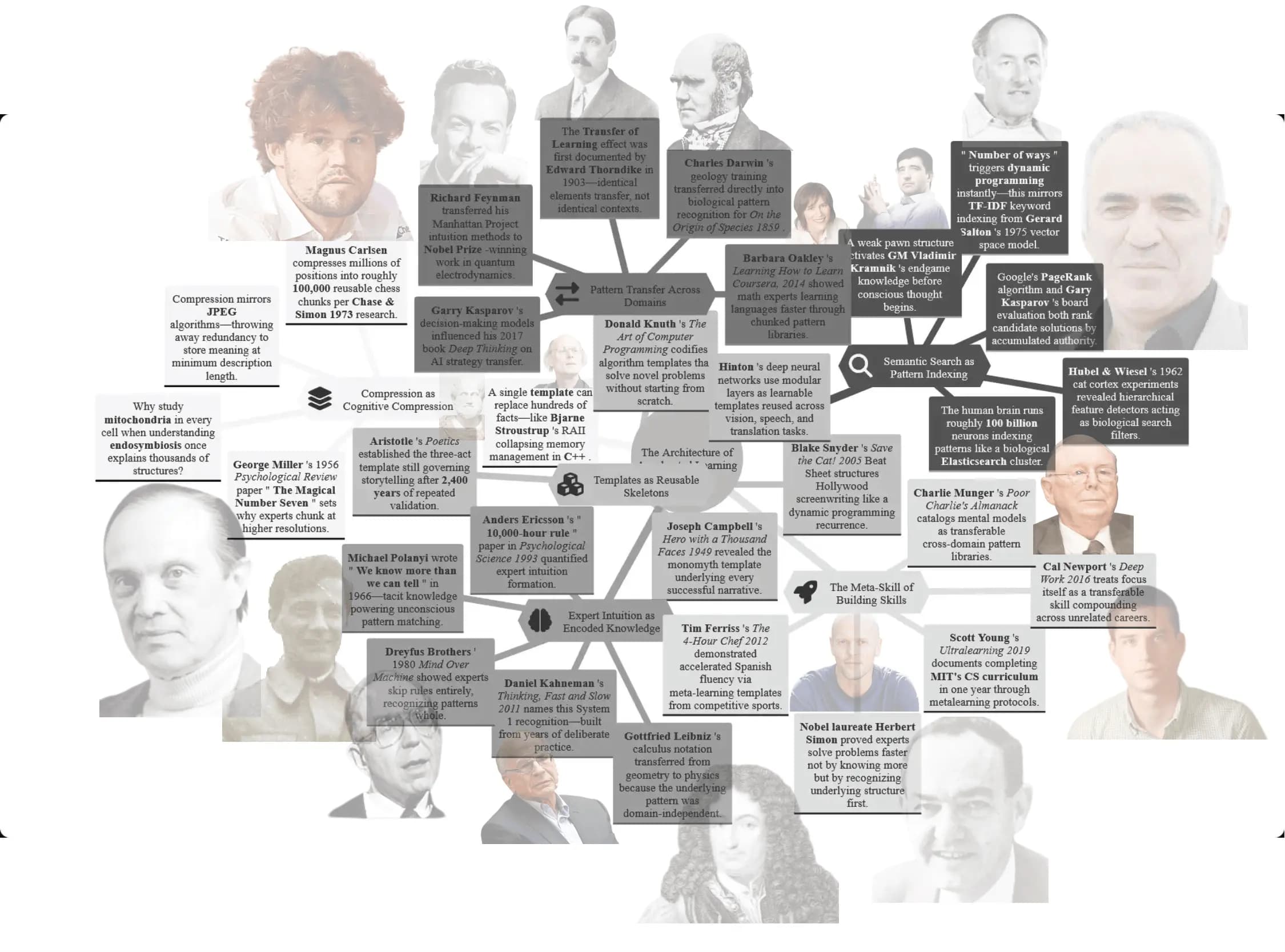
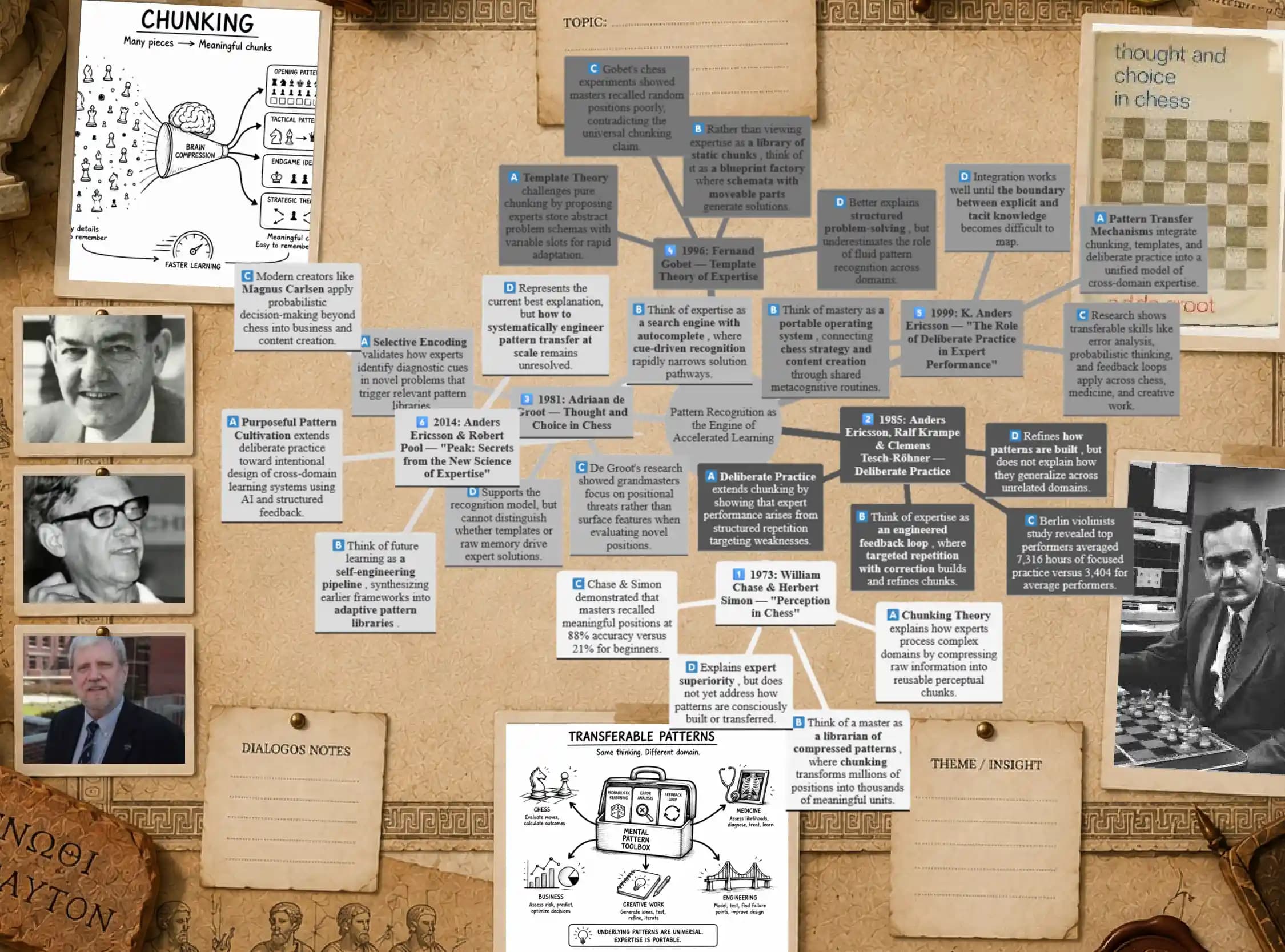
In 1973, William Chase and Herbert Simon at Carnegie Mellon studied chess players ranging from novice to master using perceptual reconstruction and five-second short-term recall tasks, analyzing the structures formed during reconstruction. Expertise was associated with larger meaningful perceptual structures, while the advantage nearly disappeared when chess positions were randomized, showing that expertise depends on domain-specific pattern organization.
| Audience / Industry / Use Case | Research Finding → Your Next Rep |
|---|---|
| Chess and strategy training | Stronger players organized board information into larger meaningful structures during reconstruction, demonstrating chunking, pattern recognition, and schema automation as products of accumulated domain knowledge; train recognition of recurring configurations alongside calculation. |
| Programming education | Expertise changed the units perceived during problem representation, suggesting that advanced programmers can process familiar code patterns as meaningful structures; measure schema formation through classification and transfer tasks. |
| Professional diagnosis | Randomized chess positions sharply reduced the normal expertise advantage, showing that expert performance depends on meaningful domain structure; expose advanced learners to unfamiliar configurations to distinguish automaticity from genuine adaptive expertise. |
Expertise Reversal vs Cognitive Load Theory vs Desirable Difficulties: Myths and Misconceptions Corrected [Summary + Infographic]
In 1992, Richard Schmidt and Robert Bjork synthesized experiments across motor and verbal learning showing that training conditions producing rapid acquisition could yield weaker long-term performance, whereas conditions that initially slowed acquisition could improve later retention and transfer. The work established a core desirable-difficulty principle: training efficiency must be evaluated against delayed performance and transfer, not immediate fluency alone.
| Audience / Industry / Use Case | Research Finding → Your Next Rep |
|---|---|
| Corporate skills academies | Practice conditions that slowed immediate acquisition could improve later retention and transfer, separating desirable difficulties, retrieval, and long-term learning from short-term fluency; evaluate training after a delay. |
| Sports and motor-skill coaching | Parallel findings across motor and verbal learning suggested that training principles could generalize across domains, supporting transfer, practice variability, and adaptive expertise as distinct outcomes; include altered-context performance tests. |
| University assessment design | Schmidt and Bjork challenged the assumption that the easiest practice produces the strongest learning, creating a useful counterweight to indiscriminate cognitive-load reduction; compare instructional efficiency, delayed retention, and transfer before labeling difficulty either productive or wasteful. |
Historical Evidence: Three Findings, Three Applications
The evidence points toward a common instructional architecture: assistance has value when it supplies missing structure, while accumulated schemas change what counts as useful guidance. The historical record supports adaptive density, contingent scaffolding, diagnostic assessment, and delayed evaluation.
| Concept | What the Researchers Did → Your Next Rep |
|---|---|
| Prior knowledge → assistance | Repeated experiments show that instructional assistance interacts with what learners already know: novices benefit from structures that expose relationships, while knowledgeable learners increasingly benefit from tasks requiring independent integration. |
| Schema formation → guidance fading | Worked examples, reciprocal teaching, concept maps, and contingent tutoring all place external structure around tasks whose internal relationships are initially difficult to coordinate; fading becomes meaningful when independent performance demonstrates that the learner has acquired those relationships. |
| Expertise → transfer | Chess reconstruction, adaptive tutoring, desirable-difficulty research, and delayed assessment converge on the same measurement lesson: fluency during training is an incomplete proxy for expertise, so durable retention, structural recognition, and transfer should determine whether instruction actually worked. |
One-Size-Fits-All to Adaptive Guidance
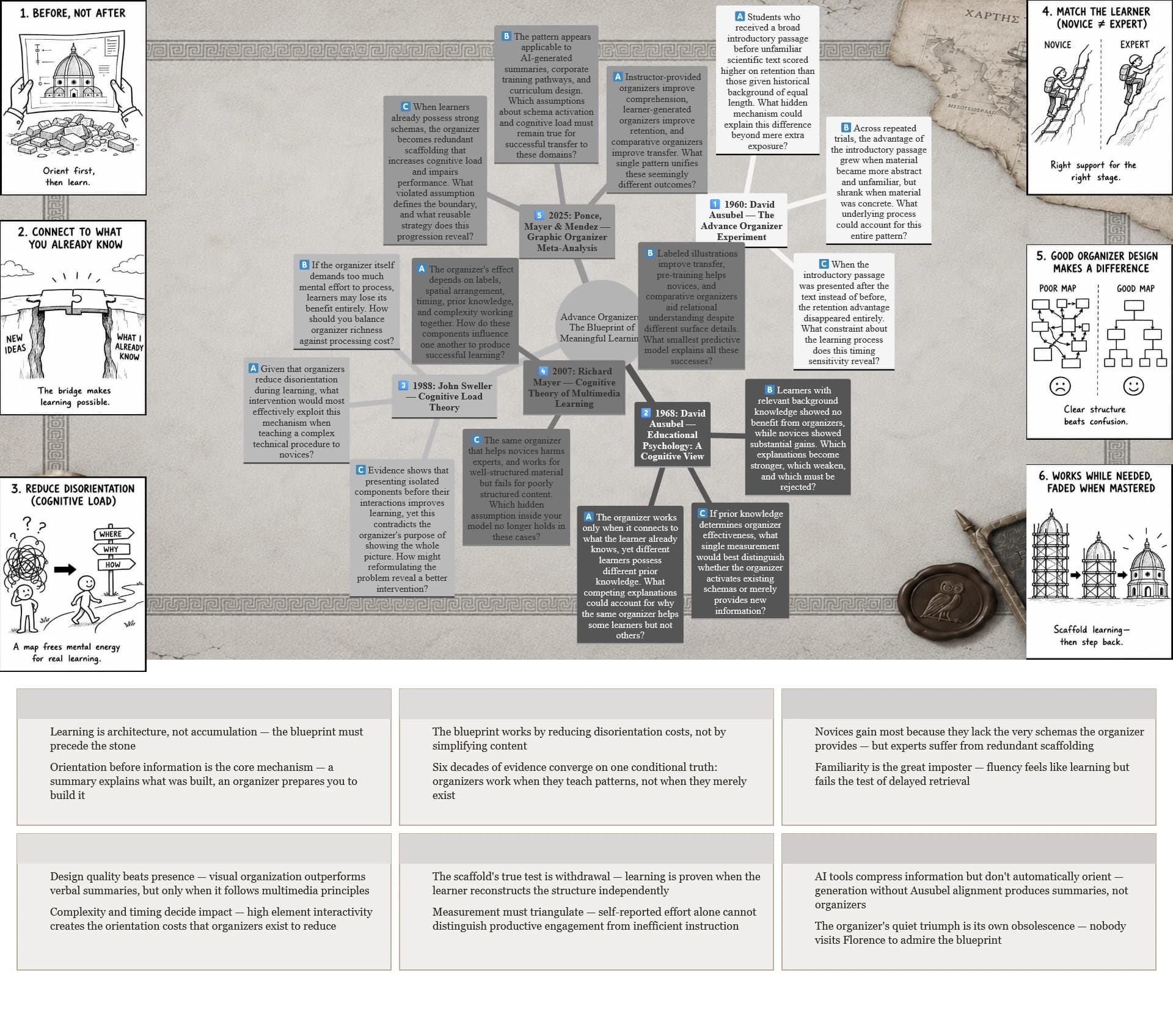
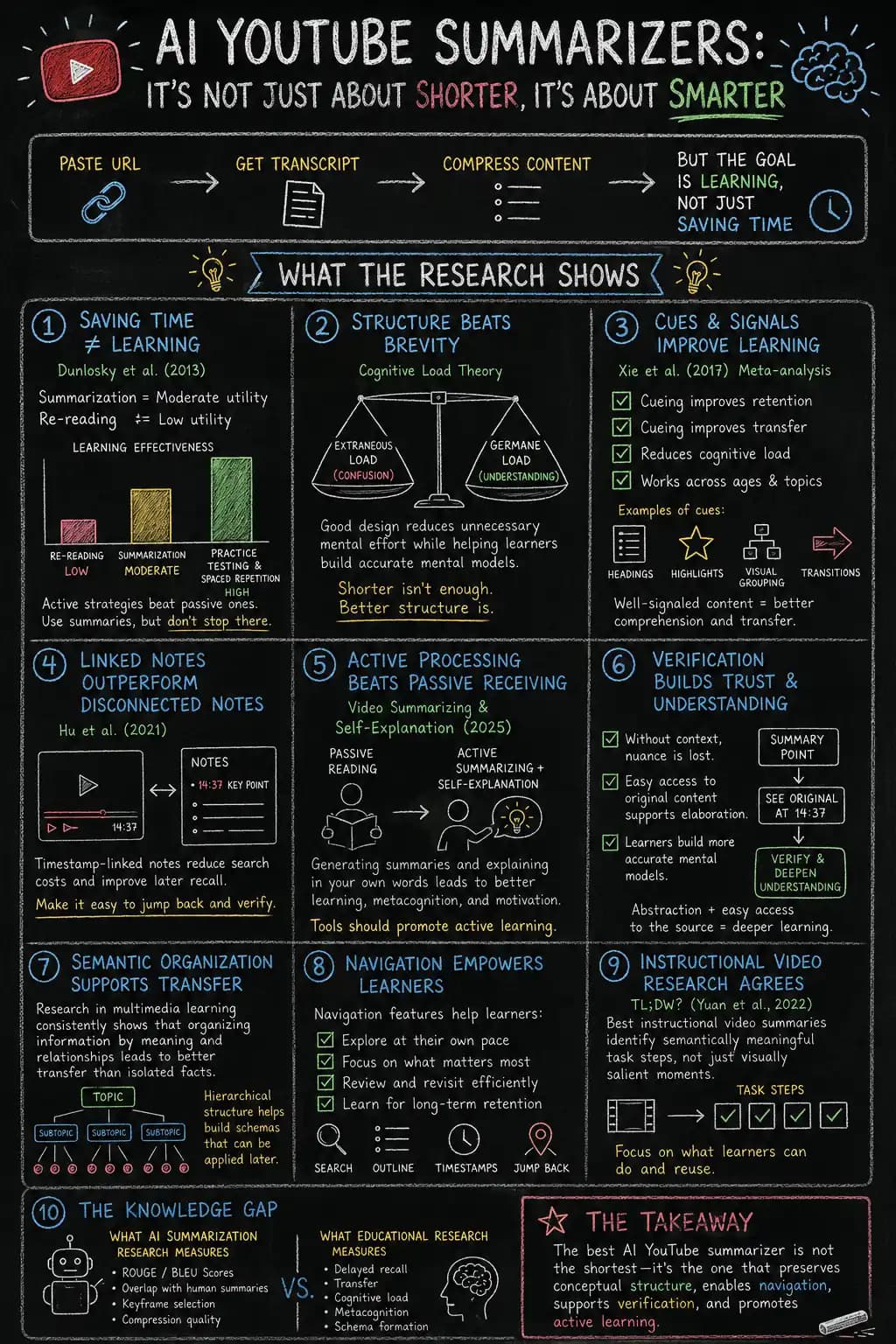
The medieval cathedral offers the better blueprint for AI learning systems than the modern assembly line. Master builders never handed every apprentice the same scaffold; each stage of construction demanded a different level of support until the structure could stand on its own. The same principle governs adaptive learning systems. Beginners benefit from rich organizers—AI-generated summaries, adaptive mind maps, terminology, and guided explanations—because they supply the missing framework from which new schemas can grow. As expertise develops, those same supports should gradually disappear through dynamic scaffolding, progressive disclosure, and instructional personalization, allowing knowledge to replace instruction. Modern AI tutors, intelligent tutoring systems, and Educational AI increasingly rely on personalized learning, real-time learner modeling, knowledge tracing, Bayesian learner models, learning analytics, mastery learning, and content personalization to regenerate identical content at multiple levels of density, ensuring guidance evolves alongside the learner.
The challenge is deciding when the scaffold should come down. A brief prior-knowledge assessment, combined with behavioral signals such as pre-test performance, time spent reading organizers, scrolling patterns, skipped sections, and repeated success, allows adaptive systems to estimate expertise before progressively reducing support. When that calibration succeeds, the expertise reversal effect becomes a design advantage. When it fails, familiar failure modes emerge: dense organizers overwhelm experts, sparse explanations abandon novices, inaccurate learner models place users on the wrong side of the crossover, and excessive assessment delays learning before it begins. The evidence strongly supports adaptive guidance, while several questions remain open—whether summaries, mind maps, and terminology reverse at different points; how much behavioral data is needed before reliable adaptation becomes possible; whether large language models in education can overcome their natural tendency toward verbosity; and whether long-term adaptive fading can continuously match growing expertise. The destination is increasingly clear even if the road remains unfinished: the most effective AI tutor is not the one that explains the most, but the one that knows precisely when to stop explaining.
Expertise Reversal in the Wild: Workflows, Deliverables, and Quality
The Instructional Designer opens the relay by requiring rapid prior-knowledge checks before any organizer is built. The AI Summarizer takes the baton and generates density-appropriate versions, comprehensive for novices and lean for experts. The Learner runs only the leg matched to expertise, skipping redundant guidance. Assessment and the System close the race by tracking skip rates, load, and cross-session growth to fade guidance over time.
Organizational use cases span curriculum design and instructional systems design (ISD)/ADDIE: learning experience design (LXD) teams tier every module novice/standard/lean; corporate training and onboarding give hires full walkthroughs while veterans get checklists; higher education sections by placement; medical simulation fades prompts as residents automate; military training and aviation training thin checklists with hours; professional development and competency-based education gate advancement on demonstrated schemas; knowledge management maintains learning pathways plus performance support systems (lean job aids for experts); adaptive workflows with instructional quality assurance audit every asset for redundancy risk.
Mind Maps vs Concept Maps vs Knowledge Frameworks: Visual Organizer Density Guide [Diagram + Comparison Table]
In 2009, Franck Amadieu, Tamara van Gog, Fred Paas, André Tricot, and Claudette Mariné studied 24 adults learning the HIV infection process through hierarchical versus network concept maps, measuring factual and conceptual learning, cognitive load, disorientation, eye movements, and navigation. Low-prior-knowledge learners gained more conceptual knowledge and experienced less disorientation with hierarchical maps, while high-prior-knowledge learners showed less dependence on map structure, demonstrating that visual-organization density should follow prior knowledge.
| Audience / Industry / Use Case | Research Finding → Your Next Rep |
|---|---|
| University biology instruction | Low-prior-knowledge learners gained more conceptual knowledge from hierarchical than network maps, showing how concept maps, prior knowledge, cognitive load, and visual organization interact; use explicit hierarchical relationships when foundational schemas are incomplete. |
| Medical education | Low-prior-knowledge learners experienced greater disorientation with network structures, while hierarchical structures reduced disorientation and posttest mental effort; structure complex clinical knowledge around visible dependencies before expecting learners to navigate relational networks independently. |
| Professional knowledge management | High-prior-knowledge learners gained similar conceptual knowledge from both structures, indicating that established schemas reduce dependence on external organization; experienced practitioners can work from skeleton maps, relational links, and self-generated frameworks. |
Learning Summaries and Glossaries: Density Guide to Avoid Redundancy [Classroom and Corporate Examples]
In 2019, Chew Chee Siong, Norazah Idris, Loh Ee-Fong, Wen-Chi Vivian Wu, Yew-Pin Chua, and Abdullahi T. Bimba evaluated Summary Writing-PAL with 58 computer-science undergraduates, comparing a theory-based computer-assisted environment with conventional instruction. The tool improved summary-writing performance, with worked examples particularly effective for lower-English-proficiency learners and lower cognitive load observed in that group.
| Audience / Industry / Use Case | Research Finding → Your Next Rep |
|---|---|
| University technical-writing courses | The computer-assisted environment outperformed conventional instruction on summary-writing performance, connecting summarization strategies, worked examples, prior knowledge, and cognitive load; embed modeled summaries before expecting independent compression of technical material. |
| Corporate onboarding | Lower-English-proficiency learners showed lower cognitive load in the supported environment, suggesting that glossaries, examples, and structured explanation can reduce language-related processing demands; preserve explanatory support where terminology itself consumes working-memory capacity. |
| Technical documentation teams | Worked examples remained effective in an ill-defined task such as summary writing, extending the approach beyond tightly structured mathematics or physics problems; provide representative summary models when writers are learning how to distinguish essential information from supporting detail. |
Retrieval Practice Without Over-Scaffolding: Quizzes and Flashcards That Build Automaticity [Case Study + Best Practices]
In 2019, Joshua L. Fiechter and Aaron S. Benjamin at the University of Illinois Urbana-Champaign compared adaptive-cue retrieval practice with standard retrieval, restudy, and diminishing-cue retrieval across six experiments using English–Iñupiaq word pairs. Adaptive cues were especially effective when standard retrieval was ineffective, while diminishing-cue retrieval achieved comparable memory benefits under easier conditions with less practice time.
| Audience / Industry / Use Case | Research Finding → Your Next Rep |
|---|---|
| Language-learning platforms | Adaptive cues produced stronger memory benefits when standard retrieval failed, showing how retrieval practice, scaffolding, adaptive cues, and memory strength can be combined; provide progressively stronger cues only when free recall breaks down. |
| Medical education | Diminishing-cue retrieval matched the memory benefits of standard and adaptive retrieval when testing was already effective while requiring less practice time; remove prompts as recall strengthens. |
| Professional certification | Across six experiments, adaptive cueing responded to moment-to-moment retrieval ability, making desirable difficulty, automaticity, and retrieval strength dynamic properties; evaluate delayed recall after progressively reducing cue support. |
Knowledge Gap Analysis: How to Detect Misconceptions and Redundancy Signals Before They Hurt Learning? [Checklist]
In 2016, Charles Secolsky, Thomas P. Judd, Eric Magaram, Stephen H. Levy, Bruce Kossar, and George Reese developed a quantitative-literacy assessment from coded think-aloud protocols and administered it to 238 high-school students and 209 remedial community-college students. The 20-item instrument paired answers with alternative solution strategies, revealing misconception patterns associated with performance and providing a diagnostic basis for changing mathematics instruction.
| Audience / Industry / Use Case | Research Finding → Your Next Rep |
|---|---|
| Secondary-school mathematics | Think-aloud protocols revealed recurring solution strategies behind incorrect answers, showing how misconceptions, think-aloud assessment, psychometrics, and knowledge-gap analysis can expose errors invisible in answer scores alone; diagnose reasoning patterns before reinforcing the next unit. |
| Community-college remediation | The instrument included 209 remedial community-college students and linked selected solution strategies with performance across 20 basic mathematics items; combine behavioral evidence with correctness to distinguish missing knowledge from systematic conceptual errors. |
| Learning analytics and assessment | The researchers converted qualitative think-aloud evidence into a structured diagnostic instrument, demonstrating a pathway from cognitive diagnosis to scalable learner analytics; track recurring strategy choices alongside accuracy to identify which misconceptions warrant targeted remediation. |
Conclusion / Final Takeaways
Central message: effective instruction changes as learner expertise grows. Fixed help is mis-help for half the audience.
Best practices and practical recommendations: practice adaptive instruction and personalized education by default; use evidence-based teaching (worked examples for novices, fading to problems for experts); pursue instructional optimization via adaptive scaffolding that thins with mastery; respect the novice learning need for structure and the expert performance need for room; encode these as instructional design principles in every template; deploy AI-assisted learning with real-time density control; and treat future research — organizer-specific thresholds, behavioral PK proxies, longitudinal fading curves — as a roadmap, not a blocker. Design implications in one line: know who is learning, then decide how much to say. For learning efficiency, silence toward experts is support.
The cabbie does not hate the GPS. He hates being narrated through streets he dreamed in. Good instruction, like good navigation, knows when to go quiet.