Abductive reasoning is the process of proposing the most plausible explanation for an observation when the evidence is incomplete. Charles Sanders Peirce developed the modern account of abduction as a form of inference that helps inquiry begin: something unexpected happens, and we ask what could explain it.
A mechanic hears a clicking sound when a car fails to start. A doctor compares several possible causes of a symptom. A scientist finds a result that an accepted model cannot explain. Each generates explanations from clues, then looks for evidence that separates a promising hypothesis from a convenient story.
The discipline lies in keeping the explanation provisional. A plausible account earns confidence by explaining the evidence, surviving tests, and outperforming credible alternatives.
How Does the Abductive Reasoning Process Work?
Abductive reasoning follows a practical cycle: notice an anomaly, generate competing explanations, identify discriminating evidence, test predictions, and revise the explanation. The steps can repeat in any order as new evidence changes the problem.
Consider a laptop that suddenly shuts down during a video call. The observation is clear; its cause is not. The battery may be failing, the device may be overheating, or a software process may be crashing. Each explanation suggests different evidence: battery health, temperature readings, system logs, or whether the shutdown recurs under a particular workload.
| Reasoning step | Question to ask | Laptop example |
|---|---|---|
| Observation | What needs explaining? | The laptop shuts down during a call. |
| Alternatives | What could account for it? | Overheating, battery failure, or a software fault. |
| Discriminating evidence | What would separate the explanations? | Temperature, battery diagnostics, and system logs. |
| Prediction | What should happen if a hypothesis is right? | An overheating device should show elevated temperatures before shutdown. |
| Revision | What does the evidence support now? | Update the leading explanation and test again if uncertainty remains. |
A useful hypothesis explains several relevant observations and produces predictions that can be checked. A story that can accommodate every possible outcome explains very little.
What Makes an Explanation the Best One?
Inference to the Best Explanation (IBE) is a common name for reasoning that compares explanations by their explanatory strength. A useful candidate accounts for the important evidence, fits reliable background knowledge, makes testable predictions, and avoids unsupported assumptions. Simplicity matters when competing explanations cover the evidence equally well; it is a guide to comparison, not a guarantee of truth.
Occam’s Razor and Abductive Reasoning
Occam’s razor advises us to avoid adding unnecessary assumptions. As described in How Does the Abductive Reasoning Process Work?, the temperature pattern distinguishes overheating from an unrelated multi-fault story — but the economical explanation still needs checking, and other causes remain possible.
The best explanation is therefore the one with the strongest overall fit to the evidence, not automatically the shortest explanation. A simple hypothesis that ignores a crucial fact loses to a more complex hypothesis that accounts for it.
What Are the Forms of Abductive Reasoning?
Abductive reasoning can take several forms depending on the evidence available and the kind of explanation being developed. These forms overlap in practice; they describe different emphases rather than a universally fixed taxonomy.
Classical abductive reasoning
Classical abduction begins with a surprising observation and proposes a hypothesis that would make the observation understandable. The hypothesis remains provisional until its consequences are checked against evidence. Peirce’s account of abduction is a foundational formulation of this pattern.
Statistical and diagnostic abduction
Diagnostic abduction compares candidate causes using evidence that changes their relative plausibility. In medicine, for example, symptoms and test results inform a differential diagnosis. Statistical information can help assess likelihood, but it does not remove the need to consider test accuracy, context, and alternative explanations.
Creative abduction and subjective logic
Creative abduction proposes a new mechanism or model that could explain an unexpected pattern. When evidence is incomplete, people may also express uncertainty in qualitative or probabilistic terms. These approaches help organize provisional beliefs; the quality of the conclusion still depends on evidence and testing.
What Is the Difference Between Abductive, Inductive, and Deductive Reasoning?
Abduction proposes an explanation, deduction derives what should follow if that explanation is true, and induction generalizes from observed results. Scientific inquiry often uses all three, revisiting earlier conclusions as evidence accumulates.
| Type | Starts with | Produces | Example |
|---|---|---|---|
| Abductive | An observation that needs explaining | A plausible, revisable hypothesis | Wet floor near an open window; rain entry is one possible cause to check. |
| Deductive | A hypothesis and its premises | A prediction that follows if those premises hold | If rain entered there, the sill and nearby wall should show matching traces. |
| Inductive | Repeated observations | A broader pattern or generalization | Several storms leave the same wet pattern, strengthening the suspected relationship. |
Deductive conclusions depend on the premises and reasoning being valid; real-world predictions also depend on whether the model captures the relevant conditions. Inductive generalizations gain support from repeated observations but remain open to revision. Abduction is useful when a problem needs an explanation before a test can be designed.
What Are Examples of Abductive Reasoning?
Historical examples are useful when they reveal the actual reasoning operation: an anomaly, competing explanations, evidence, and a consequential revision.
Examples from diagnosis, investigation, and scientific inquiry: Kepler and planetary motion
Johannes Kepler used Tycho Brahe’s detailed observations of Mars to investigate a persistent discrepancy of roughly eight arcminutes between observation and the predictions of a circular-orbit model. The mismatch was small enough to invite dismissal and precise enough to constrain the theory. Kepler tested the observations and mathematical assumptions, eventually abandoning the traditional circular model for an elliptical orbit with the Sun at one focus.
The cognitive principle is model revision under discriminating evidence: a reliable anomaly can expose a structural weakness in an explanation that otherwise appears successful.
Abductive reasoning examples in everyday life: Fleming and bacterial growth
In 1928, on the traditional account, Alexander Fleming noticed that bacterial growth was absent around a mold contaminating a culture plate. The observation suggested that the mold might produce a substance that inhibited bacteria. Follow-up investigation helped establish the path toward penicillin, though the development of penicillin into a usable treatment required later work by other researchers.
The cognitive principle is reclassification of an anomaly: a contaminant became a clue when Fleming asked what mechanism could explain the unusual boundary around it.
Abductive reasoning examples with answers: John Snow and cholera
During the 1854 cholera outbreak in Soho, London, physician John Snow mapped cases and investigated patterns of exposure to water sources. The geographic clustering supported his argument that contaminated water played a central role in the outbreak, challenging explanations that emphasized polluted air. The map helped connect individual cases to a candidate transmission mechanism.
The cognitive principle is evidence triangulation: a causal explanation becomes more credible when it accounts for the distribution of many observations and makes sense of competing accounts.
Archimedes and the golden crown: a caution about anecdotes
The story that Archimedes discovered a way to test King Hiero II’s crown through water displacement is a famous traditional anecdote recorded in a later account; the precise method Archimedes used is uncertain. The underlying reasoning problem remains instructive: identify a measurable property that distinguishes pure gold from a crown containing a less dense material. For equal mass, a less dense object occupies more volume.
The cognitive principle is designing a discriminating test: a good investigation seeks an observation that competing explanations predict differently.
Everyday, medical, business, and engineering examples
The same reasoning pattern appears wherever people must act while causes remain uncertain.
- Medicine: A clinician builds a differential diagnosis because several conditions can produce similar symptoms. Examination findings and test results change the relative plausibility of the candidates. Clinical decisions also depend on test accuracy, patient context, and the consequences of missing a diagnosis.
- Engineering and software: An engineer investigating a recurring failure compares possible causes, checks logs or physical evidence, and tests whether a proposed fix changes the failure pattern. Root cause analysis is strongest when it verifies a mechanism instead of stopping at the first plausible story.
- Business strategy: A team seeing a decline in sales might consider changes in demand, pricing, distribution, product quality, or measurement. Segment data, customer interviews, and controlled experiments help distinguish these explanations. A strategic decision should record assumptions and confidence because the evidence may remain incomplete.
- Forensics and security: Investigators preserve traces, compare them with competing accounts, and test whether a proposed sequence explains the evidence. Circumstantial evidence can support an explanation while leaving uncertainty about individual details.
Across these fields, the transferable skill is to separate what was observed from what is inferred, keep alternatives visible, and seek evidence that would change the decision.
How Does Abductive Reasoning Apply to Research?
Learners use abductive reasoning when they explain an unfamiliar result, predict what a demonstration will show, or diagnose why an answer is wrong. Prior knowledge supplies candidate explanations; feedback helps learners compare those explanations with the evidence. The quality of learning depends on the task, the learner’s knowledge, the feedback, and the opportunity to revise.
A student studying electricity might predict how changing the arrangement of components will affect a circuit. When the observed result differs from the prediction, the student can inspect the assumed relationship between current, resistance, and voltage. The discrepancy becomes useful when the learner can explain why the prediction failed and test a revised model.
This process connects to several learning practices:
- Advance organizers provide a high-level structure before detailed material arrives, helping learners locate new facts within a topic. See AI advance organizers.
- Schema theory explains how prior knowledge organizes information and shapes which explanations seem plausible. See schema theory.
- Retrieval practice asks learners to reconstruct what they know; abductive reasoning uses that knowledge to explain an observation or resolve uncertainty. The practices complement each other. See retrieval practice.
- Corrective feedback helps learners determine whether a prediction was wrong and which part of their explanation needs revision.
- Metacognition helps learners distinguish confidence from evidence and identify what they still need to find out.
Prediction before instruction can be useful when learners receive informative feedback and have enough background knowledge to make a meaningful attempt. An incorrect prediction alone does not guarantee better retention; learners need to understand the correction and connect it to a usable explanation.
Prior Knowledge, Surprise, and Prediction Error
Prior knowledge gives learners a set of candidate explanations. With too little domain knowledge, a learner may not know which possibilities to consider; with relevant knowledge, the learner can generate and compare hypotheses. Experts often recognize familiar patterns quickly, while unfamiliar cases can still require deliberate investigation.
Prediction error is the difference between an expected result and the observed result. It signals that an expectation or its underlying model may need attention. Bayesian surprise describes how much new evidence changes a probability distribution over beliefs. These are related ideas, but they are not interchangeable: prediction error concerns a mismatch, while Bayesian surprise concerns the change in belief produced by evidence.
Surprise can prompt investigation, yet learning depends on what follows. A learner who sees an unexpected result needs a plausible account, relevant evidence, and feedback to revise the mental model. When the material is too unfamiliar or the feedback is unclear, surprise can produce confusion instead of understanding.
How Much Guidance Helps Abductive Reasoning?
Useful guidance narrows the task enough for a learner to make a reasoned attempt while preserving meaningful choices. A novice may need a diagram of the main variables or a short list of candidate explanations. As described in How Much Guidance Helps Abductive Reasoning?, feedback and revision carry the learning — guidance only sets up that comparison.
The Socratic dialogue in Plato’s Meno uses questions about doubling a square to expose a mistaken assumption and guide the learner toward a revised geometric understanding. The example illustrates the value of making reasoning visible through questions. It does not establish a universal rule for how much guidance every learner needs.
A practical sequence is to provide a clear question, invite a prediction, ask for at least two explanations, present evidence, and prompt the learner to revise the original account. As competence grows, reduce the scaffolding and ask the learner to choose which evidence would best distinguish the alternatives.
Is Abductive Reasoning Just Guessing?
Abductive reasoning begins with a conjecture, but it becomes disciplined through comparison and testing. Guessing proposes an answer; abductive reasoning asks what evidence supports it, what alternatives could explain the same observation, and what result would weaken the leading hypothesis.
Marie Curie’s investigation of pitchblende illustrates this distinction. Its radioactivity exceeded what the known uranium content could explain, leading Marie and Pierre Curie to investigate whether unknown radioactive substances were present. Chemical separation and measurement supported the identification of polonium and radium. The key reasoning move was to treat the unexplained measurement as evidence about the material, then pursue tests capable of distinguishing possible causes.
A practical check is to write down three things: the observation, the leading explanation, and the evidence that could prove the explanation wrong. This simple record makes overconfidence easier to detect.
Explain abductive data analysis
Abductive data analysis moves between observations and candidate explanations. A researcher notices a pattern or contradiction, develops a possible account, and returns to the data to see whether the account fits or needs revision. The process is iterative: the initial hypothesis guides attention, while unexpected evidence can change the hypothesis.
Use abduction to develop and refine theories
Abduction can help researchers develop a theory that explains a finding that existing accounts leave unresolved. The proposed theory then needs further comparison with data, alternative explanations, and predictions. A plausible explanation is a starting point for inquiry rather than conclusive proof.
Connect qualitative evidence with explanatory hypotheses
In qualitative research, interviews, observations, and documents can reveal patterns that invite explanatory hypotheses. Researchers should document how interpretations arise, consider rival readings, and look for disconfirming evidence so that the explanation remains traceable to the material.
How Does Abductive Reasoning Apply to Research? AI and explanatory tools
AI systems can help generate candidate explanations, retrieve relevant information, compare evidence, and organize relationships among concepts. Different methods play different roles: probabilistic models estimate uncertainty, knowledge graphs represent relationships, causal models encode assumptions about mechanisms, and retrieval-augmented generation (RAG) supplies external material that a system can use when composing an answer.
A large language model can propose a plausible cause for a software failure, but fluency is not verification. The user still needs to inspect logs, reproduce the issue, check whether the evidence supports the proposed cause, and compare alternatives. An AI-generated explanation should be treated as a hypothesis with a source trail and a test plan.
Alan Turing’s 1950 imitation-game proposal offers a related lesson about evaluation. He translated a broad question about machine thinking into a procedure based on observable responses. The test illustrates operationalization—making a question assessable through specified behavior. Its relationship to abduction is indirect: an evaluator may infer a capability from observed performance, while recognizing that the performance does not settle every question about the system’s internal processes.
How Knowledge Graphs and Mind Maps Support Explanatory Reasoning
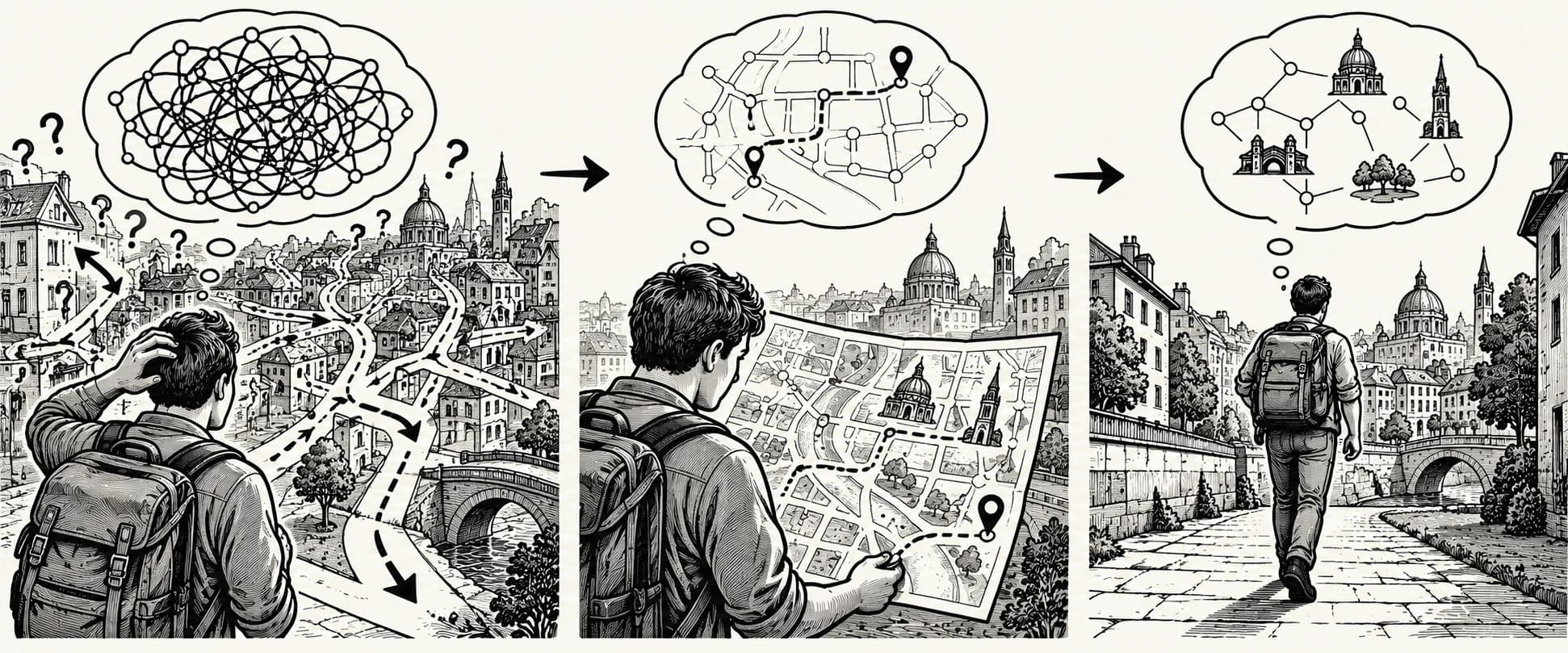
Facts become easier to evaluate when their relationships are visible. A concept map or knowledge graph can connect an observation to candidate causes, show which evidence supports each cause, and mark links that remain uncertain. This external representation reduces the need to keep every relationship in working memory and makes gaps in an explanation easier to inspect. See concept mapping and distributed cognition.
For example, a learner investigating a plant with yellowing leaves could create branches for watering, light, soil nutrients, and disease. Each branch would contain a prediction and the evidence needed to test it. If the soil is consistently wet and the roots show signs of damage, that evidence changes the relative plausibility of the hypotheses. The map records why the leading explanation changed, rather than simply displaying the final answer.
Y2Map can support this workflow by turning a lecture, article, or chapter into a structured visual overview. Learners can use that overview to identify the main concepts, generate candidate explanations, and organize the evidence they need to check. The map is a starting structure for inquiry; the learner still evaluates the claims and revises the connections.
What Are the Strengths and Limitations of Abductive Reasoning?
Generate explanations from incomplete evidence
Abduction is useful when a decision or investigation must begin before all the facts are available. It turns an anomaly into a question and creates candidate explanations that can guide what to inspect next.
Evaluate competing hypotheses and alternative causes
The process becomes stronger when several explanations remain visible and each is assessed against the same evidence. A favored hypothesis can still be wrong, especially when important causes have not yet been considered or the available data are biased.
Reduce confirmation bias through explicit testing
Writing down what would weaken a hypothesis helps prevent selective attention to confirming evidence. Researchers and decision-makers can improve the process by stating predictions in advance, recording uncertainty, and updating the explanation when results conflict with expectations.
A Practical Checklist for Abductive Reasoning
Use this five-question exercise whenever an outcome surprises you:
- What exactly happened? Record observations before interpreting them.
- What are at least two plausible explanations? Include alternatives that could produce the same result.
- What evidence would distinguish them? Prefer a test whose possible outcomes favor different hypotheses.
- What does each explanation predict? State the expected result before collecting the evidence.
- How should the explanation change? Update confidence and note what remains unresolved.
For students, this can become a short classroom routine: predict individually, compare explanations with a partner, inspect new evidence, and revise the answer with a reason. For teams, the same structure can be recorded in an incident review or decision brief. The record matters because it preserves the path from observation to conclusion, making the reasoning available for later review.
References
- Peirce, C. S. (1878). How to Make Our Ideas Clear. Popular Science Monthly. https://peirce.org/writings/p119.html
- Kepler, J. (1609). Astronomia Nova. Heidelberg: G. Voegelinus. Eight-arcminute Mars discrepancy motivating the elliptical orbit — cited as secondary source — verify.
- Snow, J. (1855). On the Mode of Communication of Cholera (2nd ed.). London: John Churchill. 1854 Broad Street outbreak mapping — cited as secondary source — verify.
- Curie, M. & Curie, P. (1898). Discovery of polonium and radium from pitchblende investigations. Comptes Rendus. cited as secondary source — verify.
- Vitruvius (1st c. BCE). De Architectura, Book IX (traditional account of Archimedes and the crown). https://math.nyu.edu/Archimedes/Crown/Vitruvius.html
- Turing, A. M. (1950). Computing Machinery and Intelligence. Mind, 59(236), 433–460. https://doi.org/10.1093/mind/LIX.236.433
Synthesis: Abduction through the Navigator Chart
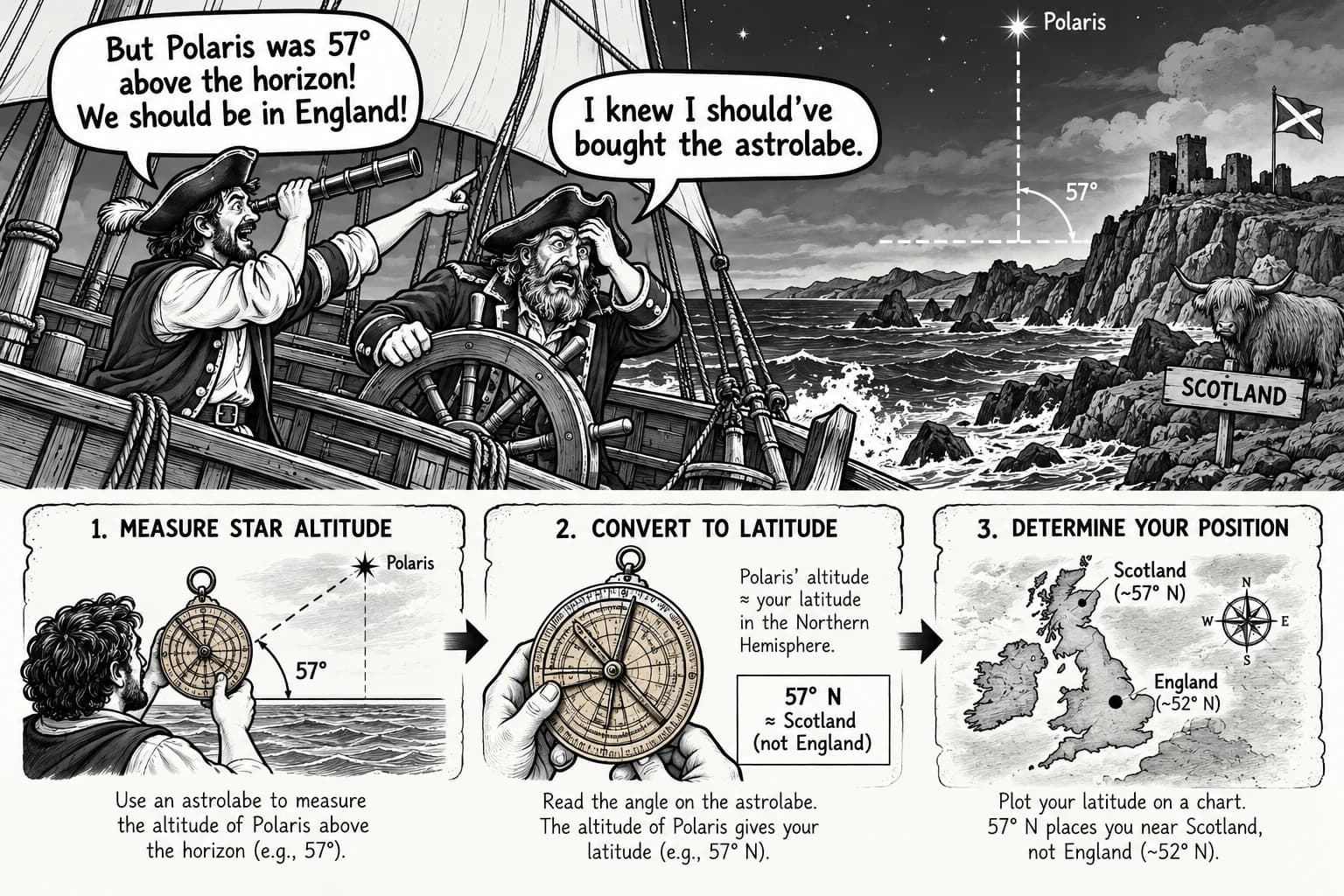
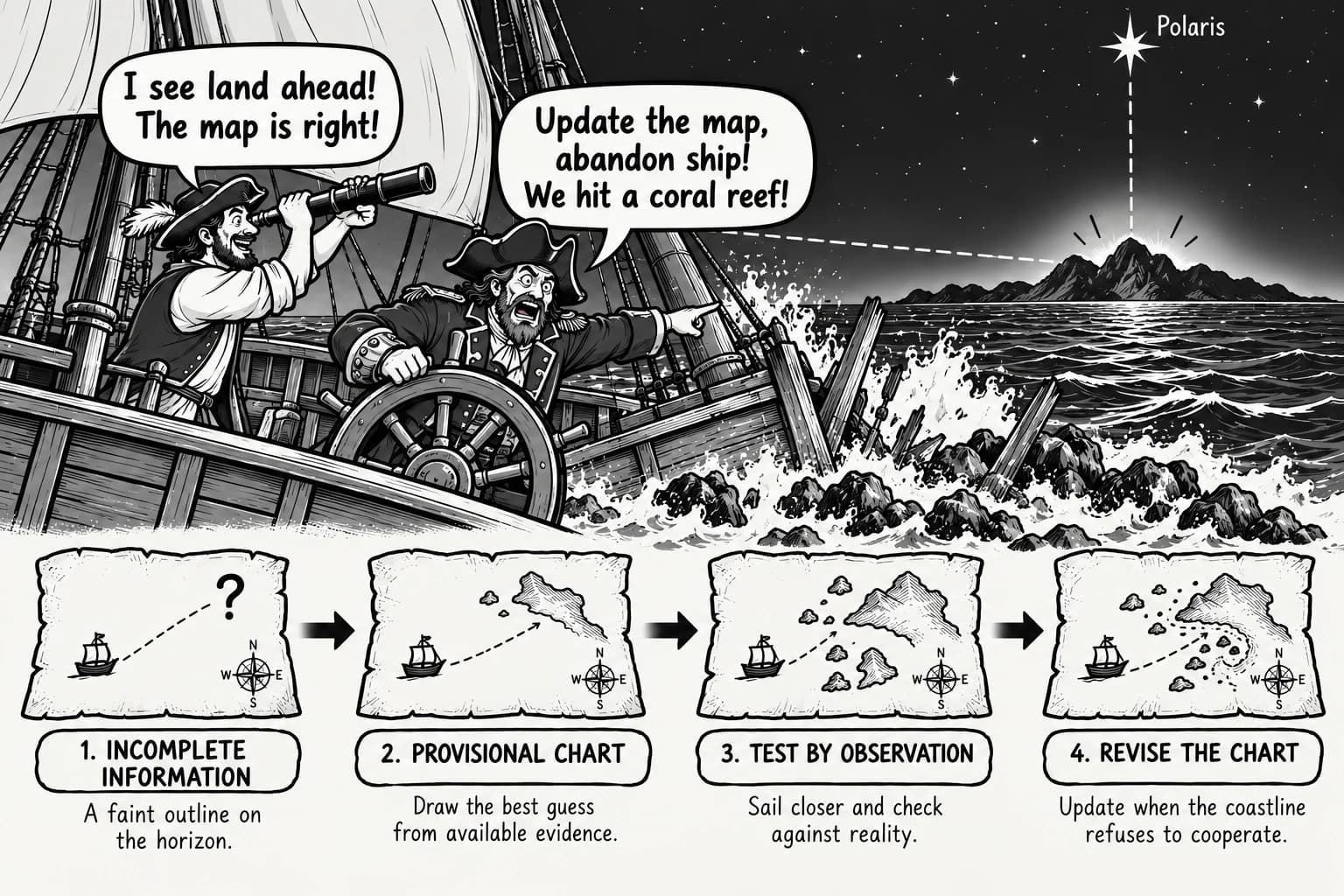
Like a navigator correcting a chart, abductive reasoning starts from a fix that will not fit: an anomaly against expectation. Candidate routes are sketched — Kepler's circles, contaminated water, an unknown element — and each is asked what waters it predicts. Tests are discriminating soundings; most conjectures run aground. The chart is redrawn provisionally, never as finished coastline, because new observations can reopen any passage. Tools from maps to models help hold competing courses in view, but the navigator still judges which line best fits the soundings. The discipline is revision under evidence: propose, predict, compare, and keep the chart honest until a better survey arrives. Each voyage therefore leaves two products — a working route for today's decisions and a log of discarded alternatives, so future navigators can see why this course was chosen and when it should be redrawn.
Frequently Asked Questions
What does abductive reasoning mean?
Abductive reasoning is inference to the best explanation: proposing a plausible account of an observation and evaluating it against evidence and alternatives.
What are five examples of abductive reasoning?
Examples include investigating a laptop shutdown, interpreting Kepler’s observations of Mars, investigating mold around bacterial growth, tracing cholera cases to a water source, and comparing possible medical diagnoses. In each case, the explanation remains provisional until evidence distinguishes it from alternatives.
What is an example of inference to the best explanation?
A laptop that shuts down under heavy use may be overheating. Checking temperature readings and system logs can help determine whether that explanation fits better than a battery or software fault.
What is the difference between abductive and inductive reasoning?
Abduction proposes a plausible explanation for an observation. Induction generalizes a pattern from repeated observations. Both conclusions can be revised as new evidence arrives.
What is the difference between abductive and deductive reasoning?
Abduction proposes an explanation; deduction derives predictions that should follow if the explanation and its premises are correct. Those predictions can then be tested.
How is abductive reasoning used in research?
Researchers use abduction to develop and refine explanations for unexpected findings, compare competing interpretations, and identify what further evidence would help distinguish them.
What is a simple example of abductive reasoning?
You return home and find the floor wet near an open window. Rain entering through the window is one possible explanation. A leaking pipe or spilled water could produce the same observation, so you inspect the window, pipes, and surrounding area before deciding which explanation fits best.
When should I use abductive, deductive, and inductive reasoning?
Use abduction to propose explanations for incomplete evidence, deduction to derive predictions from a hypothesis, and induction to identify patterns across repeated observations. Real investigations often move among all three.
What are the main advantages of abductive reasoning?
It helps people generate explanations, investigate anomalies, compare possible causes, and make provisional decisions when information is incomplete. Its reliability depends on the quality of the alternatives, evidence, and tests.
How can students practice abductive reasoning?
Ask students to predict an outcome, propose multiple explanations, identify evidence that distinguishes them, and revise their answers after feedback. Concept maps can make the links among observations, hypotheses, and evidence visible.
Does abductive reasoning improve memory?
It can encourage elaboration and active engagement with ideas, particularly when learners explain a prediction error and receive useful feedback. The effect on retention depends on the task and learning conditions; abduction alone does not guarantee durable memory.
How does AI help with abductive reasoning?
AI can suggest hypotheses, organize relevant information, and expose relationships that deserve testing. Its output can contain errors or unsupported claims, so users should verify sources and test explanations against independent evidence. AI can help arrange the evidence on the table. Judgment still belongs to the person deciding what the evidence supports.