Knowledge Compilation and ACT-R: How Practice Turns Facts Into Reflex
An apprentice blacksmith once rehearsed every step of the forge aloud before each strike. A decade later, the hammer moved before the words arrived. That transition—from consciously recalling instructions to effortlessly executing them—is the phenomenon that John R. Anderson formalized as knowledge compilation within the ACT-R cognitive architecture. ACT-R explains how declarative knowledge becomes procedural knowledge, how explicit knowledge becomes automatic skill, and why repeated learning by practice steadily reduces working-memory load, mental effort, and response time while increasing skill fluency.
Knowledge compilation sits at the center of modern cognitive psychology, skill acquisition, procedural learning, and intelligent tutoring systems because it provides a computational account of automaticity. Through proceduralization and composition, learners gradually replace slow retrieval of declarative memory with specialized production rules stored in procedural memory. The result explains why multiplication becomes instant recall, programming patterns become muscle memory, musicians improvise without consciously recalling theory, and experienced surgeons execute complex procedures with remarkable consistency. For AI-powered learning tools, the implication is equally practical: repeated workflows involving AI-generated summaries, mind maps, terminology review, and advance organizers should eventually require less cognitive effort—provided automation enhances understanding rather than replacing it.
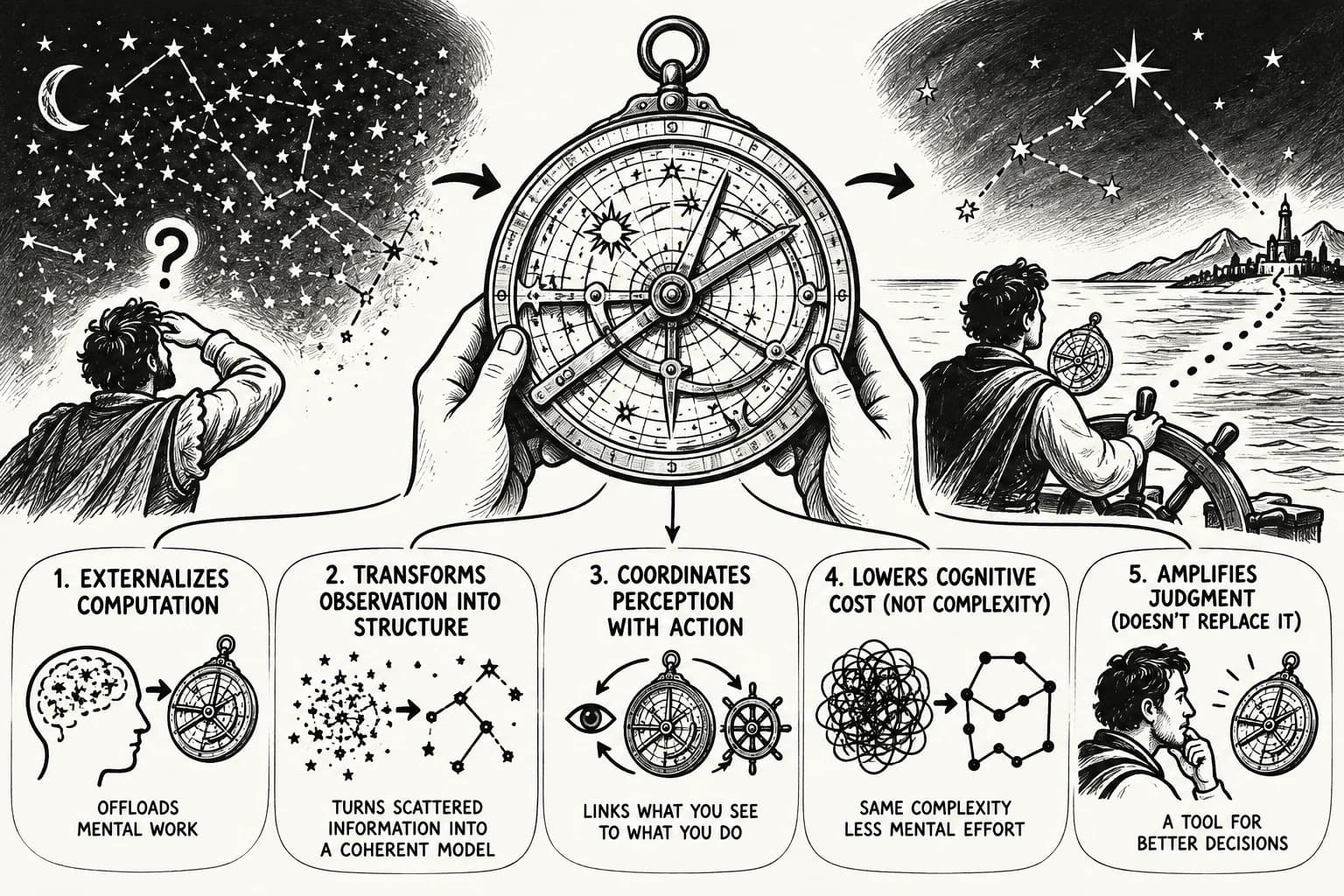
Five ideas that define Knowledge Compilation
-
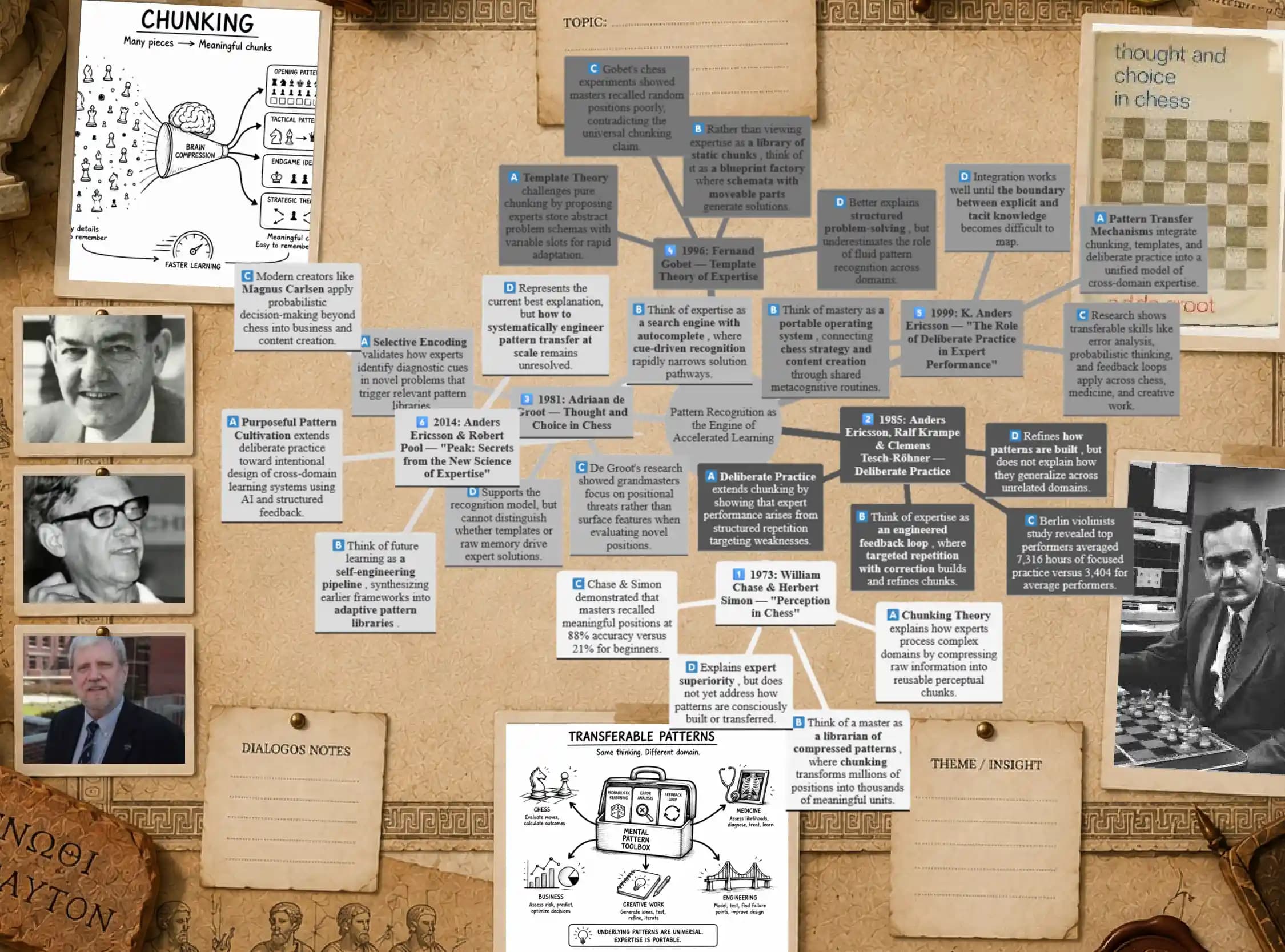
Knowledge compilation transforms facts into skills. Within ACT-R, learners begin with declarative knowledge, retrieve chunks from declarative memory, and gradually convert them into procedural knowledge stored as specialized production rules. This shift explains cognitive automation, schema acquisition, learning by practice, and the transition from deliberate reasoning to fluent expertise.
-
Two mechanisms drive compilation. Proceduralization replaces variable-heavy reasoning with task-specific rules, while composition merges multiple condition-action rules into a single production. Together they reduce goal-stack demands, eliminate unnecessary chunk retrieval, improve cognitive efficiency, and produce the characteristic acceleration seen throughout human skill acquisition.
-
Practice follows predictable learning curves. Research on the law of practice, the power law of learning, exponential learning curves, and competing models such as Logan's Instance Theory all agree that repeated performance dramatically reduces reaction time while improving automatic performance. The debate concerns why performance accelerates—not whether it does.
-
Compilation explains expertise across domains. Mathematics, programming, language learning, surgery, music, sports, engineering, and professional training all exhibit the same progression from explicit instruction toward procedural fluency. ACT-R underpins many cognitive tutors, adaptive learning systems, educational technology, and AI tutoring platforms designed around deliberate practice.
-
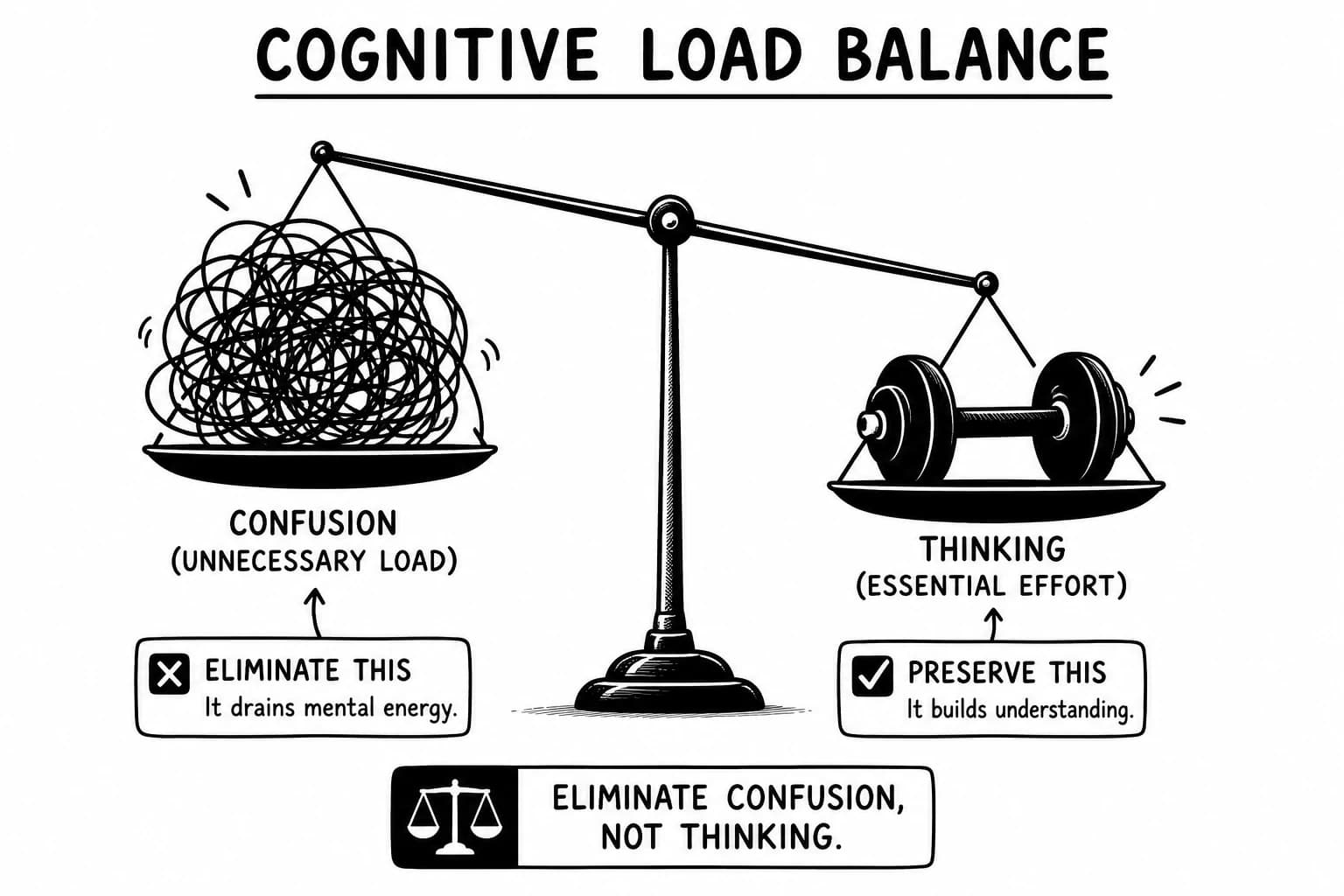
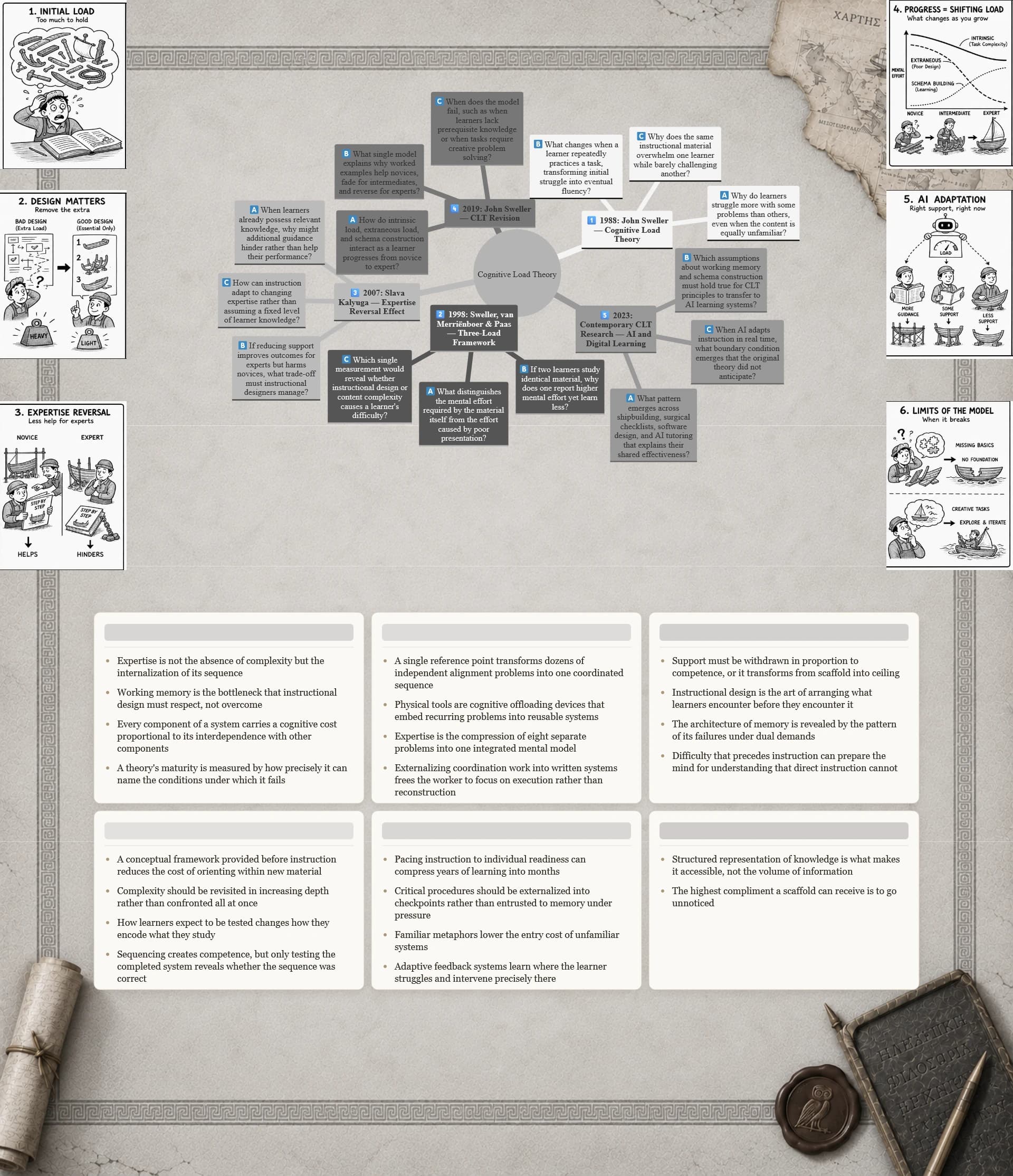
Automation is valuable only when paired with understanding. Efficient production firing lowers cognitive load, but excessive automation risks superficial performance. Effective instructional design balances automaticity, knowledge transfer, metacognition, and deep learning, ensuring learners compile productive reasoning strategies instead of merely accelerating unexamined routines.
Historical Development of Knowledge Compilation and ACT-R
| Year | Researcher(s) | Milestone | Major Concepts Introduced | Lasting Impact |
|---|---|---|---|---|
| 1976 | John R. Anderson | Language, Memory, and Thought | Declarative vs. procedural knowledge, early ACT theory | Established the distinction between factual knowledge and skill execution that underpins modern skill acquisition research. |
| 1982 | John R. Anderson | Knowledge Compilation introduced | Knowledge compilation, proceduralization, composition, production systems | Formalized how declarative memory becomes procedural memory through practice. |
| 1983 | John R. Anderson | The Architecture of Cognition | ACT*, production rules, cognitive architecture | Expanded computational modeling of human cognition and learning by practice. |
| 1981–1984 | Allen Newell & John Rosenbloom | Power Law of Practice | Power law of learning, practice effects, skill acquisition | Demonstrated predictable improvements in reaction time and automaticity with repeated performance. |
| 1992 | Richard Logan | Instance Theory of Automaticity | Memory retrieval, automaticity, competing theories of learning | Proposed retrieval of stored instances rather than rule compilation as an alternative explanation for expertise. |
| 1993 | John R. Anderson | ACT-R released | Adaptive Control of Thought–Rational, procedural memory, declarative memory | Unified cognitive architecture used extensively in educational psychology, intelligent tutoring systems, and cognitive science. |
| 1998 | Anderson & Lebiere | Atomic Components of Thought | ACT-R 4.0, computational cognitive modeling | Expanded ACT-R into a mature framework for modeling problem solving, reasoning, and learning. |
| 2000 | Heathcote, Brown & Mewhort | Exponential Learning Curves | Exponential vs. power law debate, learning curves | Showed individual learners often follow exponential rather than power-law improvement trajectories. |
| 2004 | Anderson, Bothell, Byrne, Douglass, Lebiere & Qin | Unified ACT-R architecture | ACT-R 7, neuroimaging validation, cognitive neuroscience | Linked ACT-R predictions with fMRI, showing reduced prefrontal activity as procedural knowledge develops. |
| 2008–Present | Salvucci, Taatgen and others | Modern ACT-R applications | Threaded cognition, multitasking, cognitive tutors, AI learning systems | Extended ACT-R to adaptive tutoring, educational technology, human-computer interaction, AI education, and learning analytics while continuing research on automaticity, transfer of training, and expert performance. |
How Large Are Practice Effects? Magnitude and Replication
Repeated structured practice is one of the most consistently replicated findings in cognitive psychology, producing dramatic practice effects across motor learning, perceptual learning, and cognitive skill acquisition. Knowledge compilation, procedural learning, and automaticity reliably deliver response-time reduction of roughly 50–80%, with reaction time improvements often reaching very large effect sizes (frequently d > 2.0 across complete acquisition curves) while accuracy improvements generally accompany increasing speed except under speed–accuracy trade-off conditions. Performance follows the familiar learning curve toward a performance asymptote, where early practice yields the largest gains and later repetitions primarily strengthen retention after practice, long-term skill retention, and durable procedural memory. Distributed practice effects consistently outperform massed practice for long-term learning, although intensive sessions can appear faster initially, while individual differences such as working memory, prior knowledge, age, and task complexity influence the rate of improvement more than the eventual level of expertise. Debate today concerns the boundaries rather than the phenomenon itself: researchers continue to examine power law of learning versus exponential learning curves, the transition from associative to autonomous performance, transfer of training, domain-specific practice dose-response, and why consistent-mapping tasks compile rapidly whereas varied-mapping tasks resist automation. Across hundreds of replications and numerous meta-analyses of practice effects, the conclusion remains remarkably stable: repeated, well-designed practice transforms slow, effortful reasoning into fluent, efficient performance, even as the precise mechanisms behind that transformation continue to be refined.
What Speeds Up vs Blocks Knowledge Compilation? Factors, Rivals and Evidence
How Long Does Proceduralization Take? Learning Curves, Practice Effects and Response-Time Reduction Explained
Allen Newell and Paul S. Rosenbloom’s 1981 Carnegie-Mellon research synthesized learning curves across motor, perceptual, and cognitive tasks to explain skill acquisition through progressive chunking. Their evidence showed rapid early response-time improvement followed by diminishing gains, supporting practice-linked proceduralization while later work challenged the universality of a single power-function mechanism. ([ResearchGate][1])
| Audience / Industry / Use Case | Research Finding → Your Next Rep |
|---|---|
| Software engineering teams | Across tasks including text editing and geometry-proof work, response time followed a strong nonlinear practice curve, with the largest gains early and smaller gains later; proceduralization, composition, production formation, and automaticity make repeated stable workflows increasingly efficient. ([Rice University Repository][2]) |
| Human-factors training | Newell and Rosenbloom found log-transformed practice and performance produced approximately linear relationships across diverse tasks, supporting response-time tracking, production compilation, chunking, and asymptotic performance as useful indicators of skill acquisition. ([Cognitive Psychology][3]) |
| AI/cognitive-modeling researchers | The synthesis showed that the same learning-curve form appeared across heterogeneous tasks, motivating a common account of knowledge compilation, proceduralization, composition, and automaticity; subsequent research showed that individual curves can fit exponential functions better, making model comparison part of the measurable workflow. ([ResearchGate][4]) |
Does Distributed Practice Beat Massed Practice for Durable Automaticity?
Timothy D. Lee and Elizabeth D. Genovese’s 1988 McMaster University review and meta-analysis examined motor-skill research comparing distributed and massed practice. Their synthesis found distributed practice improved both acquisition performance and retention, while the advantage after retention was smaller than the acquisition advantage, directly supporting spacing as a durability mechanism. ([ERIC][5])
| Audience / Industry / Use Case | Research Finding → Your Next Rep |
|---|---|
| Athletic skill programs | The meta-analysis found a consistent distributed-practice advantage at the end of acquisition, showing that spacing, retrieval, stabilization, and automaticity can improve immediate motor performance beyond massed schedules. ([Scribd][6]) |
| Clinical skills training | Distributed practice retained an advantage after a retention interval, although the effect was smaller than immediately after acquisition; sleep consolidation, spacing, procedural memory, and durable automaticity require retention testing. ([Scribd][6]) |
| Workplace certification | Earlier paired-associate evidence showed distributed practice could reduce proactive interference under particular list structures, while other structures showed no benefit; interleaving, interference, spacing, and retrieval require task-specific validation. ([ResearchGate][7]) |
Why Feedback Loops Decide Whether You Automate Expertise or Automate Mistakes?
R. Michael Mims and Barry Gholson at Memphis State University tested 7–9-year-old children learning discrimination problems under different feedback types and amounts in 1977. Directional feedback produced systematic strategies on about 80% of problems versus 32–43% under several weaker feedback conditions, showing that feedback materially shaped hypothesis testing and error correction. ([ScienceDirect][8])
| Audience / Industry / Use Case | Research Finding → Your Next Rep |
|---|---|
| Elementary mathematics instruction | Directional right/wrong feedback supported systematic problem-solving strategies on roughly 80% of problems, compared with 32–43% in weaker feedback cells; feedback loops, error correction, retrieval, and production accuracy shaped strategy formation directly. ([ScienceDirect][8]) |
| Adaptive tutoring systems | Children receiving weaker feedback frequently failed to resample after errors according to a local-consistency criterion; the result links forced recall, hypothesis testing, feedback, and automation risk because an unchecked response pattern can persist across subsequent decisions. ([ScienceDirect][8]) |
| Professional simulation training | The factorial manipulation separated feedback type from feedback amount, demonstrating that merely receiving some feedback did not produce identical strategic behavior; desirable difficulty, retrieval practice, error correction, and metacognition require feedback quality to be measured alongside accuracy. ([ScienceDirect][8]) |
How Do Sleep, Working Memory and Motivation Unlock Long-Term Retention?
John G. Jenkins and Karl M. Dallenbach at the University of Illinois tested two participants learning nonsense syllables before either sleep or ordinary waking activity in their 1924 laboratory study. Recall was superior after sleep at 1, 2, 4, and 8 hours, with retention declining during wakefulness while remaining comparatively stable after the initial sleep period. ([PubMed Central (PMC)][9])
| Audience / Industry / Use Case | Research Finding → Your Next Rep |
|---|---|
| Medical education | Sleep produced superior recall at every tested interval, including 1, 2, 4, and 8 hours; sleep consolidation, procedural memory, retrieval, and retention make post-learning sleep a measurable component of durable training. ([PubMed Central (PMC)][9]) |
| High-stakes professional certification | Wakefulness produced progressively greater forgetting across the tested intervals, while recall after sleep showed much less decline after the first two hours; working memory, consolidation, automaticity, and retrieval need delayed testing alongside immediate performance. ([eScholarship][10]) |
| Shift-based organizations | The same participants completed repeated sleep and waking conditions across multiple retention intervals, isolating sleep from elapsed clock time; motivation, working-memory availability, offline consolidation, and procedural retention belong in training schedules that measure next-session performance. ([PubMed Central (PMC)][9]) |
Knowledge Compilation vs Instance Theory: Are Skills Rules or Retrieved Memories?
Gordon D. Logan of the University of Illinois developed instance theory in his 1988 Psychological Review research, treating automaticity as retrieval from accumulated task-specific instances. His lexical-decision evidence showed response times decreasing with repeated presentations and supported power-function speedup, while Timothy Rickard’s later two-experiment pseudoarithmetic study showed a distinct shift from algorithms to retrieval by roughly the 60th exposure. ([EBSCO OpenURL][11])
| Audience / Industry / Use Case | Research Finding → Your Next Rep |
|---|---|
| Human-computer interaction researchers | Logan’s lexical-decision experiments showed repeated exposure produced faster retrieval of practiced items, supporting instance storage, retrieval automaticity, consistency, and response-time reduction as an alternative explanation for apparent procedural fluency. ([ResearchGate][12]) |
| Cognitive-skill training | Rickard found participants shifted from generic multistep algorithms toward fast memory-based retrieval, with complete transition by about the 60th exposure; proceduralization, instance storage, automaticity, and strategy shifts predict qualitative changes in how a skill is executed. ([ResearchGate][13]) |
| AI skill-modeling research | Rickard found the power law held within algorithmic and retrieval strategies but failed across the overall strategy transition, while learning remained highly specific to practiced problems; production compilation, instance retrieval, transfer, and strategy selection require separate measurement. ([ResearchGate][13]) |
ACT-R vs Connectionism vs SOAR: Rules, Weights or Hybrid Cognitive Architecture?
David E. Rumelhart and James L. McClelland’s 1986 PDP research modeled English past-tense learning through distributed weight adjustment rather than discrete symbolic productions. Training began with high-frequency verbs, expanded to hundreds of predominantly regular verbs, produced overregularization during learning, and eventually generalized to previously unseen verbs, demonstrating how distributed learning can generate rule-like behavior without explicit rules. ([Gwern][14])
| Audience / Industry / Use Case | Research Finding → Your Next Rep |
|---|---|
| Machine-learning researchers | The model learned from repeated exposure by adjusting distributed connection weights, demonstrating connectionism, distributed representations, learning, and generalization without explicit production rules; the architecture generated rule-like behavior from statistical structure. ([Gwern][14]) |
| Computational cognitive-science programs | After exposure expanded from 10 high-frequency verbs to 420 verbs, regular forms improved while irregular forms temporarily suffered interference and overregularization; weights, interference, automaticity, and schema-like regularities emerged dynamically from training history. ([FlipHTML5][15]) |
| Neuro-symbolic AI teams | The network generalized to verbs absent from training and captured regularities among irregular forms, showing how distributed learning, symbolic-like behavior, transfer, and cognitive architecture can coexist within one learned system. ([Stanford Encyclopedia of Philosophy][16]) |
Knowledge Compilation vs Deliberate Practice: What Ericsson Misses About Expertise?
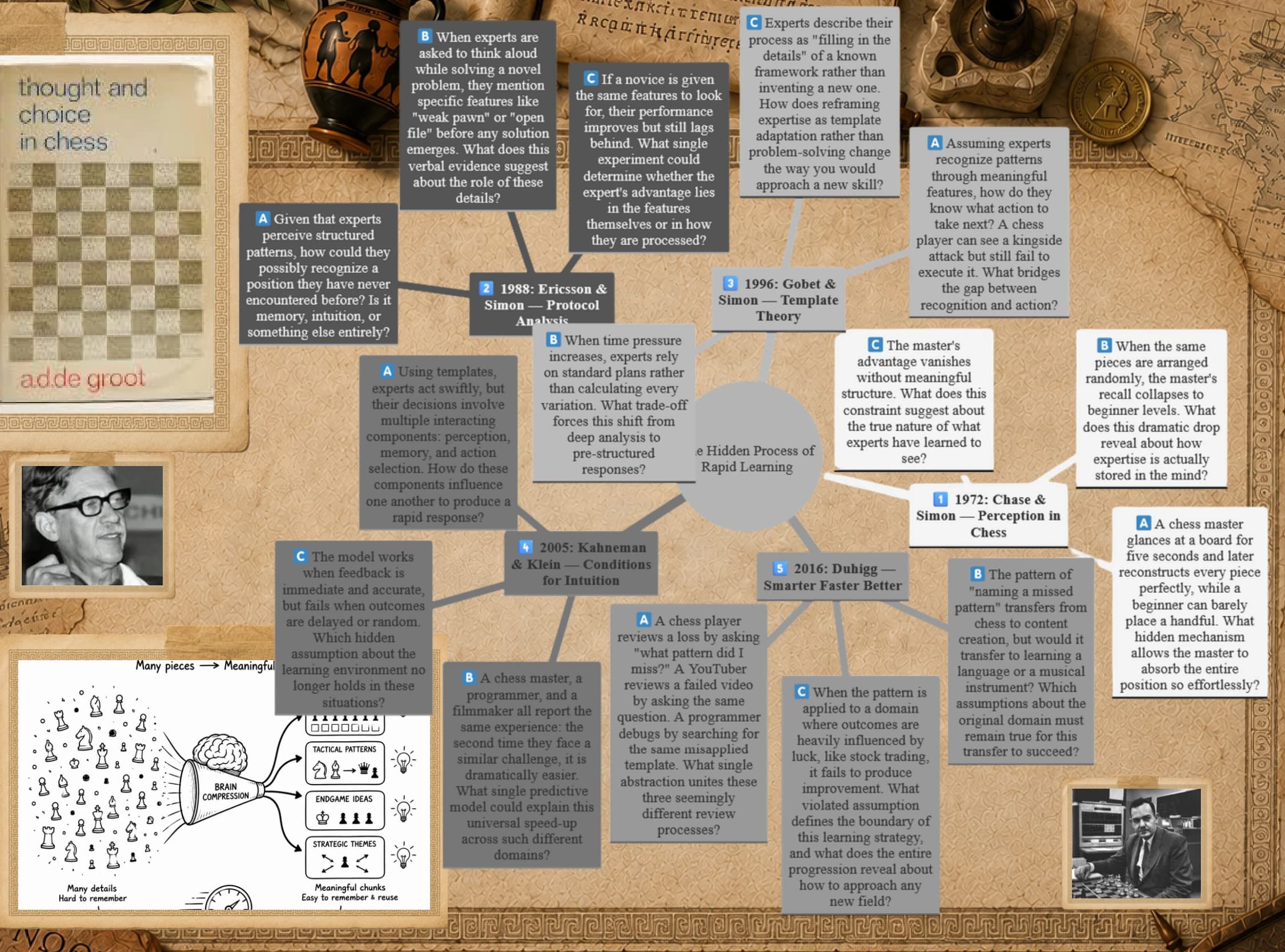
William G. Chase and Herbert A. Simon’s 1973 Carnegie-Mellon study compared chess players from novice to master levels using visible reconstruction and five-second recall tasks. Masters reconstructed meaningful chess positions far better than weaker players, while their advantage largely disappeared for randomly arranged positions, demonstrating that expertise depends heavily on domain-specific perceptual structures rather than generic memory capacity. ([DOI][17])
| Audience / Industry / Use Case | Research Finding → Your Next Rep |
|---|---|
| Chess training programs | Masters reconstructed meaningful positions almost perfectly after five seconds, while random arrangements sharply reduced their advantage; schema acquisition, chunking, deliberate practice, and domain accumulation explain expertise through structured knowledge. ([Scribd][18]) |
| Emergency-response training | The study isolated meaningful structure from raw stimulus quantity by comparing normal and randomized positions; pattern recognition, automaticity, deliberate practice, and transfer predict expertise most strongly when training repeatedly exposes the structures that matter in real decisions. ([Scribd][18]) |
| Professional expertise systems | Later Gobet–Simon work found mirror-image distortions impaired expert recall and supported location-specific chunks, while simulations supported roughly 50,000 stored chunks; domain knowledge, chunking, retrieval structures, and expertise accumulation provide measurable architecture for expert perception. ([PubMed][19]) |
When to Remove Scaffolding? Best Way to Use Expertise Reversal Effect in Corporate Training
Juhani E. Tuovinen of Charles Sturt University and John Sweller of the University of New South Wales studied 32 education students learning FileMaker Pro databases in 1999, comparing worked examples with exploration while controlling learning time. Worked examples improved novices’ performance and efficiency, whereas prior database experience eliminated the instructional difference.
| Audience / Industry / Use Case | Research Finding → Your Next Rep |
|---|---|
| Corporate onboarding | Students without database experience scored substantially higher with worked examples than exploration, supporting scaffolding, schema acquisition, cognitive load, and guidance fading when prior knowledge is limited. |
| Experienced professional training | Among participants with previous database experience, worked examples and exploration produced no significant performance difference, showing that expertise reversal, prior knowledge, scaffolding, and automation can make additional instructional structure redundant. |
| Learning-management systems | Inexperienced exploration learners reported substantially higher mental effort, while relative efficiency strongly favored worked examples; cognitive load, guidance fading, schema acquisition, and workflow autonomy require readiness-sensitive instructional branching. |
How Does Automaticity Expand Your Zone of Proximal Development by Cutting Cognitive Load?
Walter Schneider of the University of California, Berkeley, and Richard M. Shiffrin of Indiana University ran a series of 1977 visual-search experiments comparing consistent and varied stimulus-response mappings. Consistent mappings developed automatic detection after extended practice, while varied mappings retained serial, capacity-limited search, showing that stable learned associations can reduce attentional demands. ([ResearchGate][20])
| Audience / Industry / Use Case | Research Finding → Your Next Rep |
|---|---|
| Interface and workflow designers | Consistent stimulus-response mappings eventually produced search with little dependence on memory-set size, whereas varied mappings retained capacity-sensitive search; automaticity, cognitive load, working memory, and task structure predict when routine interfaces can release attentional capacity. ([studylib.net][21]) |
| Professional operations training | Automatic detection emerged only after extended consistent training, while controlled search operated under varied mappings; proceduralization, automaticity, working-memory load, and transfer make stable early practice a prerequisite for freeing attention toward higher-order decisions. ([ResearchGate][20]) |
| Human-performance assessment | With consistent mappings, memory load had little effect on reaction time and accuracy; with varied mappings, search remained sensitive to memory load and display size, providing measurable dual-task resilience, cognitive load, automaticity, and attentional capacity indicators. ([PubMed Central (PMC)][22]) |
Can Over-Automation Hurt Deep Learning? Prior Knowledge, Prediction and Metacognition Risk
Jonathan W. Schooler of UC Santa Barbara, Stellan Ohlsson of the University of Illinois, and Kevin Brooks conducted four 1993 experiments comparing verbalization with control conditions during insight and noninsight problem solving. Retrospective and concurrent verbalization impaired insight performance, while noninsight problems were unaffected, suggesting that some productive cognitive processes can be disrupted by forced explicit reporting. ([EBSCO OpenURL][23])
| Audience / Industry / Use Case | Research Finding → Your Next Rep |
|---|---|
| Creative problem-solving teams | Retrospective verbalization made participants significantly less successful on insight problems than controls, linking prediction, metacognition, automaticity, and generative learning to a boundary where explicit reporting can interfere with ongoing problem restructuring. ([EBSCO OpenURL][23]) |
| Design and engineering education | Concurrent nondirective verbalization impaired insight problems while leaving noninsight problems unaffected, demonstrating that deep learning, automatic processing, hypothesis generation, and metacognition can interact differently across problem types. ([EBSCO OpenURL][23]) |
| Expert-review systems | Encouraging participants to consider alternative approaches did not eliminate the verbalization impairment in Experiment 4, showing that prediction, self-explanation, metacognition, and automaticity should be evaluated by performance outcomes. ([EBSCO OpenURL][23]) |
Does Practice Create Flexible Experts or Brittle Habits? Near Transfer vs Far Transfer
Edward L. Thorndike and Robert S. Woodworth’s 1901 Psychological Review experiments tested whether training on one mental function transferred to related but altered tasks. Across magnitude-estimation and word-marking tasks, improvement transferred mainly where trained and tested functions shared relevant elements, while more distant changes produced little general improvement, establishing an early empirical boundary for transfer. ([Psych Classics][24])
| Audience / Industry / Use Case | Research Finding → Your Next Rep |
|---|---|
| Mathematics education | Training magnitude estimation improved judgments where relevant elements overlapped, while improvement on altered magnitude tasks remained limited; near transfer, schema acquisition, flexible productions, and task similarity constrain how far a practiced procedure travels. ([EBSCO OpenURL][25]) |
| Workplace skills training | In word-marking experiments, 90 minutes of verb-marking practice reduced trained-task time from 417 to 341 seconds while errors fell from 10 to 1, demonstrating strong local learning with weaker transfer to altered tasks; automaticity, specificity, transfer, and production learning must be tested separately. ([Psych Classics][26]) |
| Cross-domain professional development | Thorndike and Woodworth found that improvement was not a general mental power: transfer appeared where trained and tested activities contained common elements, while some similar-looking functions showed little improvement; far transfer, task structure, retrieval, and boundary conditions require direct cross-context testing. ([York University][27]) |
Knowledge Compilation in Practice: Designing Learning Workflows That Become Second Nature
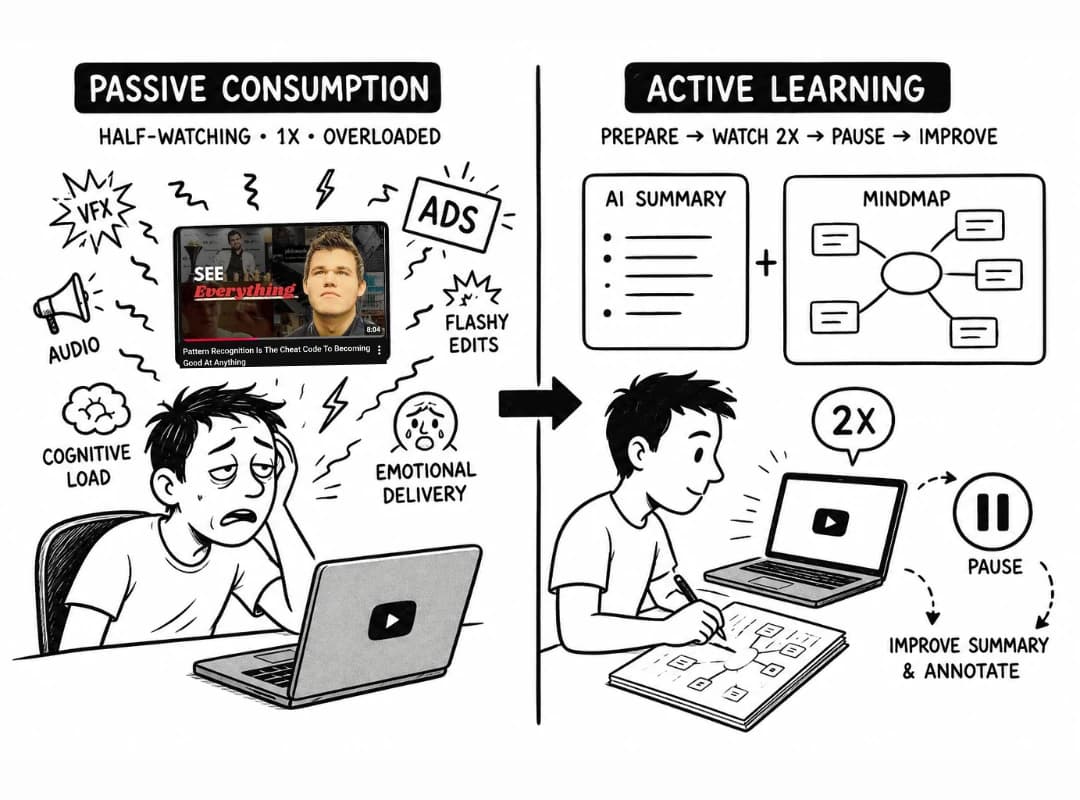
Most instructional systems measure whether learners finish a workflow. Knowledge Compilation asks a more ambitious question: does the workflow itself become a skill? Within John Anderson's ACT-R cognitive architecture, every repeated interaction—opening an AI-generated summary, scanning a mind map, reviewing a terminology glossary, and entering the learning material—can gradually shift from effortful declarative knowledge toward fluent procedural knowledge through proceduralization and composition. Consistent instructional design, UX consistency, adaptive learning, learning analytics, behavioral telemetry, knowledge tracing, and AI tutoring become more than usability decisions; they determine whether learners automate productive routines or merely develop efficient-looking habits. The engineering objective is not maximum speed but cognitive efficiency with preserved deep learning, using preparation-time analytics, engagement tracking, adaptive scaffolding, and workflow standardization to distinguish genuine expertise from autopilot.
How to Turn Learning Workflows Into Second Nature? Practical Implementation Guide
Best Way to Assess Prior Knowledge Before Instruction? Prior Knowledge Profiles That Predict Speedup
Jane F. Gaultney’s 1995 Journal of Experimental Child Psychology study trained poor-reading fourth- and fifth-grade boys with baseball expertise to use “why” questions in baseball or nonbaseball stories, measuring strategy use, recall, and monitoring after days and weeks. ([ScienceDirect][1]) Prior knowledge accelerated strategy acquisition: baseball-trained students used the strategy more successfully at both posttests, while metacognitive knowledge predicted acquisition and literal recall.
| Audience / Industry / Use Case | Research Finding → Your Next Rep |
|---|---|
| Secondary-school reading intervention | Baseball-embedded training produced greater strategy use at both 1–3-day and 2–3-week tests than nonbaseball training, showing how prior knowledge, schema activation, declarative knowledge, and metacognition can support strategy acquisition. A readiness check can distinguish missing domain knowledge from missing strategy knowledge before instruction. ([ScienceDirect][1]) |
| Corporate onboarding | Higher declarative metacognition predicted better strategy acquisition and literal recall, indicating that a prior knowledge profile should include awareness of what the learner knows. The measurable outcome is subsequent strategy use and recall across delayed assessments. ([ScienceDirect][1]) |
| Professional placement and adaptive LMSs | Recall was higher for baseball material across the study, while domain-specific expertise improved strategy acquisition, illustrating how schema activation, working-memory support, and knowledge baselines interact. Placement can separate domain familiarity from general reading skill when predicting instructional uptake. ([ScienceDirect][1]) |
How to Use Advance Organizers and AI Summaries Without Creating Dependence?
D. J. Satterly and I. G. Telfer’s 1979 study examined 180 adolescents across three instructional conditions: lessons alone, lessons with an advance organizer, and lessons with an organizer whose organizing properties were explicitly explained. ([ResearchGate][2]) The strongest gain for field-dependent pupils occurred when the organizer’s structure was explicitly connected to the material, demonstrating that advance organizers become more useful when their organizational function is made cognitively visible.
| Audience / Industry / Use Case | Research Finding → Your Next Rep |
|---|---|
| Secondary-school vocabulary instruction | Field-dependent pupils achieved their greatest gains when the advance organizer, schema activation, terminology preview, and organizing structure were explicitly connected during lessons. The finding supports measuring recall and transfer separately. ([ResearchGate][2]) |
| Corporate compliance training | The study found a significant interaction between cognitive style and treatment, showing that the same organizer does not produce identical effects across learners. A stable preview interface can be evaluated through learning and retention comparisons. ([ResearchGate][2]) |
| Adaptive LMS design | Recall and transfer differed across cognitive-style groups, while explicit attention to the organizer’s organizing properties particularly benefited field-dependent learners. This connects advance organizers, cognitive load, schema activation, and retention to an observable learner-by-instruction interaction. ([ResearchGate][2]) |
How to Use Mind Maps to Build Mental Models That Compile?
Issam Abi-El-Mona of Rowan University and Fouad Abd-El-Khalick of the University of Illinois studied 62 eighth-grade science students randomly assigned to mind-mapping or note-summarization conditions during a science unit. ([Wiley Online Library][3]) Mind mapping produced significantly higher science gains, the effect was independent of prior scholastic achievement, and accurate conceptual links and color coding distinguished maps associated with stronger conceptual understanding.
| Audience / Industry / Use Case | Research Finding → Your Next Rep |
|---|---|
| Secondary-school science | Students constructing mind maps achieved significantly higher gains than students summarizing notes, demonstrating that schema construction, conceptual organization, mental models, and relational encoding can accompany measurable achievement gains. The relevant assessment should retain separate conceptual-understanding and reasoning outcomes. ([Wiley Online Library][3]) |
| Programming and engineering education | Learning gains were not mediated by prior scholastic achievement, suggesting that the mapping intervention operated across different achievement levels. A common mind-map structure, relationship encoding, and schema-building routine can be evaluated through the same conceptual assessment. ([Wiley Online Library][3]) |
| UX and data-analysis training | Higher conceptual understanding was associated especially with accurate links between central themes and major/minor concepts, while iconography was less central than theorized. This makes mental models, semantic relationships, visual encoding, and conceptual integration measurable through map quality and conceptual-understanding scores. ([Wiley Online Library][3]) |
Concept Map vs Mind Map: Which Builds Transferable Expertise for Researchers?
Sergiu-Mihai Nicoara, Stefan-Emeric Szamoskozi, Delia-Alexandrina Mitrea, and Daniel-Corneliu Leucuta studied 505 first-year medical students at Iuliu Hațieganu University of Medicine and Pharmacy between 2015 and 2018, comparing concept mapping with traditional anatomy learning and retesting memory six months later. ([MDPI][4]) Concept mapping produced significantly better results across examinations and long-term testing, with one exception partly associated with language of instruction.
| Audience / Industry / Use Case | Research Finding → Your Next Rep |
|---|---|
| Medical education | Across 505 anatomy students, concept mapping generally produced higher examination results than traditional learning, linking concept formation, semantic relationships, knowledge organization, and retrieval to stronger performance. The six-month assessment makes delayed retention a meaningful outcome alongside immediate examination scores. ([MDPI][4]) |
| Researcher knowledge management | The advantage remained especially visible at six-month retesting, indicating that concept mapping, relational encoding, schema organization, and long-term memory can extend beyond immediate examination performance. A durable research framework warrants delayed retrieval measures. ([MDPI][4]) |
| Multilingual professional training | The study found one exception to the generally significant experimental advantage and reported that teaching language partly explained it. This boundary condition connects concept mapping, prior language knowledge, integration, and retrieval to learner-context variables that should remain visible in transfer analytics. ([MDPI][4]) |
How to Turn AI Summaries Into Procedural Fluency for Knowledge Workers?
Eileen Kintsch’s 1990 University of Colorado Institute of Cognitive Science study examined 96 students from Grades 6 and 10 and college who summarized expository texts and answered oral probes while microstructure and macrostructure difficulty were manipulated. ([ERIC][5]) Summarization changed with text structure and developmental level: college students generalized more from poorly structured texts, while poor macrostructure impaired younger students’ selection of macropropositions.
| Audience / Industry / Use Case | Research Finding → Your Next Rep |
|---|---|
| Knowledge-worker reading systems | College students generalized more when summarizing poorly structured texts, showing that summary generation, schema construction, macrostructure, and inference interact with source organization. Summary quality should be evaluated against source structure. ([DOI][6]) |
| Corporate learning platforms | Sixth-grade learners had greater difficulty selecting text-based macropropositions from poorly structured material, while older learners generated different inferential representations. This supports separating AI summarization, comprehension, knowledge organization, and learner readiness when evaluating automated learning aids. ([ERIC][5]) |
| Research literature workflows | More macropropositional statements appeared during probe responses than in summaries, consistent with retrieval conditions changing the accessible representation. A summary-to-map workflow should measure retrieval, inference, conceptual integration, and comprehension independently. ([DOI][6]) |
Fastest Way to Master Vocabulary? Terminology Review, Retrieval Cues and Semantic Memory
Nicole Goossens, Gino Camp, Peter Verkoeijen, and Huib Tabbers studied primary-school vocabulary learning by introducing 20 novel words through stories or isolated word pairs, then comparing retrieval practice with restudy and testing retention one week later. ([ResearchGate][7]) Retrieval practice produced better delayed recall than additional study, while the word-pair condition produced stronger performance than story-based learning and recognition showed no retrieval advantage.
| Audience / Industry / Use Case | Research Finding → Your Next Rep |
|---|---|
| Primary-school language learning | After one week, words practiced through retrieval were recalled better than words receiving additional study, demonstrating how retrieval cues, semantic memory, encoding specificity, and consolidation can strengthen vocabulary retention. Delayed cued recall provides a direct measurable outcome for terminology learning. ([ResearchGate][7]) |
| Healthcare terminology training | Retrieval practice improved recall while producing no recognition advantage, separating fluent retrieval from simple familiarity. This makes semantic retrieval, recognition-versus-recall, long-term memory, and terminology review measurable as different components of professional vocabulary competence. ([ResearchGate][7]) |
| Language-learning applications | Children learning isolated word pairs outperformed those learning the same number of words embedded in stories in this experiment, demonstrating that contextual richness does not automatically dominate deliberate retrieval. Retrieval cues, semantic encoding, vocabulary review, and consolidation should be evaluated according to the desired memory outcome. ([ResearchGate][7]) |
How to Link New Concepts Without Encoding Misconceptions? Structured Modules That Integrate
Panayiota Kendeou, Jason L. G. Braasch, and Ivar Bråten compared refutation texts with different justification formats in adolescent science learning, manipulating whether correct conceptions were justified through authority, multiple sources, or personal opinion. ([Taylor & Francis Online][8]) Conceptual-change learning was optimized when correct conceptions were supported by corroborated consensus across multiple sources, showing that corrective explanations require an epistemic structure that learners can evaluate.
| Audience / Industry / Use Case | Research Finding → Your Next Rep |
|---|---|
| Secondary-school science | Refutation texts explicitly connected misconceptions to correct conceptions, while learning was optimized when the correction was justified through corroborated multiple sources. Scaffolding, misconception diagnosis, knowledge integration, and conceptual change operate through the learner’s evaluation of why the replacement conception is warranted. ([Taylor & Francis Online][8]) |
| Medical education | Authority-only justification was less optimal than corroborated multi-source justification, making source convergence part of the corrective learning process. Structured modules can connect existing schemas, corrective feedback, conceptual reasoning, and evidence integration while measuring conceptual-change outcomes. ([Taylor & Francis Online][8]) |
| Professional certification | The experimental manipulation showed that the form of justification affected conceptual-change learning, establishing an important boundary condition for feedback. A knowledge module should measure misconception revision, explanation quality, schema integration, and transfer. ([Taylor & Francis Online][8]) |
How to Build a Knowledge Framework That Survives Forgetting? Organize for Durability
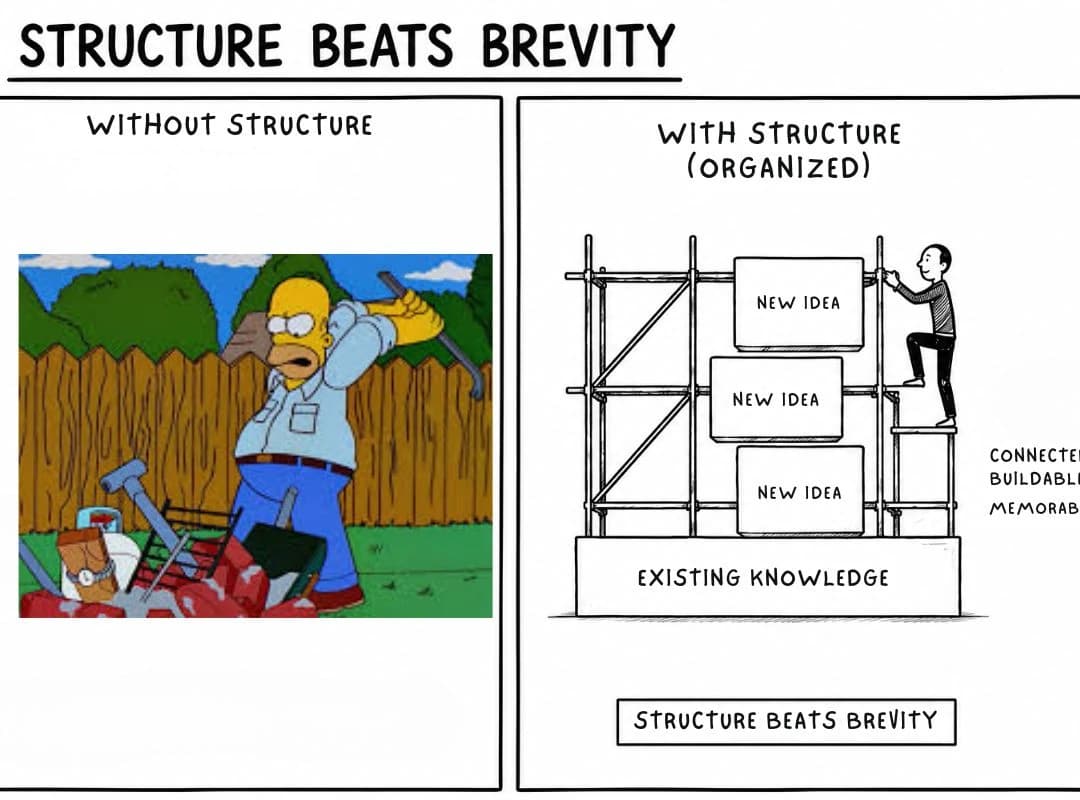
Bat-Sheva Eylon and Frederick Reif’s 1984 Cognition and Instruction research tested hierarchical, task-adapted knowledge organization with college students learning physics, using recall, error correction, knowledge modification, and alternative hierarchical organizations across multiple experiments. ([Physics Education Research Central][9]) Hierarchically organized learners outperformed detailed single-level learners on recall and knowledge-modification tasks, while performance depended on where relevant information was positioned within the hierarchy.
| Audience / Industry / Use Case | Research Finding → Your Next Rep |
|---|---|
| University physics instruction | Hierarchical organization produced better recall, error correction, and knowledge modification than a detailed single-level organization, demonstrating how knowledge organization, schema structure, retrieval, and task adaptation shape performance. A framework should be evaluated through multiple task types. ([Physics Education Research Central][9]) |
| Engineering knowledge bases | When the same physics information was distributed across alternative hierarchical levels, performance was better on tasks relying on information placed at higher levels. This shows that memory organization, information hierarchy, retrieval accessibility, and task relevance jointly influence usable knowledge. ([Physics Education Research Central][9]) |
| Enterprise knowledge management | The training successfully altered internal knowledge organization, while students with lower physics grades were less able to assimilate and use the hierarchy. This identifies prior knowledge, schema acquisition, organization, and transfer as measurable boundaries for durable knowledge frameworks. ([Physics Education Research Central][9]) |
Best Retrieval Practice Schedule: Quizzes, Flashcards, Spacing and Interleaving?
Nicholas Cepeda, Harold Pashler, Ed Vul, John Wixted, and Doug Rohrer synthesized 839 assessments from 317 experiments across 184 articles on distributed practice and verbal recall. ([eScholarship][10]) Their quantitative synthesis showed that spacing improves final retention and that the optimal interstudy interval changes with the desired retention interval, making scheduling a calibration problem.
| Audience / Industry / Use Case | Research Finding → Your Next Rep |
|---|---|
| Language-learning platforms | The synthesis covered 317 experiments and found a reliable distributed-practice effect across a large evidence base, connecting retrieval practice, spacing, forgetting, and retention to delayed performance. Scheduling should be evaluated against final retention. ([eScholarship][10]) |
| Corporate certification | The optimal interstudy interval increased as the desired retention interval increased, showing that adaptive scheduling, retrieval strength, forgetting curves, and long-term retention should be calibrated to the date when competence must actually be available. ([eScholarship][10]) |
| Medical continuing education | The meta-analysis showed that interstudy interval and retention interval jointly determine final retention, creating a measurable scheduling boundary. Distributed quizzes can be evaluated by delayed recall at the required competency horizon. ([eScholarship][10]) |
How to Standardize Summary to Map to Terminology Workflow for LMS and Enterprise AI?
Virpi Slotte and Kirsti Lonka studied 502 medical-school applicants during a Finnish entrance examination, examining the 36 applicants who spontaneously constructed concept maps while processing 17 pages of scientific information. ([Taylor & Francis Online][11]) Map complexity and interrelationships were associated with examination success, whereas merely including relevant concepts had little effect on comprehension, making structural organization more informative than terminology accumulation.
| Audience / Industry / Use Case | Research Finding → Your Next Rep |
|---|---|
| Medical-school admissions and preparation | Among 502 applicants, only 36 spontaneously created maps, and greater map extent and complexity were associated with stronger understanding of scientific text. Summary extraction, terminology, concept mapping, and knowledge organization become more informative when relationships are represented. ([Taylor & Francis Online][11]) |
| Research-literature workflows | Merely including relevant concepts had little effect on comprehension, whereas the number and complexity of interrelationships strongly related to understanding. A summary-to-map pipeline should preserve semantic links, conceptual structure, terminology, and inferential relationships, with map complexity assessed alongside comprehension. ([Taylor & Francis Online][11]) |
| Enterprise LMS knowledge systems | Students who produced concept maps or prose summaries were more likely to succeed than those producing verbatim notes or nothing, while map complexity related to examination success. This supports evaluating knowledge organization, summarization, terminology extraction, and relational encoding through downstream performance. ([ScienceDirect][12]) |
How to Diagnose Misconceptions Before They Become Automatic? Knowledge Gap Analysis That Prevents Bad Habits
Jale Durmuş and Şule Bayraktar studied 104 fourth-grade students learning “Matter and Change,” comparing conceptual-change texts, laboratory experiments, and traditional instruction with pretests, immediate posttests, and a 13-week delayed test. ([ERIC][13]) Both alternative approaches outperformed traditional instruction for misconception reduction and permanent knowledge, while neither alternative method significantly outperformed the other in misconception reduction.
| Audience / Industry / Use Case | Research Finding → Your Next Rep |
|---|---|
| Elementary-school science | Conceptual-change texts and laboratory experiments both outperformed traditional instruction in overcoming misconceptions and acquiring permanent knowledge. Knowledge-gap analysis, misconception diagnosis, corrective feedback, and conceptual change require comparison against a conventional baseline. ([ERIC][13]) |
| Medical or safety training | The absence of a significant difference between conceptual-change texts and experiments shows that multiple corrective routes can reduce misconceptions when structured around the target concept. Error analysis, schema revision, feedback loops, and retention can be assessed through pretest-to-delayed-test change. ([ERIC][13]) |
| Adaptive LMS remediation | Students were assessed immediately and again 13 weeks later, and both alternative approaches produced more permanent knowledge than traditional instruction. This makes knowledge tracing, misconception logs, delayed retrieval, and adaptive scaffolding measurable through persistence of corrected conceptions. ([ERIC][13]) |
The apprentice of 1704 could not explain production rules. He could, by 1714, shoe a horse while holding a conversation — threaded cognition before the term (Salvucci & Taatgen, 2008). The forge had done its work. The only remaining question, for blacksmiths and software alike, is whether the hands learned the right thing.