What Is Elaborative Retrieval? Why Explaining Beats Memorizing
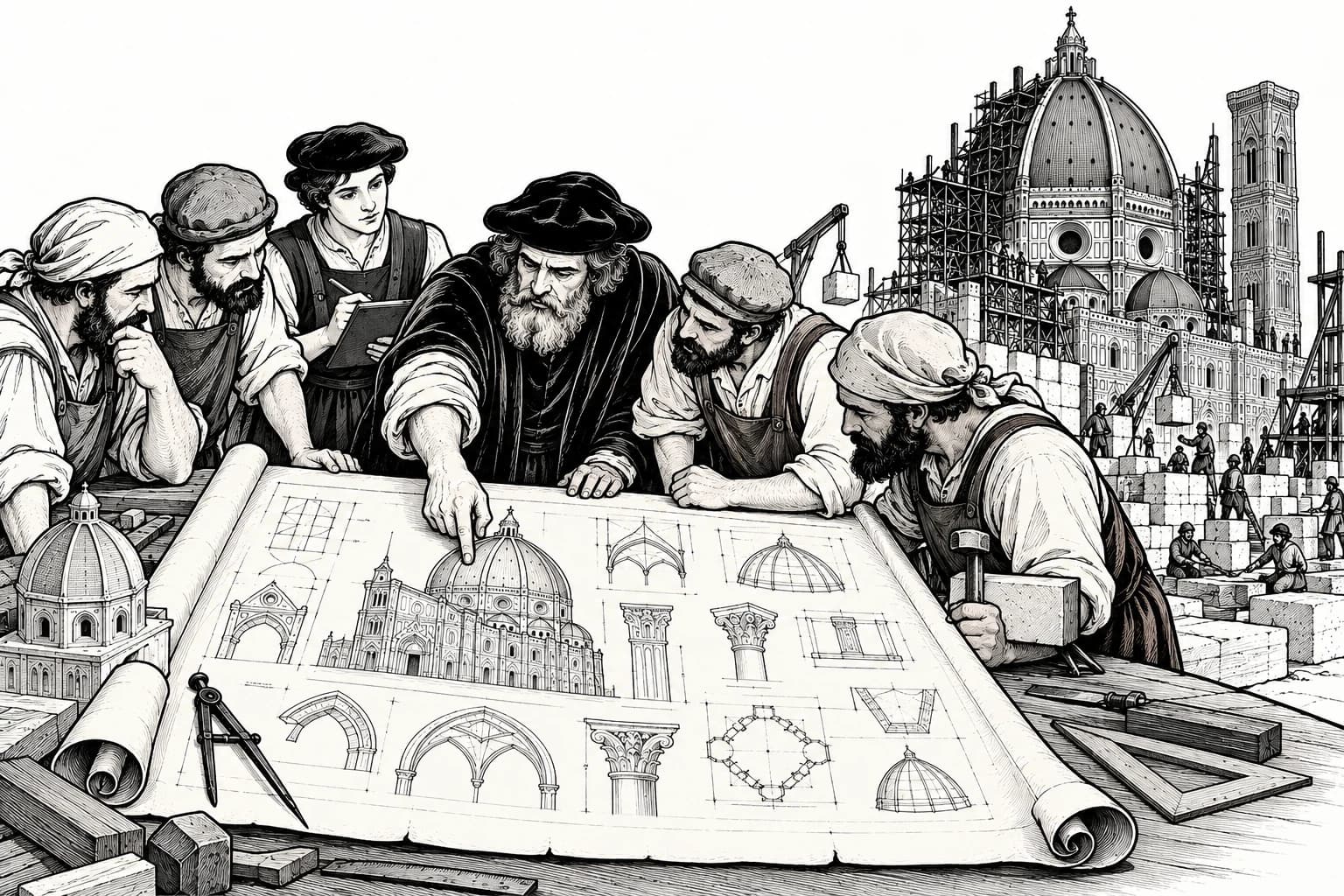
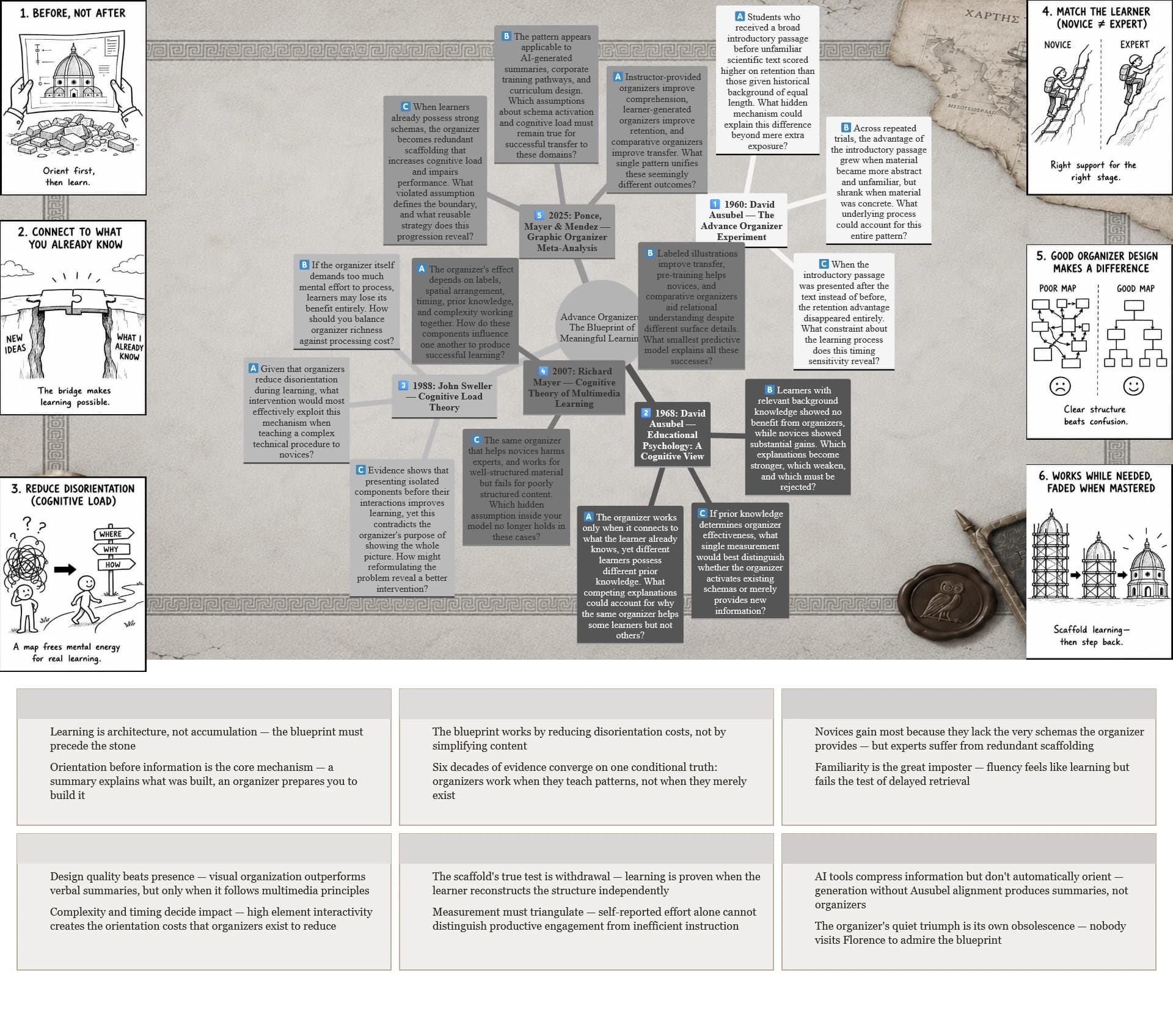
The ruins of ancient Rome taught historians a lesson psychologists would later rediscover. A fallen temple reveals where stones landed; rebuilding it reveals why the arches stood. Medieval architects restored Roman aqueducts by tracing foundations, testing joints, and discovering how each stone supported the next. The finished structure contained every original block, yet understanding emerged from reconstruction rather than inspection. Memory follows the same principle. Simply recalling a fact is like cataloguing scattered stones. Elaborative retrieval rebuilds the structure by reconnecting ideas, explaining relationships, and restoring the architecture that gave isolated facts their meaning. The memory that survives is not the list of stones, but the rebuilt cathedral.
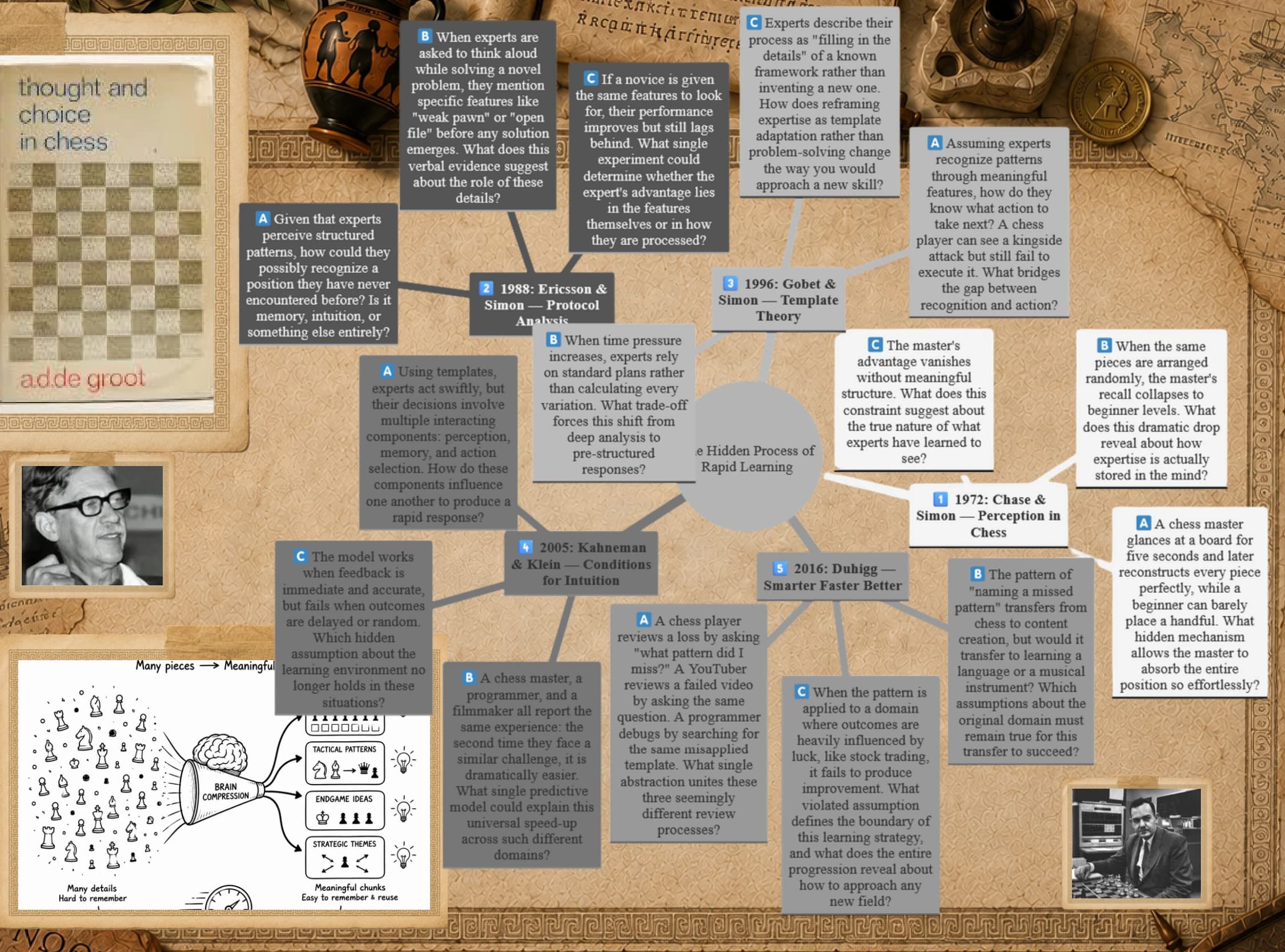
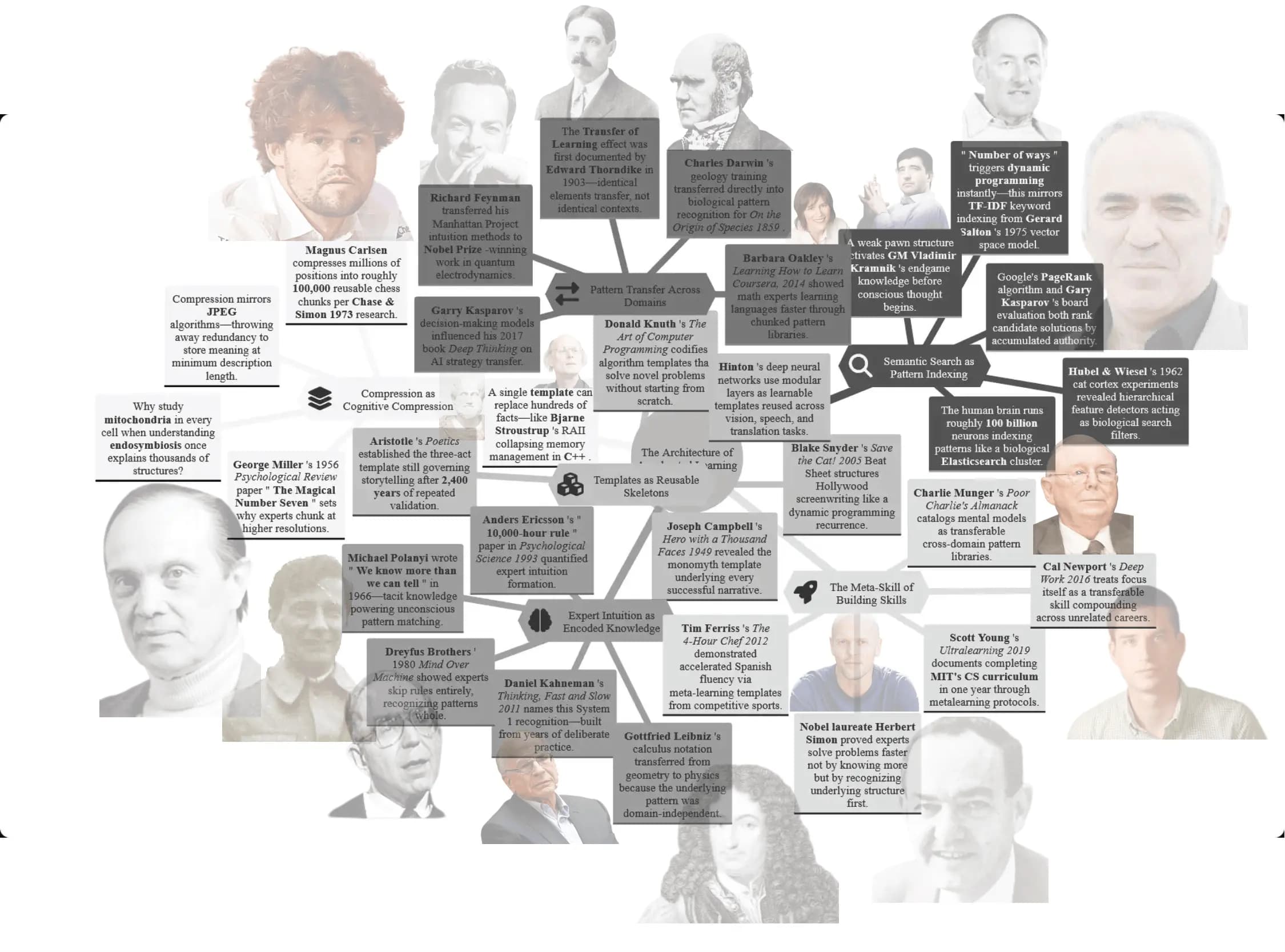
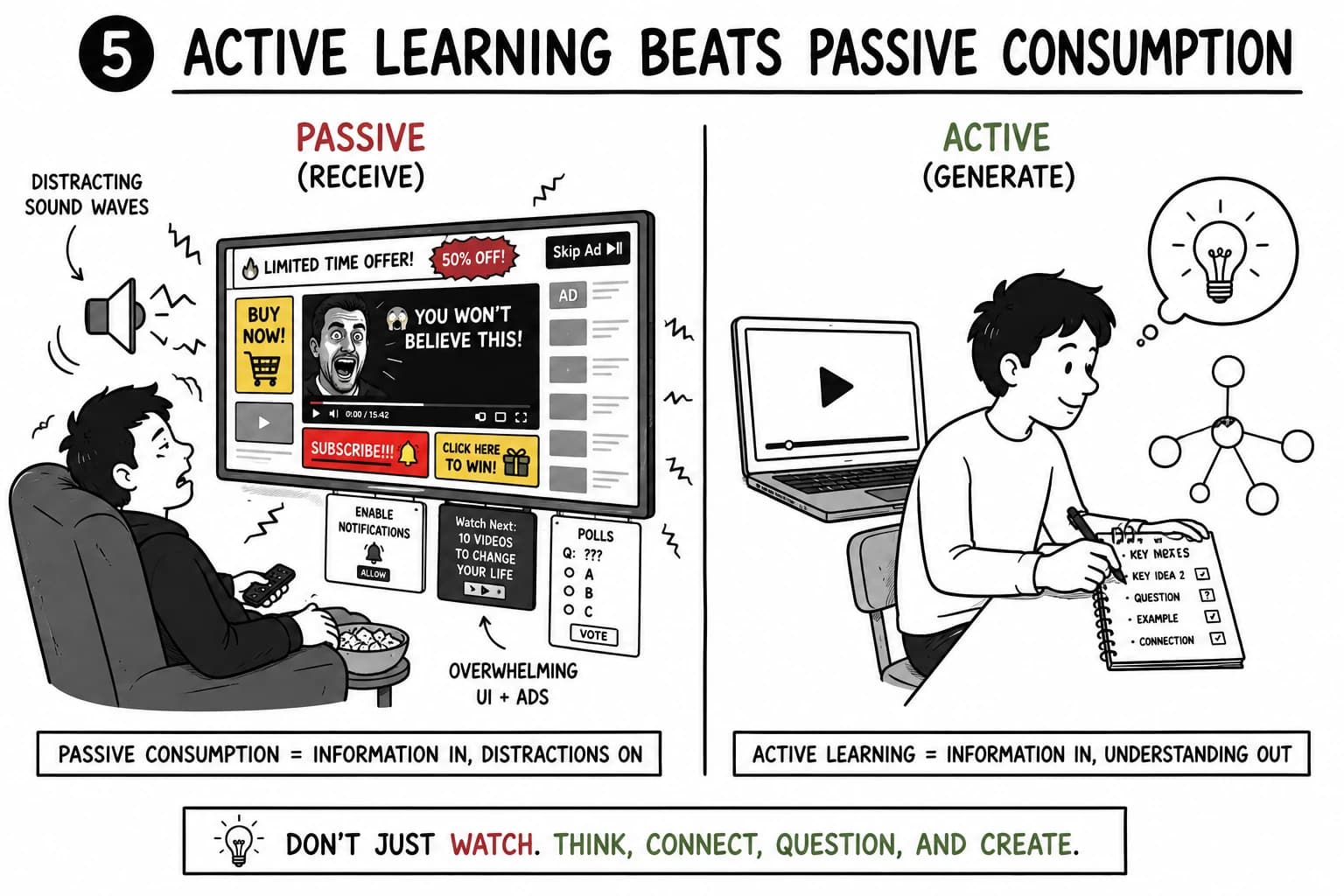
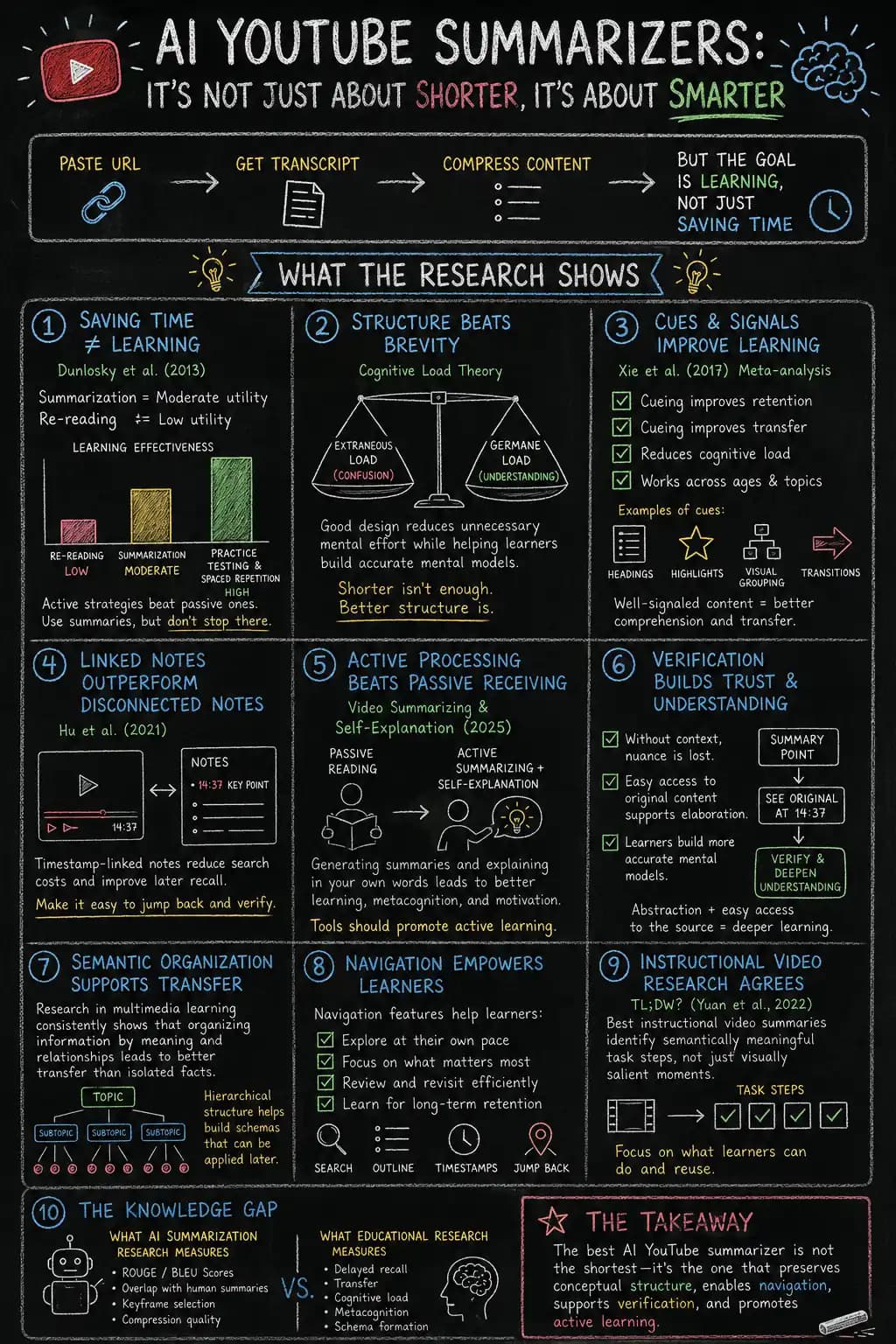
In 1972, Craik & Lockhart argued through Levels of Processing Theory that durable memory depends on meaningful processing rather than repetition. Wittrock's Generative Learning Theory (1974) showed learners remember more when they generate knowledge themselves. Pressley's elaborative interrogation (1987) transformed recall into explanation through continual "why" questions. Chi's Self-Explanation Effect (1989) demonstrated that explaining solutions produces deeper understanding than merely solving them. Roediger & Karpicke's Testing Effect (2006) established retrieval itself as a powerful learning event, before Karpicke & Blunt (2011) showed that retrieval from memory surpassed concept mapping performed while studying, and Karpicke & Smith (2012) united these traditions under elaborative retrieval—memory retrieval that reconstructs explanations, relationships, organization, and prior knowledge rather than replaying stored facts.
What This Guide Covers
-
Definition and Core Principles of Elaborative Retrieval — Return to the Roman villa, where every repaired arch depends on stones finding one another again. Here we define elaborative retrieval, retrieval-based learning, deep learning strategies, memory retrieval, elaborative retrieval meaning, elaborative retrieval in psychology, and elaborative retrieval in cognitive psychology, showing why successful recall becomes stronger when it generates explanations, links concepts to prior knowledge, and rebuilds a coherent mental representation.
-
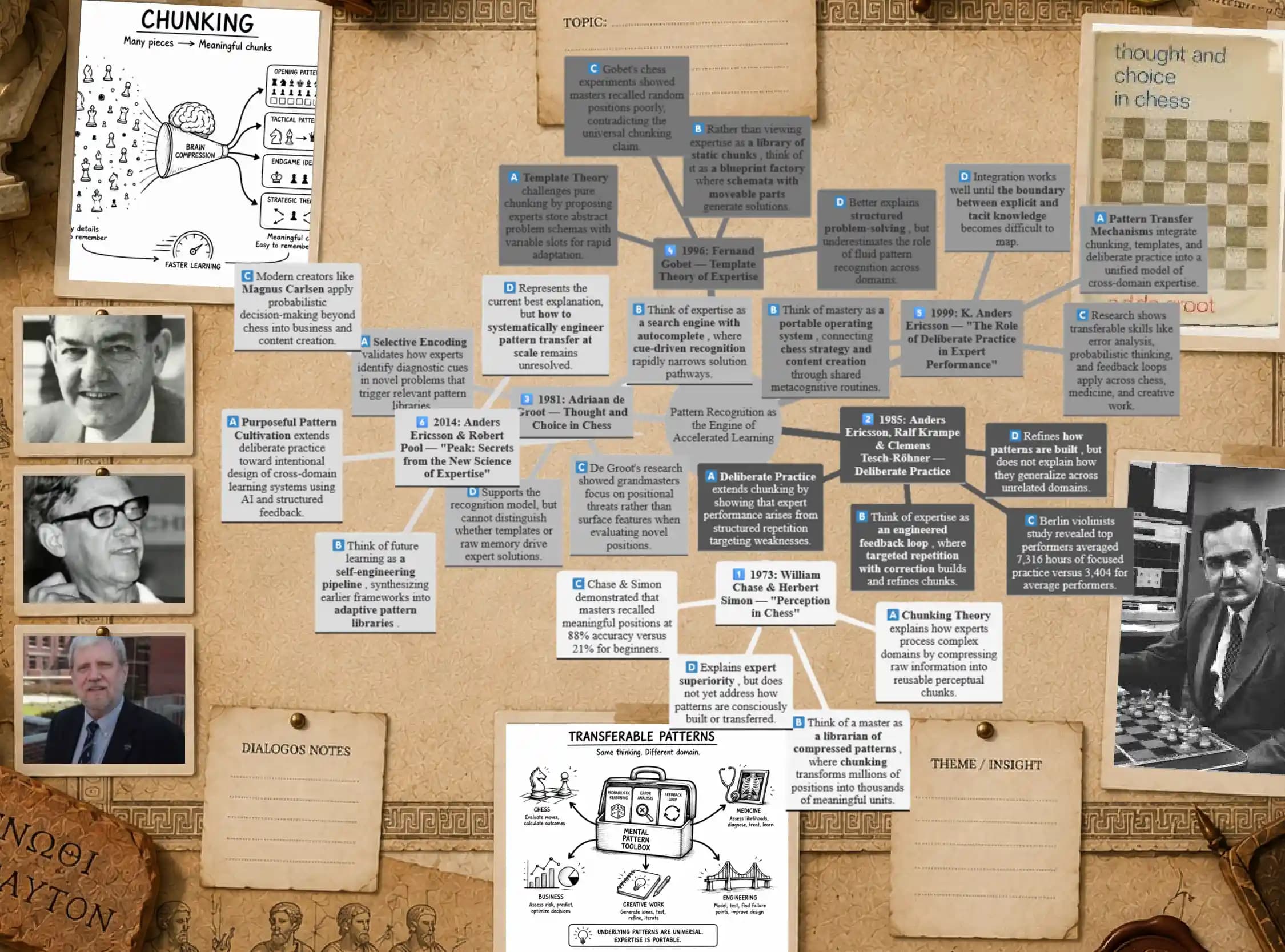
The Historical Development of Elaborative Retrieval — Walk through two thousand years of builders extending the same cathedral. Levels of Processing Theory, Craik & Lockhart, Generative Learning Theory, Wittrock, elaborative interrogation, Pressley, the Self-Explanation Effect, Chi, Bjork's Desirable Difficulties, the Testing Effect, Roediger & Karpicke, Karpicke & Blunt, Karpicke & Smith, concept mapping, and meaningful learning each added another flying buttress until reconstruction became one of the strongest traditions in modern cognitive psychology.
-
How Elaborative Retrieval Works — Step inside the workshops where memories are rebuilt through semantic memory, associative networks, schema activation, generative processing, organizational processing, knowledge integration, retrieval cues, encoding specificity, episodic memory, memory consolidation, long-term memory encoding, metacognitive monitoring, dual coding, and knowledge organization, transforming isolated fragments into structures that can support reasoning, transfer, and future learning.
-
Why Elaborative Retrieval Produces Better Learning — Follow the restored roads that connect one city to another, where every successful explanation strengthens conceptual understanding, learning transfer, near transfer, far transfer, durable learning, retention over time, critical thinking, problem solving, academic performance, exam performance, meaningful learning, long-term retention, and learning outcomes, revealing why rebuilt knowledge travels farther than memorized facts.
-
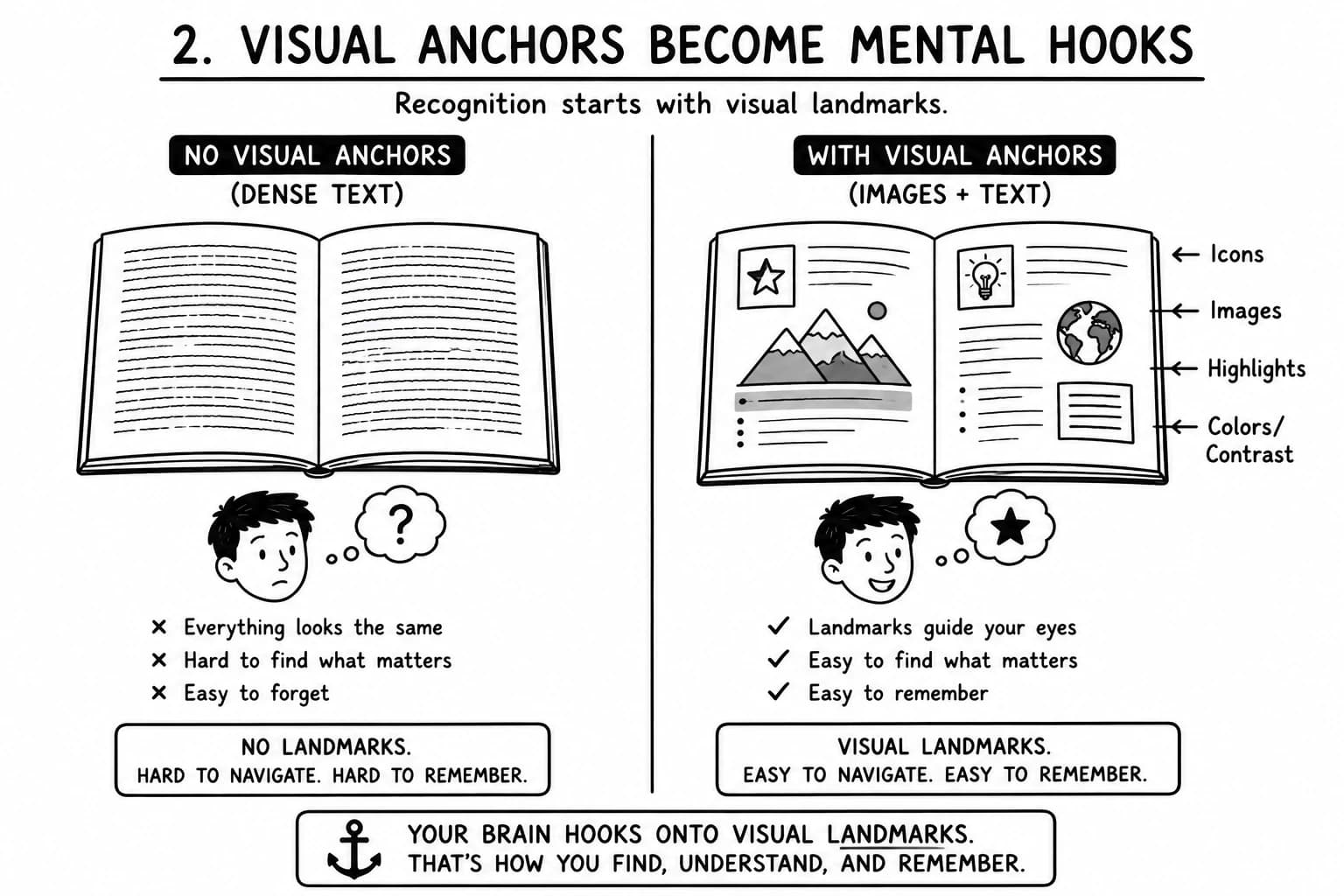
Evidence, Applications, and Boundary Conditions — Return to the construction site where every new scaffold must justify its weight. Explore retrieval practice vs elaborative retrieval, elaborative interrogation, self-explanation, concept mapping, active recall, AI learning tools, mind maps, instructional design, cognitive load, novice vs expert, task complexity, misconceptions, over-elaboration, feedback, and the growing evidence for AI-assisted learning, showing where elaborative retrieval consistently succeeds, where it requires scaffolding, and where the architecture remains unfinished.
Timeline of Elaborative Retrieval Research
| Year | Research | Key Concepts |
|---|---|---|
| Ancient Rome–Middle Ages | Roman engineering, medieval reconstruction traditions | Reconstruction as understanding, relational structure, rebuilding versus cataloguing, historical metaphor for knowledge organization |
| 1972 | Craik & Lockhart — Levels of Processing Theory | Levels of Processing Theory, deep processing, semantic processing, meaningful encoding, durable memory |
| 1974 | Merlin Wittrock — Generative Learning Theory | Generative Learning, learner-generated explanations, construction of meaning, active learning |
| 1978 | Slamecka & Graf | Generation Effect, self-generated information remembered better than presented information |
| 1987 | Pressley et al. | Elaborative interrogation, "why" questions, explanatory reasoning, prior knowledge activation |
| 1989 | Chi, Bassok, Lewis, Reimann & Glaser | Self-Explanation Effect, explanation during problem solving, conceptual understanding, knowledge integration |
| 1994 | Bjork — Desirable Difficulties | Effortful retrieval, productive struggle, long-term retention, retrieval difficulty |
| 2000 | Rawson, Dunlosky & Thiede | Meaning-based retrieval, organization during recall, transfer, retrieval quality |
| 2004 | McNamara (SERT); Ozgungor & Guthrie | Self-explanation for difficult texts, elaboration quality, moderate prior knowledge, comprehension |
| 2006 | Roediger & Karpicke | Testing Effect, retrieval practice, active recall, memory strengthening through retrieval |
| 2010 | Butler | Transfer of Learning, near transfer, far transfer, inference, retrieval beyond rote memory |
| 2011 | Karpicke & Blunt (Science) | Retrieval practice vs concept mapping, retrieval from memory, concept mapping, active recall, retrieval outperforms encoding-only strategies, reconstruction beats review |
| 2012 | Karpicke & Smith | Formal elaborative retrieval, memory retrieval, explanation during recall, retrieval-based learning, reconstructive memory, relational reasoning |
| 2013 | Dunlosky et al. | Evidence-based learning techniques, elaborative interrogation, self-explanation, utility ratings, classroom recommendations |
| 2010s–Present | Cognitive neuroscience, educational psychology, AI-assisted learning | Semantic memory, schema activation, memory consolidation, metacognition, knowledge organization, dual coding, AI learning tools, AI mind maps, instructional design, cognitive load, boundary conditions, novice vs expert, feedback, adaptive learning |
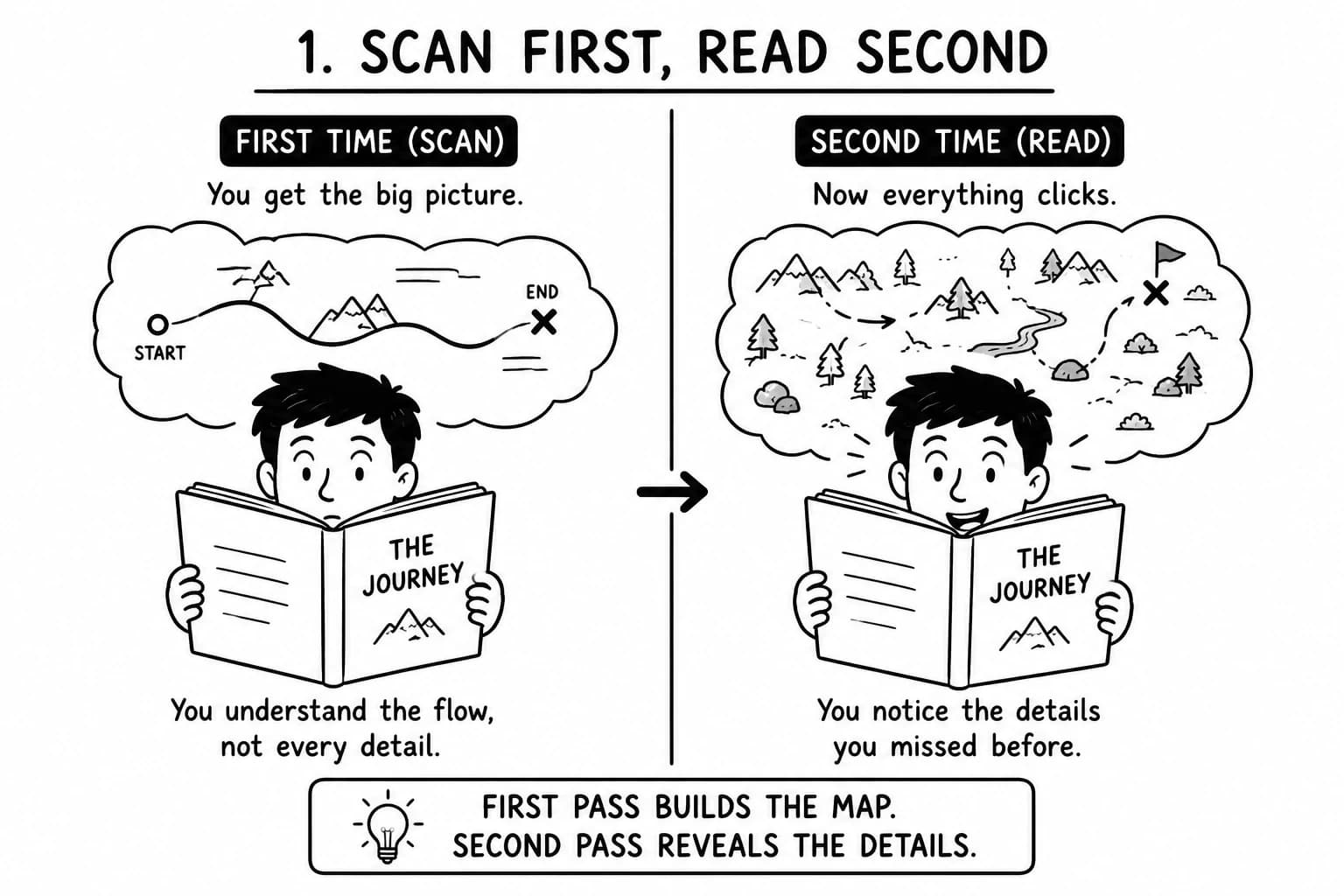
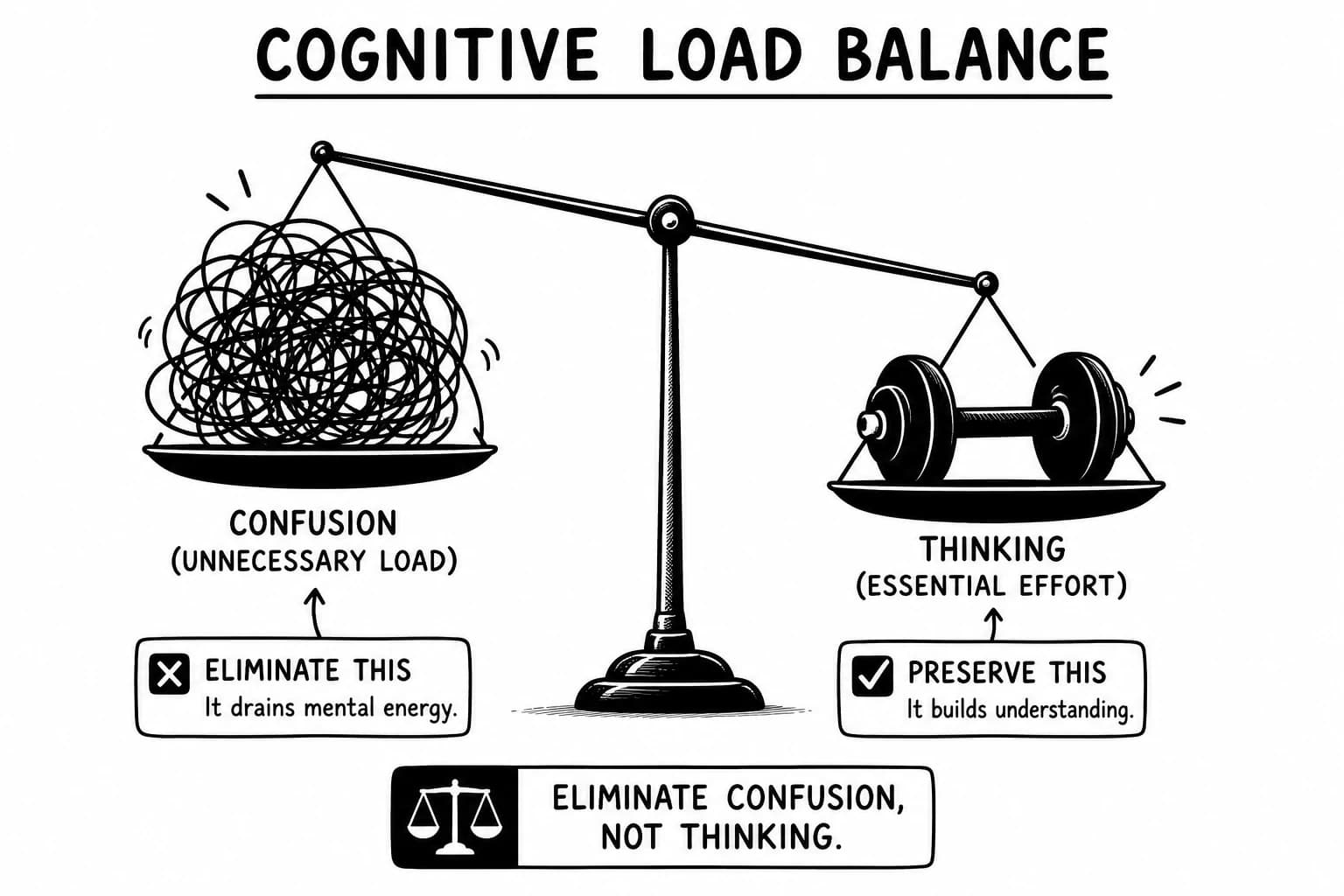
Before a cathedral could be restored, master builders first studied the surviving arches rather than admiring the finished drawings, because the quality of reconstruction depended on the quality of reasoning. Elaborative retrieval follows the same discipline. Its success is measured not by how much a learner recalls, but by explanation quality, causal accuracy, elaboration depth, concept integration, relational accuracy, and ultimately transfer performance, using both rubric-based evaluation inspired by Chi et al. (1989) and learning analytics that compare connection counts, proposition accuracy, and delayed transfer against expert models. The same measurements expose the technique's common failure modes: explaining while reading instead of retrieving, passive rereading disguised as study, shallow "why" answers, copying explanations rather than generating them, constructing a concept map before attempting retrieval practice, overconfidence born from fluency, and confidently elaborating misconceptions. Within Bloom's Taxonomy, simple recall occupies remembering, while elaborative retrieval climbs through understanding, applying, analyzing, and evaluating by requiring learners to justify, compare, connect, and explain, laying the foundations for creating. Each reconstruction also strengthens metacognition as judgments of learning, self-monitoring, self-regulation, confidence calibration, and reflective learning reveal missing stones before the next layer is built. Around this central scaffold gather related methods—active recall, spaced repetition, interleaving, the generation effect, retrieval practice, concept mapping, elaborative interrogation, dual coding, self-explanation, mnemonics, and the Feynman Technique—all converging where retrieval meets explanation. The engineering conclusion is to adopt elaborative retrieval with conditions: learners should elaborate prior knowledge rather than unseen material, generate explanations before seeing an expert diagram or mind map, limit prompts to a small number of high-value relational questions, and adapt support when prior knowledge is weak. Like medieval stonemasons restoring a weathered cathedral, the expert supplies the blueprint and mortar, but only the learner can rebuild the arches.
Elaborative Retrieval Systems Compared: Evidence, Moderators, and AI Workflow
1. Generation Effect Examples: Why Does Self-Generation Beat Passive Reading for Long-Term Memory?
In 1992, Klaus Fiedler, Harald Lachnit, Doris Fay, and Christine Krug at the University of Mannheim tested a refined generation paradigm across four experiments in which participants generated words with different levels of cueing while controlling encoding time and presentation conditions. Increasing generative activity improved free recall, remained independent of self-paced study time, and was enhanced by positive mood, supporting generation as an active encoding operation rather than extra exposure. ([PubMed][1])
| Audience / Industry / Use Case | Research Finding → Your Next Rep                                                                                                                                                                                                                                                                                                                                                               |
| ------------------------------ | ---------------------------------------------------------------------------------------------------------------------------------------------------------------------------------------------------------------------------------------------------------------------------------------------------------------------------------------------------------------------------------------------- |
| Corporate upskilling           | Increasing the amount of information learners had to generate produced higher free recall, while masking the target produced no comparable effect. The finding links **semantic search**, **generation**, and **retrieval strength** to the practical value of making employees produce an answer.                                                                                             |
| Professional certification     | Fiedler et al. replicated the generation benefit across between- and within-subject designs while controlling study time statistically, weakening the **time-on-task** explanation. Certification preparation can treat productive retrieval as the learning event and measure delayed **free recall**.                                                                                        |
| Knowledge-intensive onboarding | The fourth experiment found a larger generation effect under positive mood, while the preceding experiments showed that generative activity itself remained predictive when study time was controlled. This connects **active processing**, **attention**, and **memory encoding** to onboarding designs that require employees to reconstruct procedures before seeing the canonical version. |
2. Is Incorrect Generation Harmful? Why Errorful Generation Plus Immediate Feedback Improves Memory
Rosalind Potts, Gabriella Davies, David Shanks and colleagues investigated errorful generation in a series of experiments in which participants guessed foreign-word translations before receiving the correct answer, comparing this procedure with studying intact pairs. Six experiments found that generating errors enhanced processing of corrective feedback, increased curiosity about the answer and improved subsequent recognition, even when the guesses were wrong. ([PubMed][2])
| Audience / Industry / Use Case     | Research Finding → Your Next Rep                                                                                                                                                                                                                                                                                                     |
| ---------------------------------- | ------------------------------------------------------------------------------------------------------------------------------------------------------------------------------------------------------------------------------------------------------------------------------------------------------------------------------------ |
| Language-learning platforms        | Incorrect translation guesses produced better recognition than intact study, while generating after the correct answer was already known did not produce the same benefit. The sequence **prediction → prediction error → corrective feedback → curiosity** supplies the critical learning episode.                                  |
| Employee compliance training       | Participants became more curious about the correct answer after generating an incorrect one, and experiments showed enhanced recognition of the subsequent target. A pre-question followed by immediate correction can convert **errorful generation**, **surprise**, and **feedback processing** into measurable recognition gains. |
| Medical or technical certification | The research showed that the benefit depended on enhanced processing of the corrective answer rather than simply producing a wrong response. Assessment should compare post-feedback **target recognition**.                                                                                                                         |
3. How Much Prior Knowledge Is Required? Schema Theory, Semantic Memory and Familiar Material
In 2003, John Lutz, Amanda Briggs, and Kristy Cain at East Carolina University tested the generation effect across six experiments using legal nonwords, familiar clichés, new sentences, and unfamiliar textbook sentences. Generation produced no benefit for legal nonwords and a greatly reduced benefit for unfamiliar sentences, showing that generation depends strongly on meaningful material capable of engaging existing semantic representations. ([PubMed][3])
| Audience / Industry / Use Case | Research Finding → Your Next Rep                                                                                                                                                                                                                                                                           |
| ------------------------------ | ---------------------------------------------------------------------------------------------------------------------------------------------------------------------------------------------------------------------------------------------------------------------------------------------------------- |
| Beginner technical training    | Four experiments using legal nonwords produced no generation effect, showing that an empty **semantic memory** network supplies little material for useful **generation**. New learners need terminology and basic **schema acquisition** before open-ended production becomes a reliable memory strategy. |
| University language courses    | Familiar clichés produced a stronger generation advantage than newly constructed or unfamiliar sentences. Existing **semantic representations**, **prior knowledge**, and meaningful associations determine whether completing a sentence creates useful retrieval structure.                              |
| Professional reskilling        | Unfamiliar textbook sentences showed a greatly reduced generation effect, establishing a boundary condition rather than a universal benefit. Training can measure prerequisite vocabulary before assigning open **semantic search**, with later delayed recall providing the relevant outcome measure.     |
4. How Long Should Generation Attempts Last? The Inverted-U Desirable Difficulty Curve
John L. Dobson and Tracy Linderholm at Georgia Southern University varied retrieval difficulty in university anatomy learning by comparing repeated reading, word-fragment generation, and free-recall testing. The most demanding condition—read, test, read, test—produced the highest absolute recall at both immediate and one-week assessments, while simple generation occupied an intermediate level of effort. ([American Association for Anatomy][4])
| Audience / Industry / Use Case | Research Finding → Your Next Rep                                                                                                                                                                                                                                                                        |
| ------------------------------ | ------------------------------------------------------------------------------------------------------------------------------------------------------------------------------------------------------------------------------------------------------------------------------------------------------- |
| Medical education              | Passive rereading four times produced less anatomy recall than alternating reading with free recall, establishing a measurable benefit for higher **retrieval effort**. The practical workflow is **read → free recall → reread → free recall**, with immediate and one-week tests measuring retention. |
| Nursing certification          | Word-fragment generation required less effort than free recall, while the free-recall condition produced the strongest absolute retention. The finding separates **generation**, **retrieval practice**, and **desirable difficulty** according to task demand.                                         |
| Anatomy e-learning             | The advantage of read-test-read-test remained visible after one week, demonstrating a delayed retention benefit. A learning system should evaluate **delayed recall** alongside immediate accuracy when calibrating task difficulty.                                                                    |
5. Generation Effect vs Testing Effect vs Retrieval Practice: Does Test Format Match Matter?
In 1997, Patricia deWinstanley and Elizabeth Bjork at Oberlin College conducted two experiments manipulating processing instructions while comparing generated and read material on free- and cued-recall tests. Identical study materials produced different generation effects depending on whether processing emphasized target information, cue-target relationships, or other relational information, demonstrating that retention depends on the compatibility between encoding and retrieval demands. ([PubMed][5])
| Audience / Industry / Use Case | Research Finding → Your Next Rep                                                                                                                                                                                                                                                           |
| ------------------------------ | ------------------------------------------------------------------------------------------------------------------------------------------------------------------------------------------------------------------------------------------------------------------------------------------ |
| University examination design  | The same generated material produced different outcomes on free versus cued recall when processing instructions changed. **Transfer-appropriate processing**, **encoding specificity**, and **retrieval practice** require practice tests whose retrieval demands resemble the assessment. |
| Professional certification     | Generation can emphasize target-specific or cue-target information depending on the task. Practice should reproduce the expected **test format**, because a recall-heavy certification requires different retrieval operations from recognition-heavy assessment.                          |
| Technical skills assessment    | The experiments showed that generation could reverse its relative advantage across free- and cued-recall conditions. Training designers can measure **near transfer** with the target task itself.                                                                                         |
6. When Should Teachers Provide Hints? Feedback Presence, Timing and Error Correction
Julius M. Sassenrath and G. D. Yonge reported a 1969 experiment with 311 undergraduates who answered 60 factual multiple-choice questions and received immediate or 10-second-delayed feedback under different feedback-cue conditions. Immediate and delayed feedback produced similar immediate retention, while delayed feedback produced slightly higher five-day retention, showing that feedback timing interacts with the retrieval episode rather than making immediacy universally optimal. ([DOI][6])
| Audience / Industry / Use Case | Research Finding → Your Next Rep                                                                                                                                                                                                                                  |
| ------------------------------ | ----------------------------------------------------------------------------------------------------------------------------------------------------------------------------------------------------------------------------------------------------------------- |
| Online certification           | Delaying feedback by 10 seconds produced slightly higher five-day retention despite no immediate-retention advantage. **Corrective feedback**, **retrieval practice**, and a short **feedback delay** can coexist when durable retention matters.                 |
| Corporate knowledge checks     | Feedback containing the question stem performed slightly worse on delayed retention than feedback without the stem. The finding suggests that **feedback cues** should preserve retrieval rather than simply reproduce the original prompt.                       |
| Assessment platforms           | The study manipulated timing, question stems, and whether correct and incorrect alternatives were displayed, showing that feedback is a multidimensional design variable. Platforms should compare delayed **retention**, feedback format, and response accuracy. |
7. Does the Generation Effect Work for Everyone? Age, ADHD, Dyslexia, Gifted Learners and Working Memory Capacity
Carl E. McFarland Jr., Edward Duncan, and Jan Marie Bruno studied children aged approximately 7, 9, 11, and 13 using semantic and phonetic generation tasks followed by free recall, recognition, or rhyme-recognition tests. The generation effect emerged at different ages depending on encoding orientation and test type: semantic recognition appeared by age seven, semantic recall by nine, and phonetic recall much later. ([ScienceDirect][7])
| Audience / Industry / Use Case         | Research Finding → Your Next Rep                                                                                                                                                                                                                                                                              |
| -------------------------------------- | ------------------------------------------------------------------------------------------------------------------------------------------------------------------------------------------------------------------------------------------------------------------------------------------------------------- |
| Primary-school curriculum              | Seven-year-olds already showed a substantial generation effect for semantic recognition, while recall advantages appeared later. **Working-memory constraints**, **generation**, and **test expectancy** imply that early instruction should use constrained production before demanding unrestricted recall. |
| Secondary-school instruction           | Phonetic generation produced recognition benefits around age 11 but recall benefits only around age 13. The result demonstrates that **encoding orientation** and **retrieval demand** jointly determine developmental performance.                                                                           |
| Accessibility-focused learning systems | The same learners showed different effects across recognition, free recall, and rhyme recognition. Adaptive systems can vary **generation difficulty**, cueing, and assessment format.                                                                                                                        |
8. Is It Just Time on Task? Laboratory Studies vs Classroom Studies and Ecological Validity
Klaus Fiedler, Harald Lachnit, Doris Fay, and Christine Krug addressed the time-on-task confound directly in their 1992 four-experiment generation study by holding the encoding operation constant and manipulating how much information learners had to generate. Free recall increased with generative activity, the effect survived controls for self-paced study time, and the same pattern appeared across experimental designs, weakening the explanation that generation simply receives more exposure. ([PubMed][1])
| Audience / Industry / Use Case    | Research Finding → Your Next Rep                                                                                                                                                                                                         |
| --------------------------------- | ---------------------------------------------------------------------------------------------------------------------------------------------------------------------------------------------------------------------------------------- |
| Corporate learning analytics      | Increasing generative activity improved recall even when self-paced study time was controlled. **Time-on-task**, **encoding quality**, and **retrieval strength** need separate metrics when evaluating whether training actually works. |
| University study-skills programs  | Experiments manipulating generativity within the same task avoided the qualitative difference between reading and generating. A fair A/B test should equalize study time where possible and compare **delayed recall**.                  |
| Learning-platform experimentation | The generation effect replicated under between- and within-subject manipulations, reducing dependence on one experimental design. Product experiments can track **retention**, time, and failure rate simultaneously.                    |
9. Is It Just Deeper Reading? The Generation Effect vs Levels of Processing
Ian Begg, Ede Vinski, Linda Frankovich, and Brian Holgate at McMaster University ran multiple experiments comparing generation with different forms of reading. Generation outperformed poor reading based on pronunciation, yet disappeared when readers engaged in effective imagery, while learners still predicted that generation would be superior even when actual memory showed no difference. ([PubMed][8])
| Audience / Industry / Use Case | Research Finding → Your Next Rep                                                                                                                                                                                                                                                                                                        |
| ------------------------------ | --------------------------------------------------------------------------------------------------------------------------------------------------------------------------------------------------------------------------------------------------------------------------------------------------------------------------------------- |
| Textbook authors               | Generation exceeded reading when reading involved shallow pronunciation, while imagery-based reading eliminated the memory difference. **Levels of processing**, **semantic encoding**, and **generation** indicate that the meaningful comparison is active processing versus effective processing, not generation versus all reading. |
| Instructional designers        | Effective imagery removed the generation advantage, showing that a well-designed passive presentation can sometimes produce comparable memory. A learning module should compare **encoding depth** and delayed recall.                                                                                                                  |
| Learning-strategy coaching     | Participants expected generated words to be remembered better even when the actual advantage disappeared. This separates **metacognition**, **processing fluency**, and **memory performance**, making delayed testing essential for evaluating study methods.                                                                          |
10. Why Does Active Recall Feel Harder But Work? Distinctiveness, Effort Heuristic and Metacognition
In 2017, Cindy Yang, Rosalind Potts, and David Shanks investigated learners’ judgments about errorful generation across five experiments involving incorrect guesses followed by corrective feedback. Participants consistently underestimated the later memory benefit of errorful generation, assigned lower immediate judgments of learning to generated errors, and often allocated extra study time to the read condition despite superior final recall after errorful generation. ([UCL Discovery][9])
| Audience / Industry / Use Case | Research Finding → Your Next Rep                                                                                                                                                                                                                                                         |
| ------------------------------ | ---------------------------------------------------------------------------------------------------------------------------------------------------------------------------------------------------------------------------------------------------------------------------------------- |
| Professional exam preparation  | Participants gave lower immediate **judgments of learning** to errorful generation despite subsequently remembering it better. The finding separates **metacognition**, **retrieval difficulty**, and **storage strength**, making delayed testing more diagnostic than subjective ease. |
| Adaptive learning software     | Informing participants about the errorful-generation benefit partly improved calibration, while immediate item-level judgments remained misaligned. Systems should use observed **delayed recall** to decide what requires further practice.                                             |
| Corporate knowledge management | Learners preferentially allocated study resources toward material that felt easier even when harder generation produced stronger retention. A measurable **effort heuristic** can misdirect learning time unless performance data override fluency judgments.                            |
11. Does It Improve Understanding or Just Memory? The Source and Context Memory Cost
In 2001, E. J. Marsh, G. Edelman, and Gordon Bower at Washington University conducted three experiments testing whether generated words were remembered with their surrounding context. Participants generated or read words associated with different rooms, computer screens, or perceptual characteristics, and generated items consistently showed better context memory alongside the item-memory advantage. ([PubMed][10])
| Audience / Industry / Use Case | Research Finding → Your Next Rep                                                                                                                                                                                                                                                                |
| ------------------------------ | ----------------------------------------------------------------------------------------------------------------------------------------------------------------------------------------------------------------------------------------------------------------------------------------------- |
| Medical case-based education   | Generated words retained their contextual episode across different experimental contexts, extending the generation effect beyond isolated item memory. **Source memory**, **context reinstatement**, and **episodic encoding** support reconstructing both the answer and its originating case. |
| Legal training                 | Context memory improved when generated material was associated with distinct rooms, screens, or perceptual properties. Case-law learning can test **what** rule was remembered alongside **where or under what case structure** it was encountered.                                             |
| Knowledge-worker documentation | The experiments show that generation can preserve contextual information. Documentation training can assess **item memory** and **context memory** separately when provenance matters.                                                                                                          |
12. Hippocampus, LTP and Neuroplasticity: What Is the Neuroscience of Generation?
In 2013, Zachary Rosner, Jeffrey Lopez, Alison Peterson, and colleagues at the University of California, Berkeley used fMRI while participants generated synonyms from fragments or simply read synonym pairs. Generation improved later recognition and recruited a broad prefrontal and posterior cortical network, with subsequent-memory activity appearing specifically during generation, providing neural evidence for richer encoding without directly establishing long-term potentiation or dopamine mechanisms. ([PubMed Central (PMC)][11])
| Audience / Industry / Use Case    | Research Finding → Your Next Rep                                                                                                                                                                                                                                                                                                                                     |
| --------------------------------- | -------------------------------------------------------------------------------------------------------------------------------------------------------------------------------------------------------------------------------------------------------------------------------------------------------------------------------------------------------------------- |
| Neuroscience-informed education   | Generated synonyms produced better later recognition than read synonyms and engaged inferior and middle frontal regions alongside posterior cortical areas. **Neural encoding**, **semantic retrieval**, and **memory consolidation** have a plausible neural substrate, while LTP remains a mechanistic inference rather than this experiment's direct measurement. |
| Clinical cognitive rehabilitation | The generation condition recruited a distributed prefrontal-posterior network rather than a single memory region. Rehabilitation protocols can treat **active generation** as a distributed cognitive operation and measure subsequent recognition.                                                                                                                  |
| Learning-technology research      | Subsequent-memory activity was stronger for generated items, linking neural activity during encoding with later memory outcome. Experimental systems can pair **generation**, behavioral retention, and neurophysiological measures while avoiding unsupported claims that the experiment directly demonstrated synaptic plasticity.                                 |
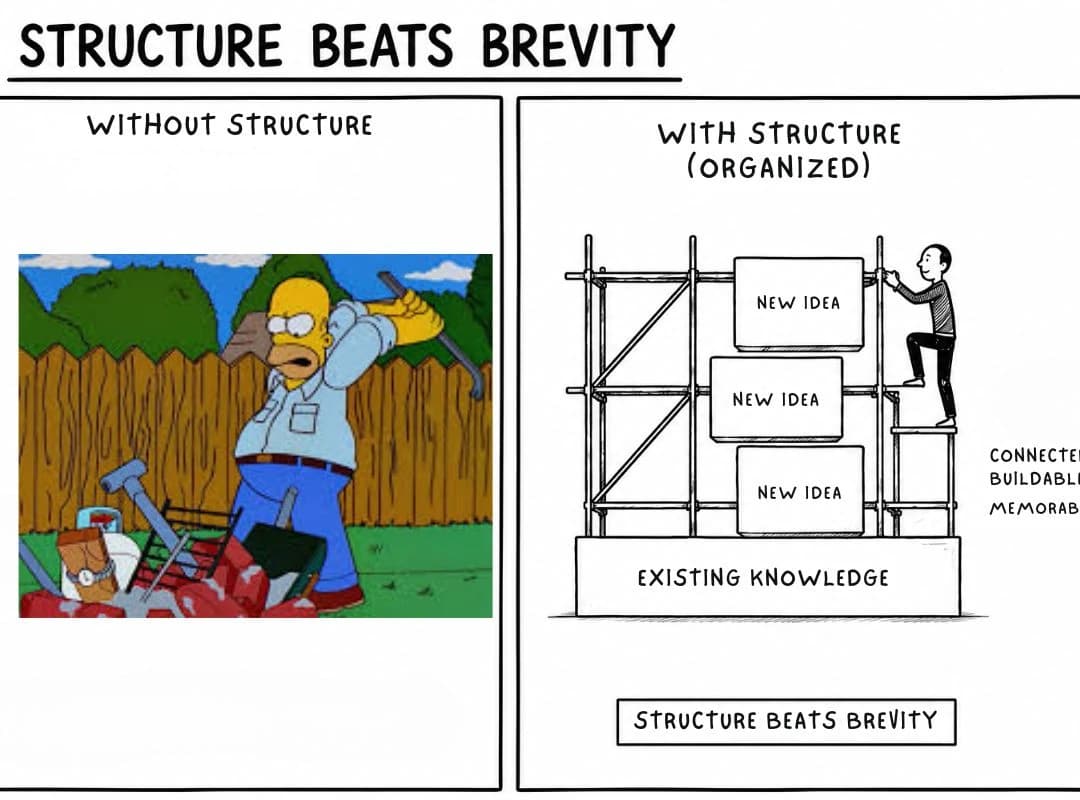
13. Mind Maps, Concept Maps and Dual Coding: How Visual Scaffolds Reduce Cognitive Load
Gwo-Jen Hwang, Li-Hsueh Yang, and Sheng-Yuan Wang tested a concept-map-embedded educational computer game in an elementary natural-science course in 2013. Compared with conventional game-based learning, integrating concept maps improved learning achievement, reduced cognitive load, and increased perceived usefulness, demonstrating that visual organization can alter both performance and the cognitive conditions under which learning occurs. ([ScienceDirect][12])
| Audience / Industry / Use Case | Research Finding → Your Next Rep                                                                                                                                                                                                                                                               |
| ------------------------------ | ---------------------------------------------------------------------------------------------------------------------------------------------------------------------------------------------------------------------------------------------------------------------------------------------- |
| Elementary science education   | Embedding concept maps into the butterfly-ecology game improved learning achievement while reducing cognitive load. **Concept mapping**, **visual scaffolding**, and **cognitive load** worked as an organizational layer.                                                                     |
| Digital learning platforms     | Students using the concept-map game also reported higher perceived usefulness than the conventional game condition. The result connects **visual organization**, **learning strategy**, and learner acceptance, supporting interfaces where relationships are visible during problem solving.  |
| Corporate knowledge systems    | The study integrated mapping directly into the learning activity rather than presenting a finished graphic as decoration. A knowledge platform can use **nodes**, **relationships**, and retrieval prompts as part of the learning operation and evaluate both performance and cognitive load. |
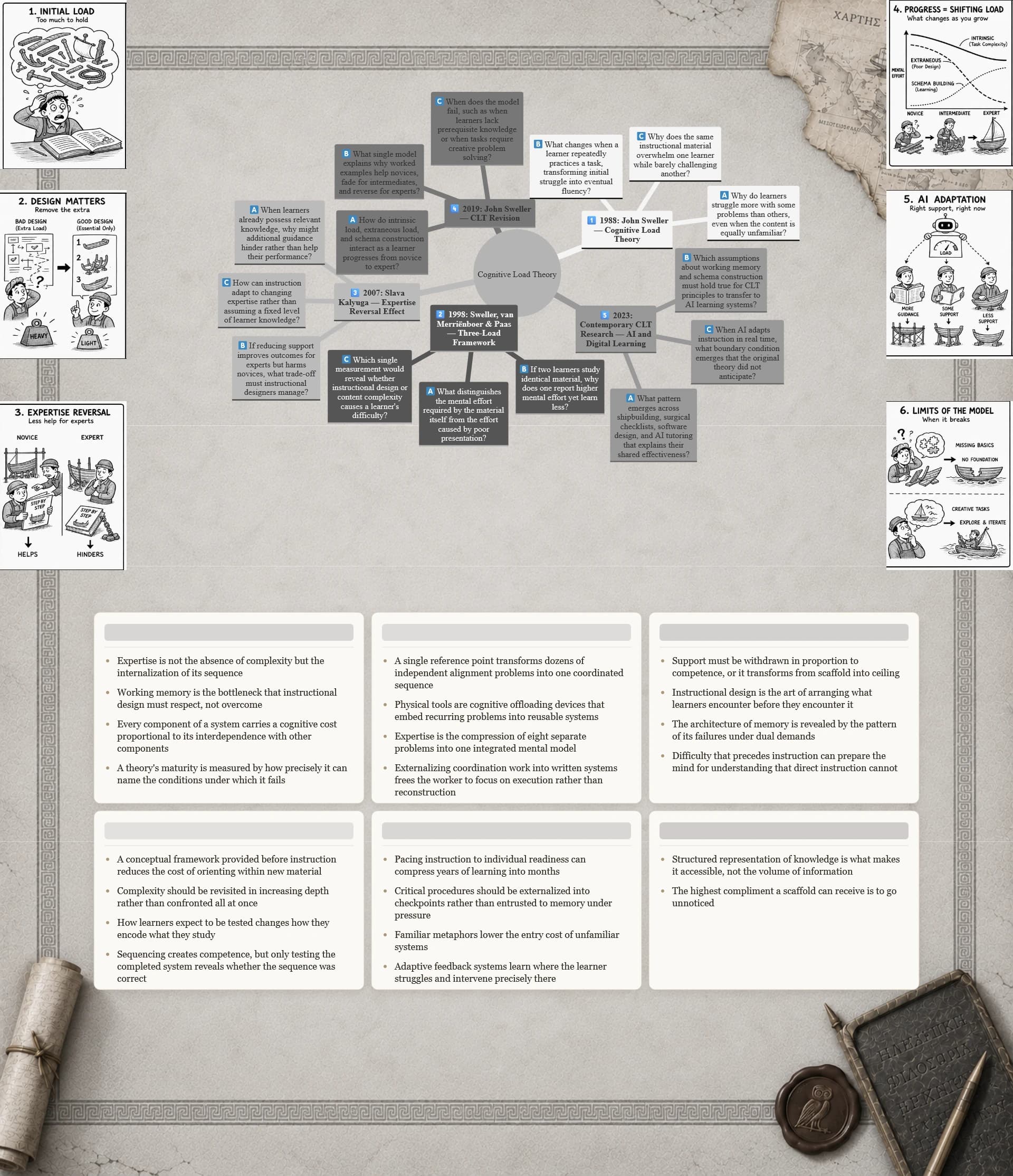
14. Can You Overuse Generation? Prior Knowledge as Critical Moderator and Expertise Reversal Effect
Ron J. C. M. Salden, Vincent Aleven, Rolf Schwonke, and Alexander Renkl tested adaptive fading of worked examples in a Cognitive Tutor across a laboratory study and a real classroom study with high-school geometry learners. Adaptive fading based on learner performance outperformed fixed fading and pure problem solving in the laboratory on immediate and delayed tests, while the classroom reproduced the advantage on the delayed test but not the immediate test. ([DOI][13])
| Audience / Industry / Use Case | Research Finding → Your Next Rep                                                                                                                                                                                                                                                      |
| ------------------------------ | ------------------------------------------------------------------------------------------------------------------------------------------------------------------------------------------------------------------------------------------------------------------------------------- |
| Mathematics tutoring           | Adaptive fading produced higher immediate and delayed performance than fixed fading or pure problem solving in the laboratory. **Expertise reversal**, **worked examples**, and **schema acquisition** support reducing guidance as demonstrated competence increases.                |
| Vocational education           | The classroom experiment reproduced the adaptive-fading benefit on the delayed test but not the immediate test. The finding demonstrates that **expertise**, **guidance**, and **retention interval** interact, so immediate performance alone can conceal instructional differences. |
| Intelligent tutoring systems   | The tutor estimated individual understanding and used those estimates to decide when worked-out steps should become open problems. This operationalizes **adaptive scaffolding**, **knowledge tracing**, and **generation** as a learner-specific control loop.                       |
15. What Subjects Benefit Most? Mathematics, Medical Education, Language Learning, Programming and Law
Steven C. Pan and Faria Sana compared pretesting and posttesting across five experiments involving 1,573 participants learning expository passages through multiple-choice or cued-recall tests. Both approaches improved later memory relative to no testing, while pretesting retained an advantage across test formats, feedback conditions, and five-minute versus 48-hour retention intervals, with enhanced processing of passage content proposed as the explanation. ([PubMed][14])
| Audience / Industry / Use Case | Research Finding → Your Next Rep                                                                                                                                                                                                                                                                                             |
| ------------------------------ | ---------------------------------------------------------------------------------------------------------------------------------------------------------------------------------------------------------------------------------------------------------------------------------------------------------------------------- |
| University subject teaching    | Across five experiments, both pretesting and posttesting improved memory for expository text relative to no-test controls. **Generation**, **retrieval practice**, and **test-potentiated learning** apply beyond vocabulary tasks to content-heavy academic instruction.                                                    |
| Professional certification     | The pretesting advantage survived multiple-choice and cued-recall formats and remained visible at both five-minute and 48-hour tests. The finding supports using **prequestions** before dense instructional content when the goal is durable retrieval.                                                                     |
| Online technical training      | Corrective feedback was present in some experiments and absent in others without eliminating the pretesting advantage. This suggests that **errorful generation**, **feedback**, and **content processing** can operate across different training architectures, with delayed criterial tests providing the outcome measure. |
16. Spaced Repetition, Flashcards, Feynman Technique or Generation: Best Evidence-Based Study Technique?
Steven C. Pan and Faria Sana directly compared pretesting, an errorful-generation procedure, with posttesting, a retrieval-practice procedure, across five experiments with 1,573 participants. Both methods improved learning relative to no testing, while pretesting produced higher overall scores across test formats, feedback conditions, and retention intervals, showing that generation and retrieval practice are complementary mechanisms rather than evidence for a single universal study method. ([PubMed][14])
| Audience / Industry / Use Case | Research Finding → Your Next Rep                                                                                                                                                                                                                                                                                                      |
| ------------------------------ | ------------------------------------------------------------------------------------------------------------------------------------------------------------------------------------------------------------------------------------------------------------------------------------------------------------------------------------- |
| Exam preparation               | Both pretesting and posttesting improved later memory over no testing, establishing that active retrieval before and after study can strengthen learning. **Generation**, **retrieval practice**, and **delayed retention** belong in the same study architecture.                                                                    |
| Corporate learning programs    | Pretesting remained competitive with posttesting across multiple-choice and cued-recall formats and across retention intervals. Training can place **prequestions** before new material and **retrieval practice** afterward, then evaluate performance on a delayed criterial test.                                                  |
| Learning-platform design       | Experiments with and without feedback showed that the pretesting benefit survived changes in feedback conditions and appeared linked to enhanced processing of passage content. A platform can combine **errorful generation**, **feedback**, and **spaced retrieval** while measuring actual retention instead of perceived fluency. |
17. Glossary Strategy for Medicine, Nursing, Engineering, Law and Language Learning
In 1982, Isabel Beck, Charles Perfetti and Margaret McKeown at the University of Pittsburgh taught 27 fourth-graders 104 words across five months and tested semantic decisions, sentence verification and connected-text memory against matched controls. The instructed students outperformed controls across all three tasks, showing that systematic terminology instruction improved both word knowledge and the efficiency with which learned words were processed during comprehension. ([Reading Rockets][1])
| Audience / Industry / Use Case         | Research Finding → Your Next Rep                                                                                                                                                                                                                                                                                                                                            |
| -------------------------------------- | --------------------------------------------------------------------------------------------------------------------------------------------------------------------------------------------------------------------------------------------------------------------------------------------------------------------------------------------------------------------------- |
| **Medical and nursing education**      | **Semantic decisions:** Students receiving long-term vocabulary instruction performed significantly better when making semantic decisions about taught words. **Terminology + semantic memory + conceptual encoding** connected the word form to its meaning strongly enough to support faster semantic processing; terminology assessment should test meaning recognition. |
| **Engineering and technical training** | **Sentence verification:** The instructed group also performed significantly better when judging sentences containing taught vocabulary. This demonstrates how **conceptual encoding + semantic memory + elaborative interrogation** can move terminology from isolated glossary knowledge into usable propositions about mechanisms and systems.                           |
| **Law and language learning**          | **Connected-text memory:** The vocabulary group performed significantly better when remembering connected text containing taught words. The finding links **terminology → semantic memory → comprehension**, making domain vocabulary most useful when learners repeatedly retrieve terms inside meaningful passages.                                                       |
18. What Does a Good Session Look Like? Concept Framework + Elicit-Compare-Instruct Module
In 2007, Bethany Rittle-Johnson of Vanderbilt University and Jon Star randomly assigned 70 seventh-graders to learn algebra equation solving either by comparing alternative methods or by reflecting on methods sequentially. Comparison produced greater gains in procedural knowledge and flexibility, while conceptual-knowledge gains were comparable, demonstrating that comparison particularly strengthened coordination and selection among alternative procedures. ([DOI][2])
| Audience / Industry / Use Case        | Research Finding → Your Next Rep                                                                                                                                                                                                                                                                                                                                                              |
| ------------------------------------- | --------------------------------------------------------------------------------------------------------------------------------------------------------------------------------------------------------------------------------------------------------------------------------------------------------------------------------------------------------------------------------------------- |
| **Secondary-school mathematics**      | **Procedural knowledge:** Students who compared alternative equation-solving methods made greater procedural gains than students who studied the same methods sequentially. **Concept integration + organizational processing + relational learning** made structural differences between procedures visible; compare methods before formal instruction to strengthen procedural acquisition. |
| **University quantitative education** | **Flexibility:** The comparison group showed greater flexibility in solving equations. **Schema construction + relational learning + semantic networks** connected procedures through their underlying relationships, making flexibility a measurable outcome alongside ordinary correctness.                                                                                                 |
| **Professional technical training**   | **Conceptual knowledge boundary:** Both groups achieved comparable conceptual gains despite the comparison group's procedural advantage. This separates **conceptual integration** from procedural flexibility and shows why a good session should measure both what a learner understands and which method the learner selects for a given problem.                                          |
19. Adaptive AI Tutor + Personalized Path: Best Prompts, Schedules and Scaffolding
In 2001, Gregory Aist, Jack Mostow and colleagues at Carnegie Mellon evaluated Project LISTEN's computer tutor against one-to-one human tutoring and classroom instruction across 144 second- and third-graders. ([Robotics Institute Publications][3]) Among third-graders, computer tutoring improved word-comprehension gains over classroom instruction with an effect size of 0.56, while human tutoring produced an effect size of 0.72 and did not differ significantly from computer tutoring on that outcome. ([Robotics Institute Publications][4])
| Audience / Industry / Use Case            | Research Finding → Your Next Rep                                                                                                                                                                                                                                                                                                                                  |
| ----------------------------------------- | ----------------------------------------------------------------------------------------------------------------------------------------------------------------------------------------------------------------------------------------------------------------------------------------------------------------------------------------------------------------- |
| **AI literacy and language platforms**    | **Word comprehension:** Third-graders using the computer tutor showed greater word-comprehension gains than classroom controls, with an effect size of 0.56. **AI tutors + adaptive feedback + learning analytics** converted ongoing learner interaction into targeted assistance with a measurable vocabulary outcome.                                          |
| **Corporate learning platforms**          | **Human–computer comparison:** Human tutoring produced an effect size of 0.72 and computer tutoring 0.56, with no significant difference between them for third-grade word comprehension. **Personalized learning + adaptive feedback + AI personalization** have empirical support for this outcome while preserving human tutoring as the comparison benchmark. |
| **Reading and language-learning systems** | **Grade-level boundary:** Second-graders showed no significant treatment differences in word-comprehension gains, whereas third-graders showed significant advantages for both tutoring conditions over classroom instruction. **Knowledge tracing + adaptive difficulty + learning analytics** require learner-level and outcome-level measurement.              |
20. How to Score Depth? Explanation Quality Rubric for Causal Accuracy
In 1994, Michelene Chi, Nicholas De Leeuw, Mei-Hung Chiu and Christian Lavancher studied 14 eighth-graders who self-explained each line of a circulatory-system passage while 10 controls reread the same material without explanation prompts. The prompted group achieved greater pretest-to-posttest gains, while high explainers showed stronger understanding, correct mental models and success on questions requiring implicit functional inference. ([Wiley Online Library][5])
| Audience / Industry / Use Case        | Research Finding → Your Next Rep                                                                                                                                                                                                                                                                                                        |
| ------------------------------------- | --------------------------------------------------------------------------------------------------------------------------------------------------------------------------------------------------------------------------------------------------------------------------------------------------------------------------------------- |
| **Medical education**                 | **Overall learning gain:** Prompted self-explanation produced greater pretest-to-posttest improvement than rereading. **Explanation quality + elaboration depth + concept integration** transformed reading into active integration of new information with existing knowledge; evaluate explanations alongside factual answers.        |
| **Science and engineering education** | **Mental-model accuracy:** Every high-explaining student achieved the correct circulatory-system mental model, whereas many low explainers and unprompted students did not. **Causal accuracy + relational accuracy + concept integration** provide a deeper signal than isolated factual correctness.                                  |
| **AI explanation-scoring systems**    | **Implicit inference:** High explainers performed better when asked to infer the function of a component that was only implicitly described. **Explanation quality + causal accuracy + elaboration depth** support scoring whether an explanation reconstructs relationships, with novel inference providing the measurable depth test. |
21. Can It Replace Flashcards? Transfer Assessment for Exams and Novel Problems
In 1980, Mary Gick and Keith Holyoak investigated analogical problem solving across five experiments in which participants attempted Duncker's radiation problem after encountering a structurally related military problem. ([ScienceDirect][6]) Transfer increased when participants were prompted to use the analogy, declined when the source problem was substantially disanalogous, and was supported when participants first generated their own solution to the source problem. ([ScienceDirect][7])
| Audience / Industry / Use Case          | Research Finding → Your Next Rep                                                                                                                                                                                                                                                                                                                                       |
| --------------------------------------- | ---------------------------------------------------------------------------------------------------------------------------------------------------------------------------------------------------------------------------------------------------------------------------------------------------------------------------------------------------------------------- |
| **Professional certification**          | **Hinted transfer:** Participants who read the military problem and its solution tended to generate an analogous solution to the radiation problem when given a hint to use the story. **Transfer performance + conceptual understanding + knowledge transfer** require tests where learners must recognize and apply a previously learned structure to a new problem. |
| **University science education**        | **Surface mismatch:** Transfer frequency fell when the military problem was substantially disanalogous to the radiation problem, even though its solution corresponded to an effective radiation solution. **Near transfer + far transfer + relational learning** require deliberately varied surface features while preserving or testing the underlying structure.   |
| **Engineering and management training** | **Self-generated solution:** Participants who first solved the military problem themselves subsequently generated analogous radiation solutions. **Problem solving + reconstruction + knowledge transfer** make productive generation itself part of transfer preparation; measure whether learners can reconstruct the principle before applying it elsewhere.        |
22. For Teachers: Instructional Design Dashboard That Surfaces Depth
In 1984, Lynn Fuchs, Stanley Deno and Phyllis Mirkin randomly assigned 39 special educators to repeated curriculum-based measurement or conventional evaluation across an 18-week implementation, with each educator working with three or four pupils. The measurement group produced greater student achievement, more realistic and responsive instructional decisions, greater changes in instructional structure, and students who were more aware of their goals and progress. ([DOI][8])
| Audience / Industry / Use Case        | Research Finding → Your Next Rep                                                                                                                                                                                                                                                                                                                       |
| ------------------------------------- | ------------------------------------------------------------------------------------------------------------------------------------------------------------------------------------------------------------------------------------------------------------------------------------------------------------------------------------------------------ |
| **Special-education leadership**      | **Student achievement:** Repeated curriculum-based measurement produced greater achievement than conventional evaluation. **Instructional design + assessment analytics + curriculum development** became an intervention loop because progress information entered instructional decisions repeatedly.                                                |
| **School instructional coaches**      | **Decision responsiveness:** Teachers using repeated measurement made decisions that showed greater realism and responsiveness to student progress. **Assessment analytics + educational psychology + teacher strategies** connect measurement quality to instructional decision quality, making responsiveness itself an observable coaching outcome. |
| **Learning-platform analytics teams** | **Learner awareness:** Students whose teachers used repeated measurement showed greater awareness of their goals and progress. **Learning analytics + instructional design + assessment analytics** support dashboards that expose trajectory and goal state alongside achievement, with learner awareness becoming an additional measurable outcome.  |
23. Does It Really Work? Meta-Analysis, Effect Sizes, Classroom Trials and Future AI Research
In 2021, Gregory Donoghue and John Hattie at the University of Melbourne synthesized 242 studies, 1,619 effects and 169,179 participants across ten learning techniques. The overall mean effect was 0.56, with distributed practice and practice testing among the strongest techniques, while the synthesis also revealed substantial variation across techniques and outcomes. ([Frontiers][9])
| Audience / Industry / Use Case              | Research Finding → Your Next Rep                                                                                                                                                                                                                                                                                                            |
| ------------------------------------------- | ------------------------------------------------------------------------------------------------------------------------------------------------------------------------------------------------------------------------------------------------------------------------------------------------------------------------------------------- |
| **University learning-design teams**        | **Evidence scale:** The synthesis combined 242 studies, 1,619 effects and 169,179 unique participants, producing an overall mean effect of 0.56. **Meta-analysis + effect sizes + confidence intervals + replication** turn scattered intervention results into an evidence base suitable for comparing learning techniques quantitatively. |
| **Schools and corporate learning programs** | **Technique strength:** Distributed practice produced a large pooled effect of d = 0.85, while practice testing was also classified among the strongest techniques. **Spacing effect + testing effect + desirable difficulties** justify delayed assessments as a core outcome.                                                             |
| **AI learning-research platforms**          | **Evidence boundary:** The meta-analysis found substantial heterogeneity across techniques and highlighted the importance of moderators and outcome types. **Learning analytics + optimal prompt design + AI-generated explanations + replication** require evaluation across delayed retention, conceptual outcomes and transfer.          |
Mortar Matters
The villa still stands in the metaphor because someone mixed mortar, not because someone took photographs.
Karpicke & Blunt (2011) gave the numbers: retrieval alone beats mapping alone, but rebuilding from memory beats both. That is elaborative retrieval — old stones, new mortar, standing wall.
Photographs have their uses. Just do not live in them.