What Is the ICAP Framework? Measuring Learning by What Learners Actually Do
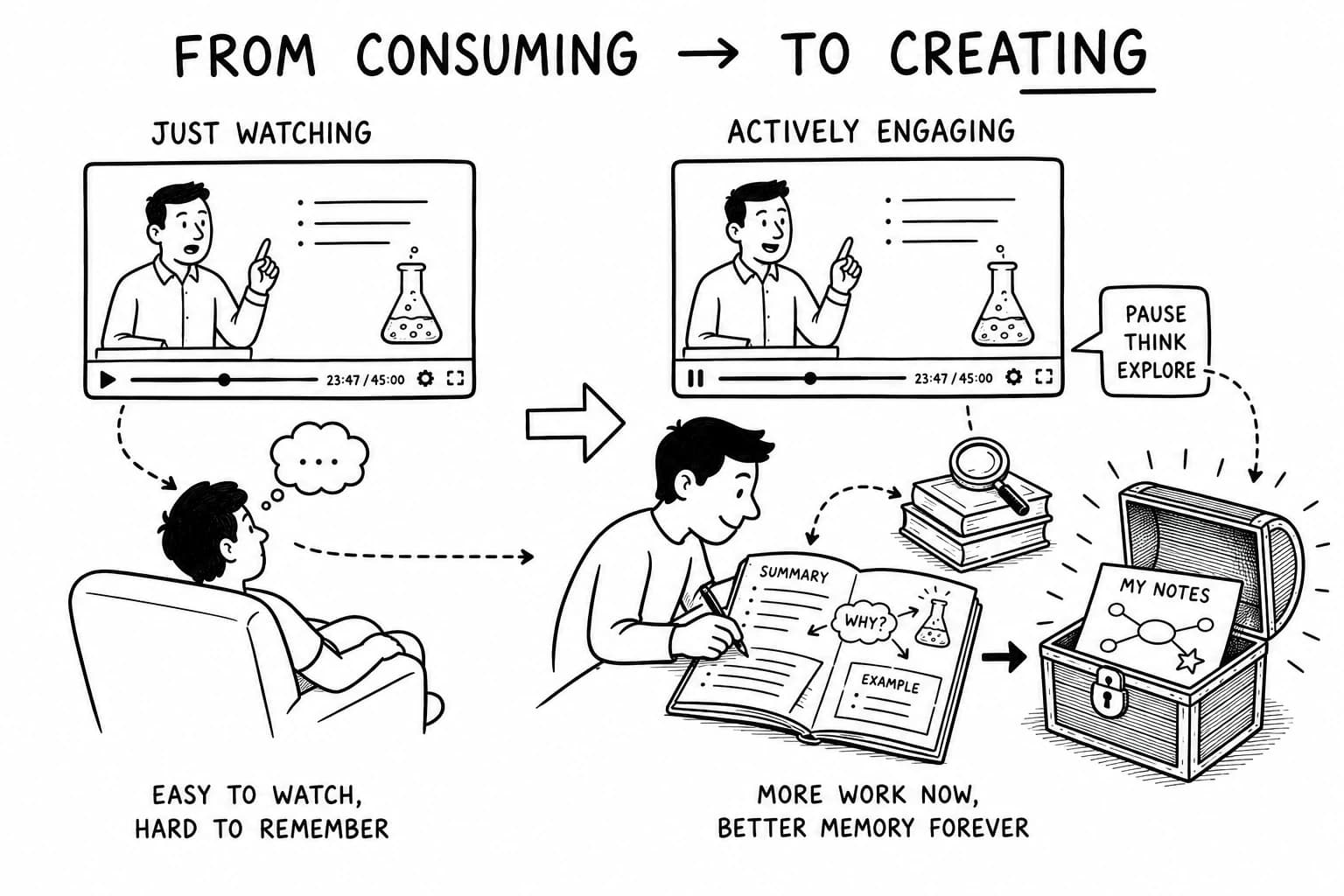
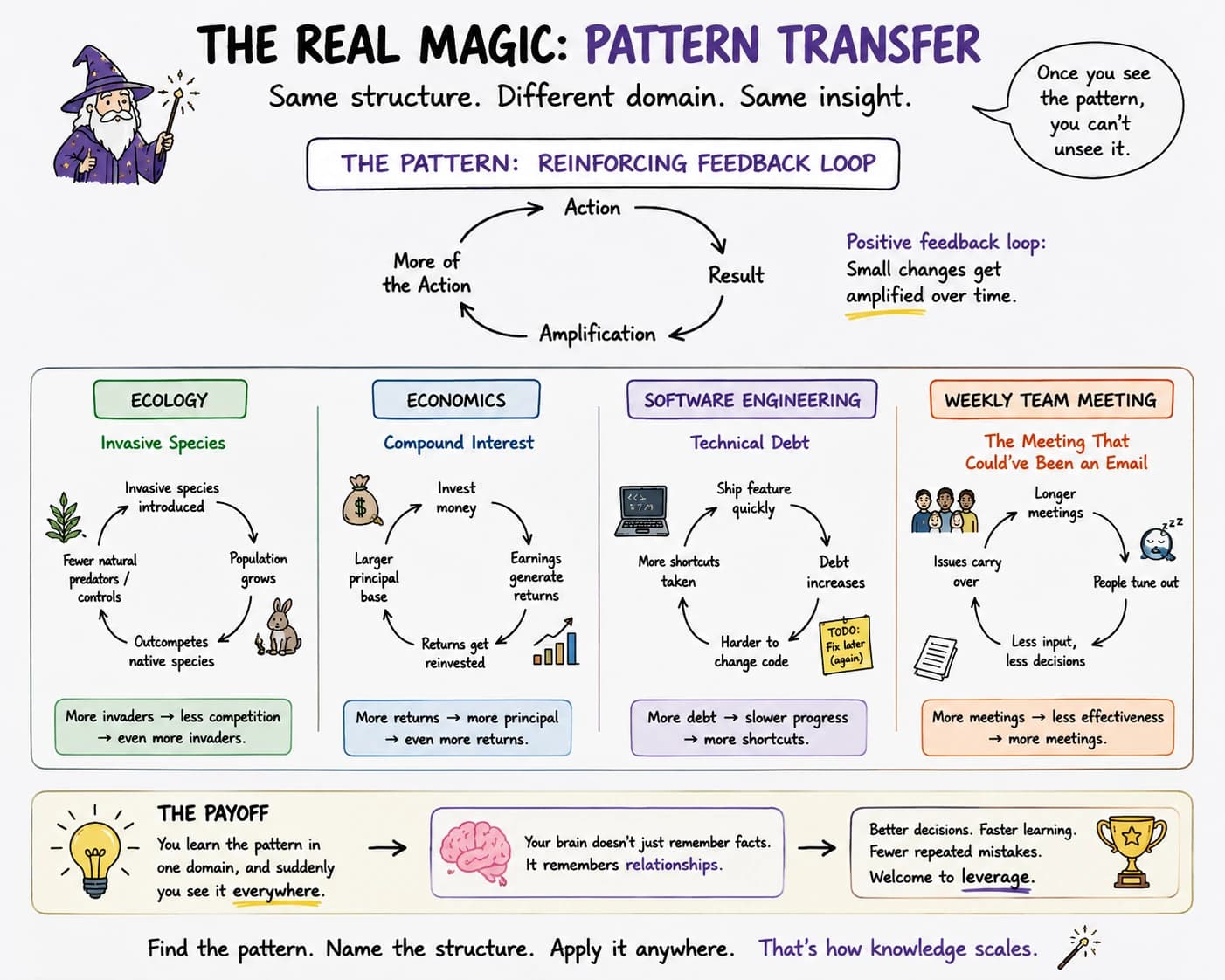
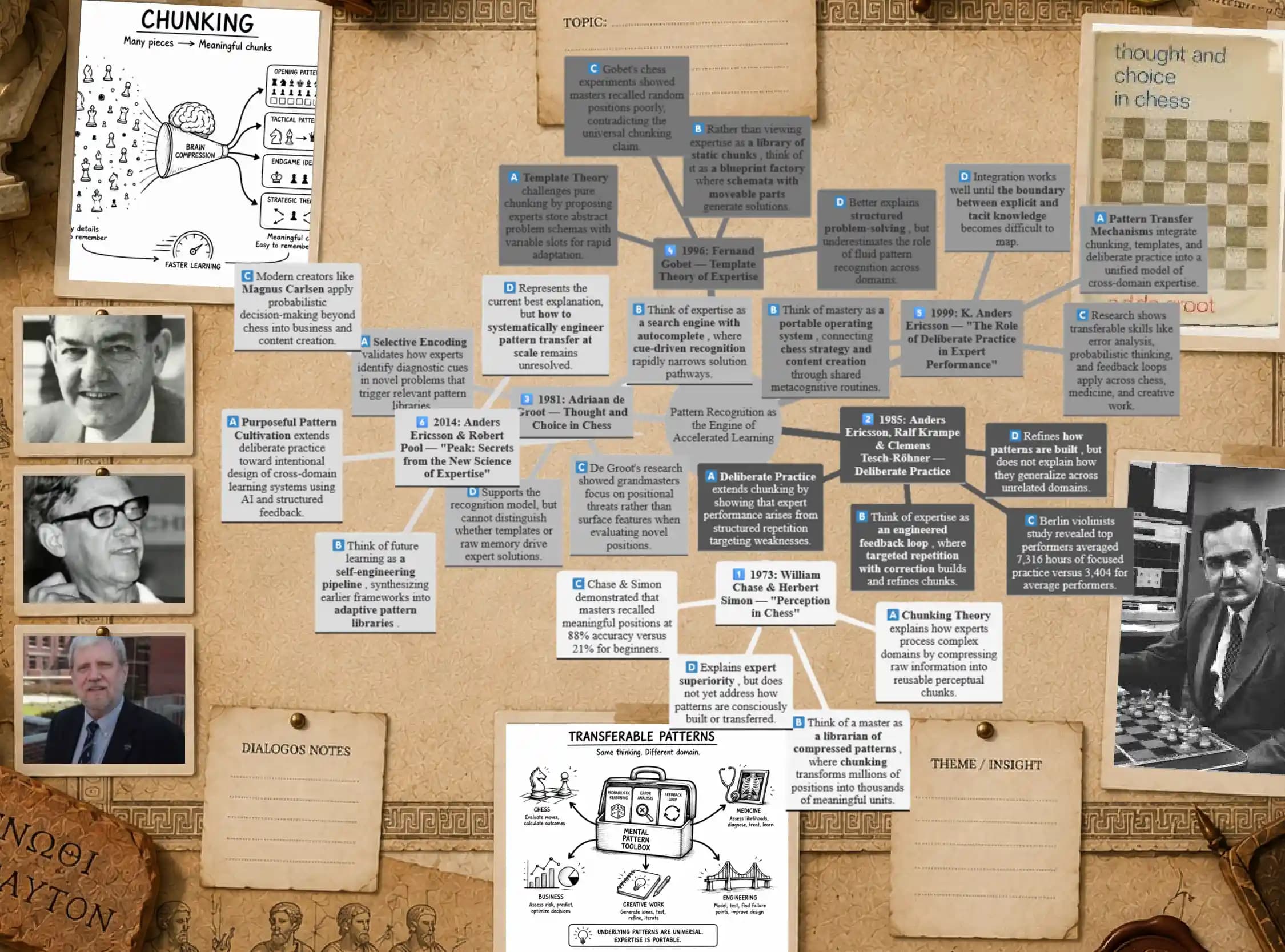
For centuries, classrooms judged learning by silence. A room full of attentive faces looked like success because attention was visible while understanding remained invisible. Medieval universities prized careful listening and faithful copying; modern classrooms inherited much of the same assumption. In 2014, Michelene Chi and Ruth Wylie challenged that tradition with the ICAP Framework, arguing that the best predictor of learning is not what information reaches the learner, but what the learner visibly does with it. Their hierarchy—Interactive > Constructive > Active > Passive—turned engagement from a vague feeling into an observable, research-based model for active learning, instructional design, educational psychology, and AI-powered learning systems. ICAP asks whether they generated ideas, extended another person's reasoning, or merely consumed information.
Passive Learning Collects Information. Active Learning Manipulates It.
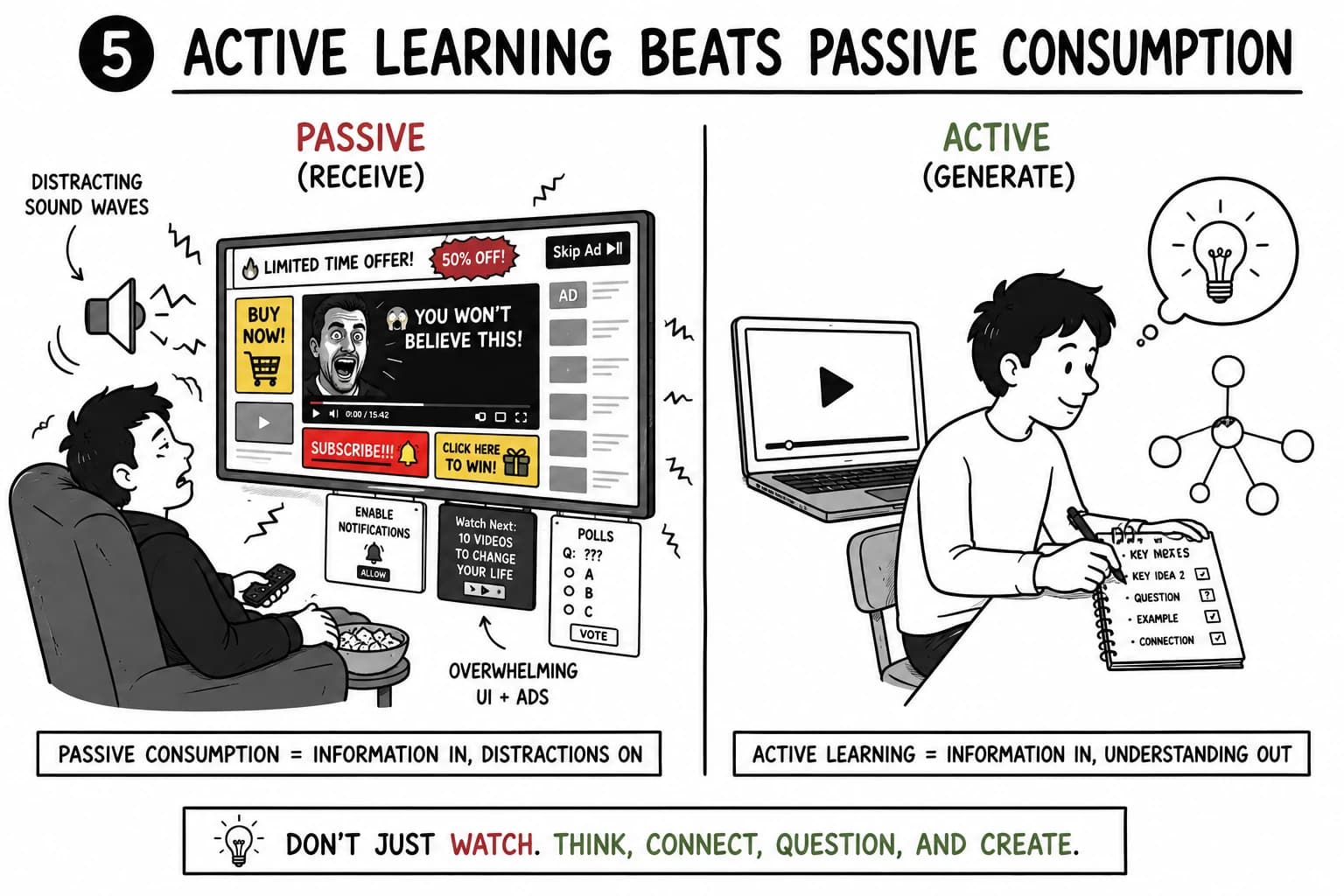
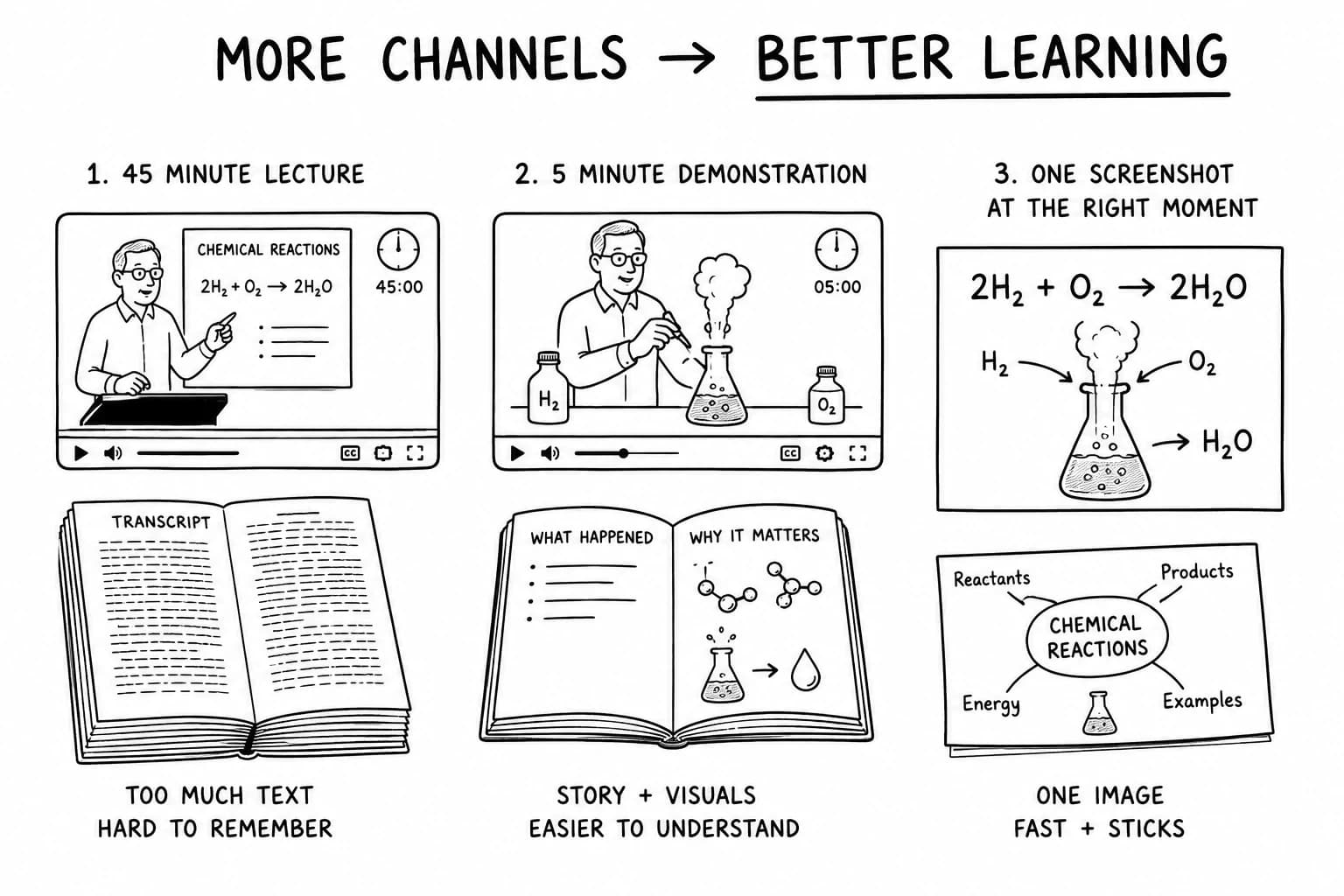
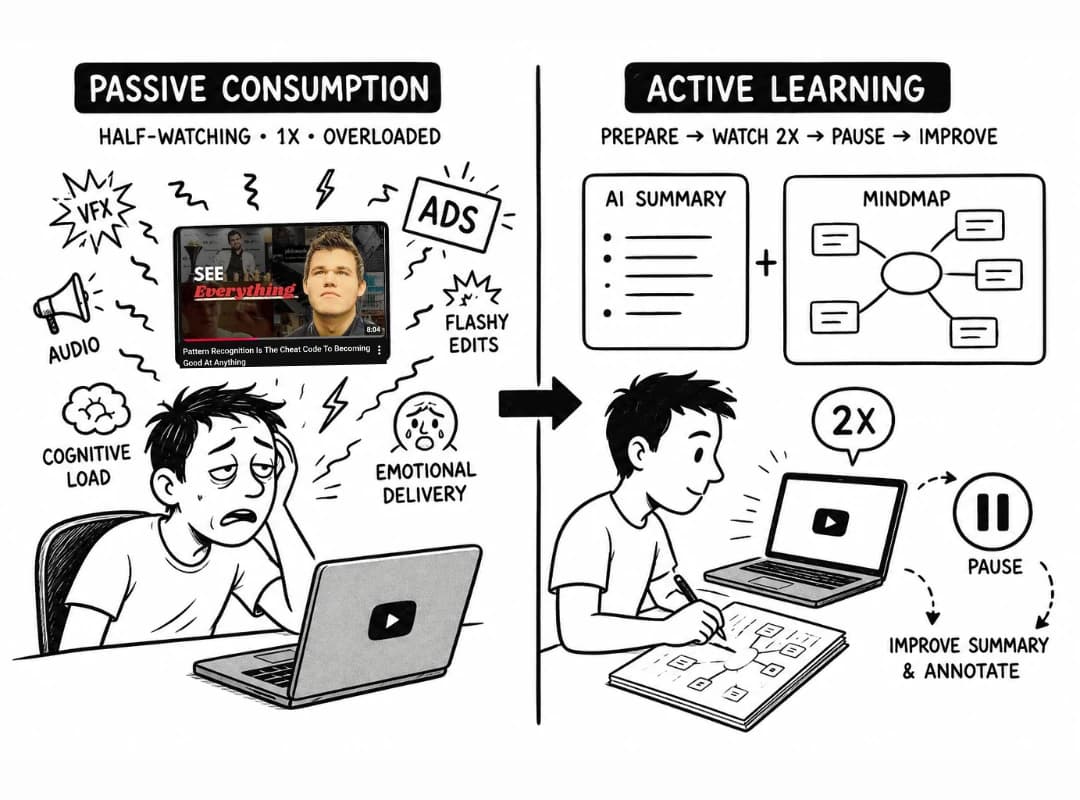
The lowest two levels describe familiar classroom behavior. Passive learning includes reading, watching lectures, or consuming an AI-generated summary without producing anything new. Active learning adds physical manipulation—highlighting, annotating, clicking through mind maps, expanding knowledge graphs, or copying notes—but still stays close to the original material. Both increase exposure, yet neither guarantees the learner has constructed understanding. Within online learning, educational technology, and learning management systems (LMSs), many popular features remain Active because interaction is mistaken for thinking.
Constructive Learning Generates New Meaning
The framework changes dramatically at the Constructive level. Here learners produce something absent from the original instruction: predictions, explanations, summaries, analogies, questions, diagrams, or causal links. These activities activate schema construction, prior knowledge integration, knowledge elaboration, self-explanation, and meaning making, making constructive learning the practical bridge between Generative Learning Theory, the Generation Effect, and modern AI learning assistants. Research from Michelene Chi, Merlin Wittrock, and Richard Mayer consistently shows that generating explanations and predictions produces deeper conceptual understanding, stronger knowledge retention, and better transfer of learning than simply manipulating instructional materials.
Interactive Learning Builds Knowledge That Neither Partner Could Produce Alone
At the highest level, learners construct ideas together. Genuine interactive learning is more than conversation; each contribution extends the previous one until a new explanation emerges. This is the domain of collaborative learning, peer instruction, Socratic dialogue, and increasingly AI tutoring systems that respond directly to a learner's reasoning rather than delivering predetermined answers. A modern ChatGPT learning assistant reaches Interactive mode only when it builds upon the learner's prediction, challenges misconceptions with targeted prompts, and guides revision through dialogue.
Why ICAP Matters for AI Education and Instructional Design
The framework provides an engineering blueprint as much as a learning theory. Most educational products optimize convenience by moving information quickly from model to learner. ICAP suggests reversing that direction. Effective AI education, adaptive learning systems, personalized learning, and instructional design begin by eliciting predictions, explanations, and questions before revealing answers. In practice, this means replacing answer-first interfaces with Socratic prompting, AI-generated prediction tasks, knowledge scaffolding, and adaptive feedback. Designers can evaluate learning quality by identifying the highest ICAP level their product consistently produces.
ICAP Framework Historical Timeline
| Period / Milestone | Research & Historical Development | Core Contribution | ICAP Level or Related Concept | Modern AI & Educational Design Implication |
|---|---|---|---|---|
| Medieval Universities (11th–13th centuries) | Lectures, dictation, manuscript copying dominate higher education | Learning primarily measured through faithful reception | Passive | Highlights why information delivery alone rarely guarantees understanding |
| 1989 | Chi et al. introduce the Self-Explanation Effect | Learners who explain worked examples outperform readers | Constructive | AI tutors should ask learners to explain reasoning before revealing solutions |
| 1994 | Chi et al. demonstrate elicited self-explanations improve comprehension | Generated explanations strengthen understanding and transfer | Constructive | Prediction prompts, explanation prompts, and reflective questioning become evidence-based instructional tools |
| 2009 | Chi proposes an early engagement taxonomy | Distinguishes manipulation from genuine knowledge generation | Passive → Active → Constructive | Lays conceptual foundation for modern adaptive learning systems |
| 2013 | Menekse et al. compare classroom engagement modes | Constructive activities outperform merely Active participation | Active vs Constructive | Interactive digital lessons should require idea generation rather than navigation |
| 2014 | Chi & Wylie publish the ICAP Framework | Formal hierarchy: Interactive > Constructive > Active > Passive | Complete ICAP Model | Becomes a practical framework for instructional design, EdTech, learning analytics, and AI tutoring |
| Present | AI tutors, LLMs, adaptive learning platforms | Dialogue, prediction, and feedback become observable engagement mechanisms | Interactive | AI should function as a collaborative reasoning partner rather than an answer generator |
| Future Research | AI-assisted learning, educational data mining, adaptive tutoring, learning analytics | Measure engagement through observable learner behaviors instead of interface activity | Interactive + Constructive | AI systems can dynamically detect engagement level and adapt prompts to move learners upward through the ICAP hierarchy |
The evidence behind the ICAP Framework consistently points in the same direction: Interactive > Constructive > Active > Passive for learning outcomes, although the strongest empirical support lies in the Constructive > Active comparison rather than the full hierarchy. Across educational psychology, learning sciences, and instructional design research, constructive learning reliably improves conceptual understanding, deep learning, knowledge retention, long-term retention, problem solving, critical thinking, academic performance, and both near transfer and far transfer. ICAP predicts that the quality of observable learner behavior determines how well knowledge is constructed. Supporting evidence comes from component studies rather than a single ICAP meta-analysis: self-explanation versus passive reading commonly produces large effects (approximately d ≈ 0.8–1.2), while studies comparing constructive learning with merely active learning consistently show superior transfer and understanding. In practical terms, an effect size near 0.8 moves the average learner close to the 79th percentile, although classroom effect sizes and online learning implementations generally shrink once time-on-task and real instructional constraints are controlled.
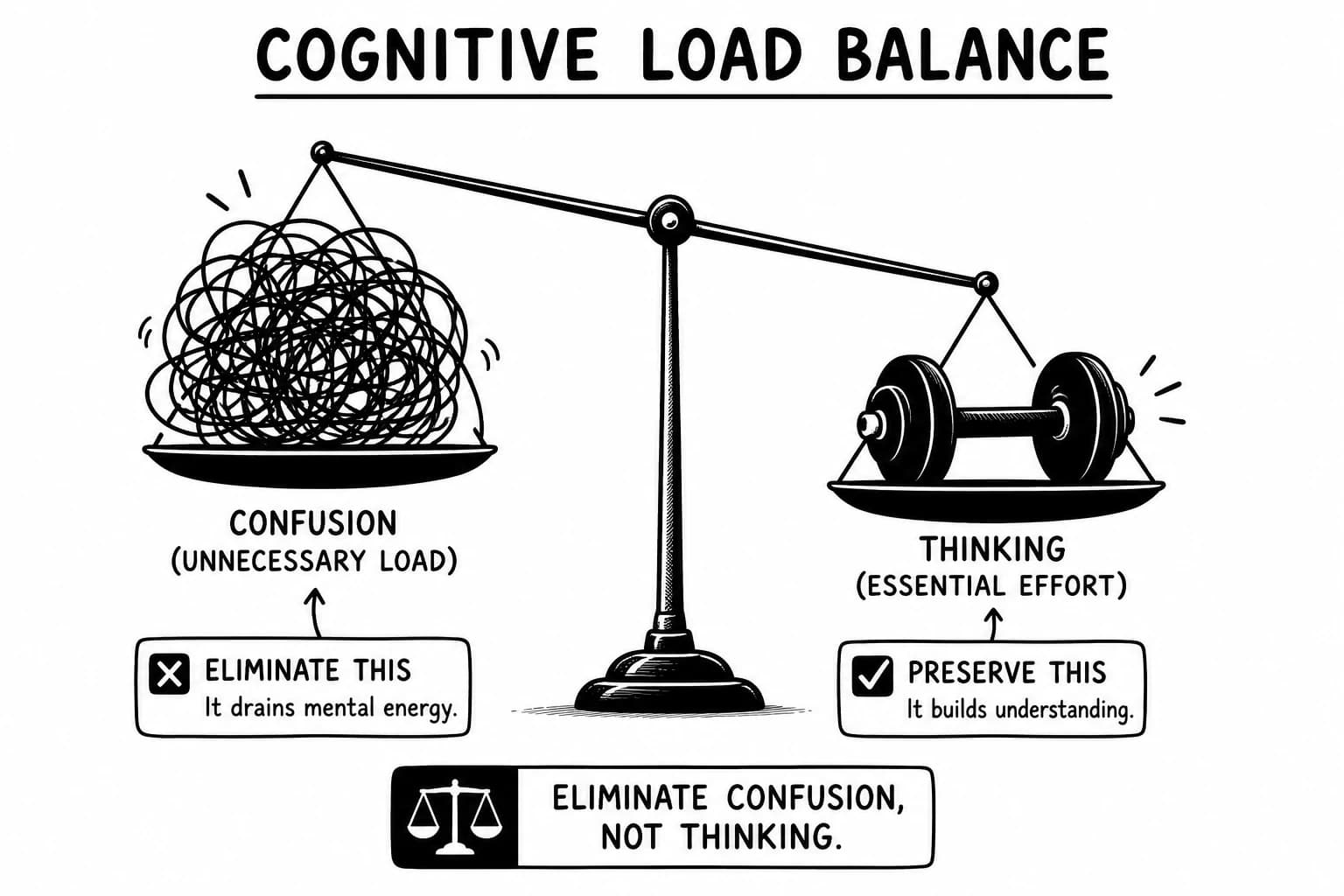
The size of the advantage depends less on the framework itself than on how learning activities are designed. Interactive learning and constructive learning benefits grow when learners explain ideas, generate predictions, resolve misconceptions, and are assessed on transfer rather than memorization. Gains become smaller when instruction focuses on factual recall, tasks require only manipulation, or activities remain at the Active learning level through highlighting, navigation, or annotation without inference. Moderator variables such as prior knowledge, task complexity, assessment alignment, and available study time explain much of the observed heterogeneity, while relatively few direct Interactive vs. Constructive comparisons leave wider confidence intervals and possible publication bias around the highest tier. For digital learning, online education, AI learning assistants, and advance organizers, the design implication is straightforward: passive video watching establishes the baseline, clickable mind maps and knowledge graphs reach Active engagement, prediction prompts, self-explanation, and question generation elevate learners into Constructive processing, and only sustained co-constructive dialogue with peers or AI tutoring systems achieves the Interactive level that ICAP predicts will produce the deepest and most durable learning.
Factors, Rivals, and Evidence at a Glance
Is ICAP Evidence-Based? How Constructive Learning Beats Passive Reading
Alison King, a professor of educational psychology at California State University San Marcos, reported a 1994 classroom study in which fourth- and fifth-grade pupils learned science through paired self-generated questioning and explanation, comparing lesson-only questions with questions that also activated prior knowledge. The prior-knowledge condition produced more complex knowledge construction and stronger comprehension, directly supporting constructive activity over passive exposure. ([Sage Journals][1])
| Audience / Industry / Use Case        | Research Finding → Your Next Rep                                                                                                                                                                                                                                                                                                                             |
| ------------------------------------- | ------------------------------------------------------------------------------------------------------------------------------------------------------------------------------------------------------------------------------------------------------------------------------------------------------------------------------------------------------------ |
| **Secondary-school science teachers** | Pairs trained to generate and answer questions produced more complex knowledge construction than controls; self-explanation and elaboration transformed lesson material into connected representations. Use generated questions rather than exposure as the core activity, then assess comprehension with knowledge maps and post-lesson questions.          |
| **Teacher-training programs**         | Questions linking new science content to prior knowledge produced more complex verbal interaction and knowledge maps than lesson-internal questions alone, showing that constructive processing benefits from schema activation. Build prompts that require learners to connect new concepts with existing explanations and measure resulting comprehension. |
| **Educational technology platforms**  | Both questioning conditions induced complex knowledge construction, while prior-knowledge prompts produced the stronger effect, demonstrating that generation quality matters within Constructive engagement. Replace passive summaries with prompts requiring learners to generate explanations and connections before receiving system feedback.           |
How Do Teachers Use ICAP? Constructive vs Active vs Passive Examples
Pam Mueller and Daniel Oppenheimer, then researchers at Princeton University and UCLA, reported three 2014 experiments comparing university students taking lecture notes by laptop or longhand, including tests of conceptual learning, verbatim transcription, and delayed study. Laptop users wrote substantially more words yet performed worse on conceptual questions, while longhand note-taking reduced transcription and improved conceptual and application performance. ([DOI][2])
| Audience / Industry / Use Case         | Research Finding → Your Next Rep                                                                                                                                                                                                                                                                 |
| -------------------------------------- | ------------------------------------------------------------------------------------------------------------------------------------------------------------------------------------------------------------------------------------------------------------------------------------------------ |
| **University lecturers**               | Across three studies, laptop note-takers performed worse on conceptual questions despite producing more notes, showing that greater Active output can coexist with shallower processing. Require paraphrase, explanation and inference during note-taking when conceptual understanding matters. |
| **Corporate L&D teams**                | Laptop users produced substantially greater verbatim overlap with lectures across all three studies, linking transcription to reduced processing. Training systems should capture learner-generated reformulation instead of treating note volume as evidence of Constructive engagement.        |
| **Medical and professional education** | When learners received time to study their notes, longhand-plus-study produced higher overall performance than the alternative conditions, including a conceptual/application advantage and a factual advantage. Pair note generation with retrieval or review.                                  |
What Is Interactive Learning? Why Peer Instruction Beats Q-and-A
Michelle Smith, William Wood, Wendy Adams, Carl Wieman and colleagues reported a 2009 undergraduate genetics experiment in which students answered conceptual questions individually, discussed them with peers, revoted, and then answered isomorphic questions; discussion improved subsequent performance even when nobody in the group initially knew the correct answer. The result supports genuine Interactive knowledge construction rather than simple peer influence. ([ResearchGate][3])
| Audience / Industry / Use Case     | Research Finding → Your Next Rep                                                                                                                                                                                                                                                                                                   |
| ---------------------------------- | ---------------------------------------------------------------------------------------------------------------------------------------------------------------------------------------------------------------------------------------------------------------------------------------------------------------------------------- |
| **University biology instructors** | Correct responses increased after peer discussion, demonstrating that exchanging reasoning can change conceptual understanding rather than merely redistribute correct answers. Use an individual prediction → peer explanation → revote sequence so Interactive engagement becomes observable.                                    |
| **STEM peer-instruction programs** | Among students initially wrong who became correct after discussion, 77% answered the later isomorphic question correctly, showing transfer of the newly constructed understanding across surface changes. Assess a second problem.                                                                                                 |
| **AI tutoring platforms**          | Students learned even when no discussion participant initially possessed the correct answer, indicating that the productive mechanism lay in reasoning during dialogue rather than answer transmission. Evaluate whether each AI turn extends the learner's prior reasoning and whether that reasoning transfers to a new problem. |
How to Use Prior Knowledge with ICAP? Diagnosis, Scaffolding and ZPD Guide
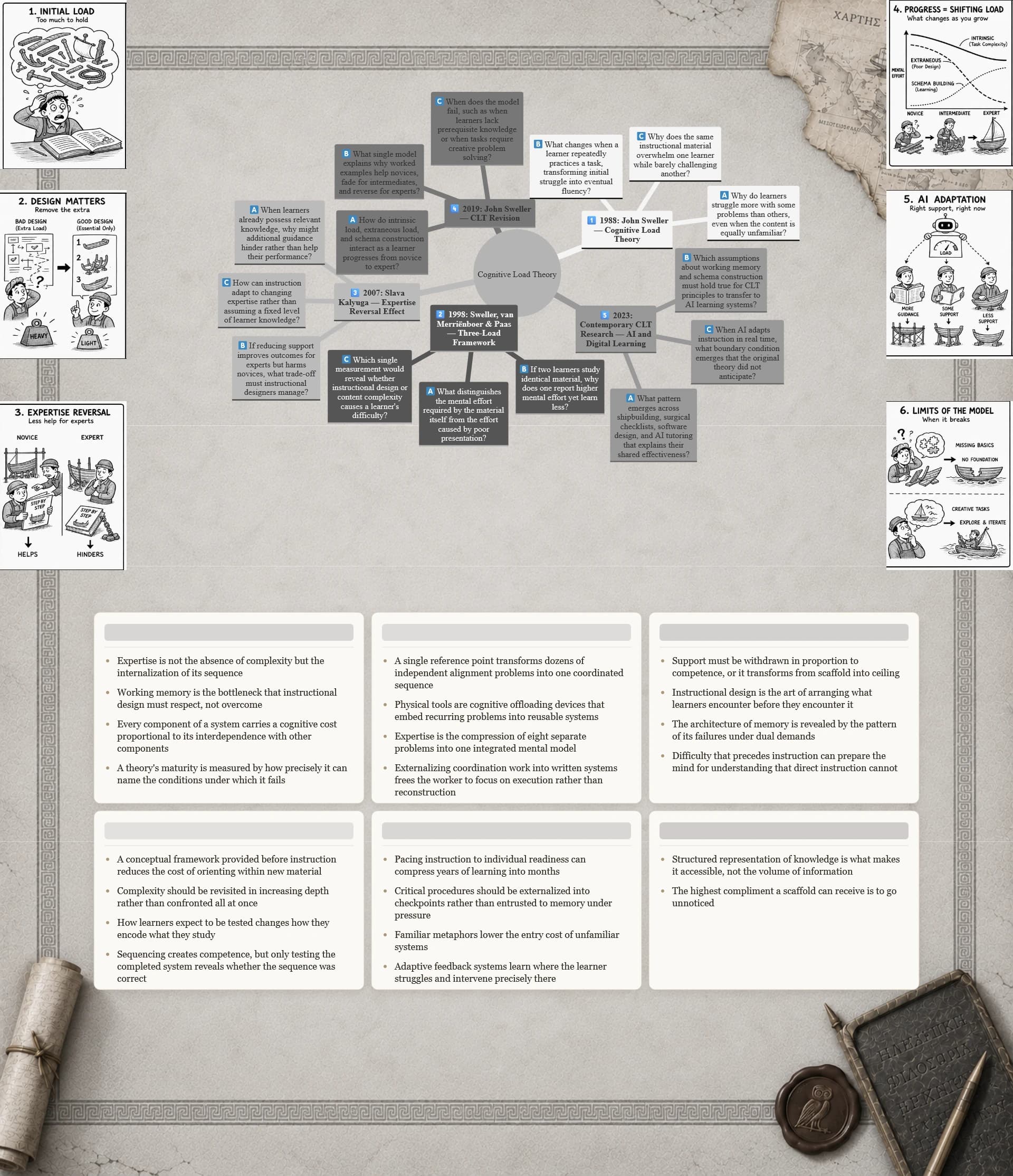
Jana Reisslein, Robert Atkinson, Patrick Seeling and Martin Reisslein reported a 2006 computer-based electrical-circuit study comparing example–problem, problem–example and fading sequences across low- and high-prior-knowledge learners. The instructional procedures showed an expertise reversal pattern: low-knowledge learners benefited most from example–problem sequencing, whereas high-knowledge learners benefited most from problem–example sequencing. ([ResearchGate][4])
| Audience / Industry / Use Case       | Research Finding → Your Next Rep                                                                                                                                                                                                                                                                                                  |
| ------------------------------------ | --------------------------------------------------------------------------------------------------------------------------------------------------------------------------------------------------------------------------------------------------------------------------------------------------------------------------------- |
| **Introductory engineering courses** | Low-prior-knowledge learners benefited most from example–problem sequencing, showing how prior knowledge changes the value of Constructive problem solving under cognitive load. Diagnose prerequisite knowledge before asking novices to generate solutions independently.                                                       |
| **Advanced engineering courses**     | High-prior-knowledge learners benefited most from problem–example sequencing, demonstrating an expertise-dependent reversal in instructional efficiency. Shift toward generation before comparison once schemas are sufficiently developed.                                                                                       |
| **Adaptive learning systems**        | No overall difference emerged among example–problem, problem–example and fading procedures, while their effectiveness varied by prior knowledge, making learner diagnosis more informative than a universal sequence. Use prior-knowledge estimates to select scaffolding intensity and evaluate performance by learner subgroup. |
ICAP vs Cognitive Load Theory: When Active Beats Constructive for Novices
Gabriele Cierniak, Katharina Scheiter and Peter Gerjets conducted a 2009 2×2 study with 60 university students learning nephron physiology using integrated or separated text-picture formats while eye movements and cognitive-load ratings were recorded. Low-prior-knowledge learners performed better with integrated material, while viewing behavior supported active text-picture integration more strongly than the proposed extraneous-load account. ([ResearchGate][5])
| Audience / Industry / Use Case         | Research Finding → Your Next Rep                                                                                                                                                                                                                                                                                                                          |
| -------------------------------------- | --------------------------------------------------------------------------------------------------------------------------------------------------------------------------------------------------------------------------------------------------------------------------------------------------------------------------------------------------------- |
| **Medical educators**                  | Low-prior-knowledge learners performed better with integrated text-picture material on labeling and complex-fact tests, while high-prior-knowledge learners showed no corresponding disadvantage. Reduce extraneous load through integrated scaffolding before demanding open Constructive generation.                                                    |
| **Multimedia instructional designers** | Separated-format learners spent more time viewing pictorial information and switched between pictorial areas more frequently, while integrated-format learners switched far more often between corresponding text and pictures. Spatial contiguity changes the cognitive processing path, making representation design part of cognitive-load management. |
| **Adaptive e-learning platforms**      | High-prior-knowledge learners substantially outperformed low-prior-knowledge learners across labeling, factual and inference tests, with prior knowledge explaining very large variance in baseline performance. Use prerequisite diagnosis to calibrate intrinsic load and avoid treating identical instructional formats as universally appropriate.    |
ICAP vs Levels of Processing and Dual Coding: How Deep Learning Works
Fergus Craik and Endel Tulving, psychologists at the University of Toronto, reported ten 1975 experiments in which undergraduates processed words through structural, phonemic or semantic questions before unexpected recognition or recall tests. Semantic encoding produced dramatically stronger retention, with one recognition comparison rising from 15% after case decisions to 81% after sentence decisions, establishing encoding depth as a major determinant of later memory. ([ResearchGate][6])
| Audience / Industry / Use Case           | Research Finding → Your Next Rep                                                                                                                                                                                                                                                                                          |
| ---------------------------------------- | ------------------------------------------------------------------------------------------------------------------------------------------------------------------------------------------------------------------------------------------------------------------------------------------------------------------------- |
| **Reading and study-skills programs**    | Semantic sentence judgments produced 81% recognition for yes responses versus 15% after case judgments, showing that deeper processing creates stronger encoding than surface analysis. Replace rereading with questions requiring meaning, relationships and explanation.                                                |
| **Corporate knowledge-management teams** | Across recognition and recall experiments, semantic questions consistently produced higher retention than structural processing, including incidental and intentional learning. Convert documentation consumption into retrieval prompts that require employees to interpret concepts rather than merely inspect wording. |
| **Learning-technology designers**        | In recall experiments, semantic encoding outperformed rhyme and case processing, while repeated presentation further increased performance and interacted with semantic encoding. Design learning loops that combine semantic generation with later retrieval.                                                            |
ICAP vs Generative, Inquiry and Problem-Based Learning: Which Builds Transfer?
Mary Gick and Keith Holyoak reported five 1980 experiments on analogical problem solving in which participants read a military problem and solution before attempting Duncker's radiation problem. Participants generated analogous solutions more often when given a hint to use the prior story, while transfer also depended on structural similarity and learners' ability to retrieve the relevant analogy. ([ScienceDirect][7])
| Audience / Industry / Use Case       | Research Finding → Your Next Rep                                                                                                                                                                                                                                                           |
| ------------------------------------ | ------------------------------------------------------------------------------------------------------------------------------------------------------------------------------------------------------------------------------------------------------------------------------------------ |
| **Problem-based university courses** | Participants who read a military solution could generate an analogous medical solution when prompted to use the story, demonstrating transfer through constructive mapping rather than simple exposure. Require learners to generate a hypothesis before revealing the analogous solution. |
| **Engineering design programs**      | Transfer declined when the source problem was substantially disanalogous even though its solution remained useful, showing that structural alignment matters more than superficial similarity. Present multiple varied cases and require learners to identify the shared causal structure. |
| **Professional case-based training** | Participants could retrieve a relevant story despite distractor stories, yet transfer dropped markedly without a hint to consider the analogy. Build explicit retrieval cues into case libraries and assess whether learners can apply the principle to an unfamiliar problem.             |
Does ICAP Work for Higher Education, K-12 and Corporate Training?
Scott Freeman, Sarah Eddy, Miles McDonough and colleagues published a 2014 PNAS meta-analysis of 225 studies comparing active-learning and traditional lecture formats across undergraduate STEM courses. Active learning increased examination and concept-inventory performance by 0.47 standard deviations, reduced failure risk from 33.8% to 21.8%, and showed benefits across STEM disciplines and class sizes, with the largest effects in classes of 50 or fewer. ([DOI][8])
| Audience / Industry / Use Case         | Research Finding → Your Next Rep                                                                                                                                                                                                                                      |
| -------------------------------------- | --------------------------------------------------------------------------------------------------------------------------------------------------------------------------------------------------------------------------------------------------------------------- |
| **University STEM departments**        | Across 158 studies, active learning increased examination and concept-inventory performance by 0.47 SD, approximately a 6% average score improvement. Replace lecture-dominant sessions with activities requiring learners to solve, explain or discuss during class. |
| **STEM retention programs**            | Across 67 studies, traditional-lecture courses had a failure odds ratio of 1.95, corresponding to failure rates of 33.8% versus 21.8% under active learning. Track DFW outcomes alongside assessment performance when evaluating instructional redesign.              |
| **Large and small classroom programs** | Heterogeneity analysis found active learning effective across STEM disciplines and class sizes, with the largest effects in classes of 50 or fewer. Treat class size as a moderator of effect magnitude.                                                              |
ICAP vs Bloom's Taxonomy vs Direct Instruction: Which Should You Use?
Wesley Becker and Russell Gersten evaluated the later effects of the Direct Instruction Follow Through program across five sites in a 1982 longitudinal study of low-income fifth- and sixth-grade pupils who had completed three years of first-through-third-grade instruction. Compared with local groups, graduates showed strong reading-decoding effects, consistent mathematics problem-solving and spelling effects, and retained knowledge and problem-solving skills into later grades. ([Sage Journals][9])
| Audience / Industry / Use Case                     | Research Finding → Your Next Rep                                                                                                                                                                                                                                                                                              |
| -------------------------------------------------- | ----------------------------------------------------------------------------------------------------------------------------------------------------------------------------------------------------------------------------------------------------------------------------------------------------------------------------- |
| **Elementary reading programs**                    | Fifth- and sixth-grade Follow Through graduates showed consistently strong, significant WRAT reading-decoding effects relative to local comparison groups. For foundational knowledge, explicit sequencing and cumulative practice can establish the prerequisite schemas required before higher-order Constructive activity. |
| **Elementary mathematics programs**                | The follow-up found consistent effects in mathematics problem solving alongside retained knowledge and problem-solving skills from the primary grades. Sequence Bloom objectives through explicit acquisition and later problem-solving assessment.                                                                           |
| **School systems evaluating instructional models** | Benefits extended across reading, mathematics, spelling and other academic domains, while comparison with national norms showed later losses without continued programming. Evaluate instructional models through longitudinal retention and transfer measures.                                                               |
What Is Self-Explanation? The ICAP Lineage Every Teacher Should Know
Katerine Bielaczyc, Peter Pirolli and Ann Brown at the University of California, Berkeley, reported a 1995 experiment with 24 university students who had no prior programming experience, explicitly training one group in self-explanation and self-regulation strategies while a control group received matched learning activities without explicit strategy training. The trained group increased strategic explanation use and achieved significantly greater problem-solving gains, supporting self-explanation as a causal learning strategy. ([Gwern][10])
| Audience / Industry / Use Case      | Research Finding → Your Next Rep                                                                                                                                                                                                                                                                                                                               |
| ----------------------------------- | -------------------------------------------------------------------------------------------------------------------------------------------------------------------------------------------------------------------------------------------------------------------------------------------------------------------------------------------------------------- |
| **Computer-science education**      | Explicitly trained students showed significantly greater gains in self-explanation and self-regulation than controls, while the interventions were matched for learning materials and time. Teach learners to connect concepts, examples and code.                                                                                                             |
| **Professional technical training** | Increased strategy application was accompanied by significantly greater problem-solving gains, linking self-explanation and self-regulation to performance. Require learners to articulate why an example works and monitor unresolved comprehension failures before independent problem solving.                                                              |
| **Intelligent tutoring systems**    | The experiment used the Carnegie Mellon Lisp Tutor to provide standardized programming exercises and detailed performance records, allowing strategy use to be connected with subsequent problem solving. Capture explanation quality, concept-example links and error resolution alongside task completion as measurable indicators of Constructive learning. |
ICAP in Practice: Designing Learning Experiences That Climb the Engagement Ladder
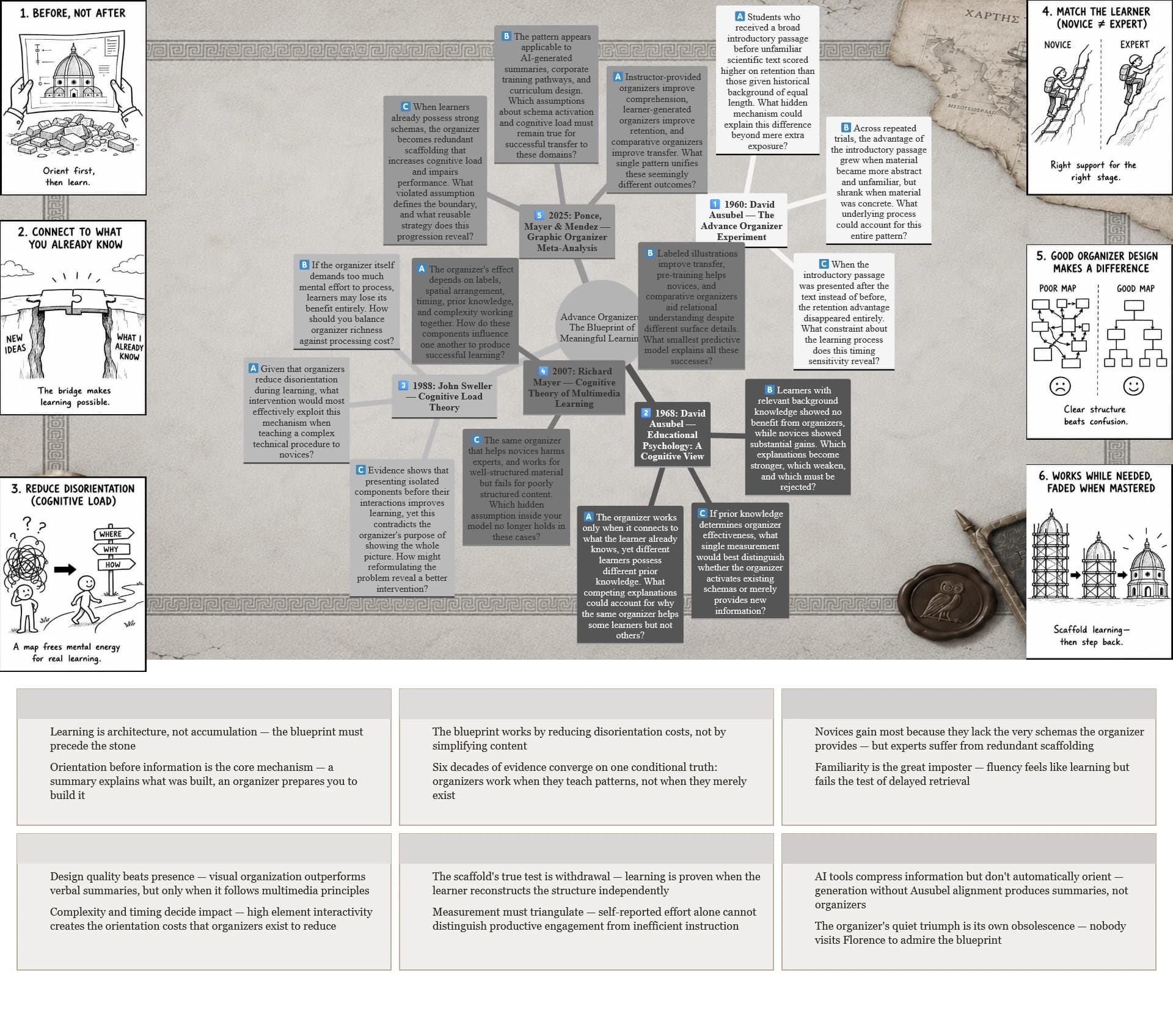
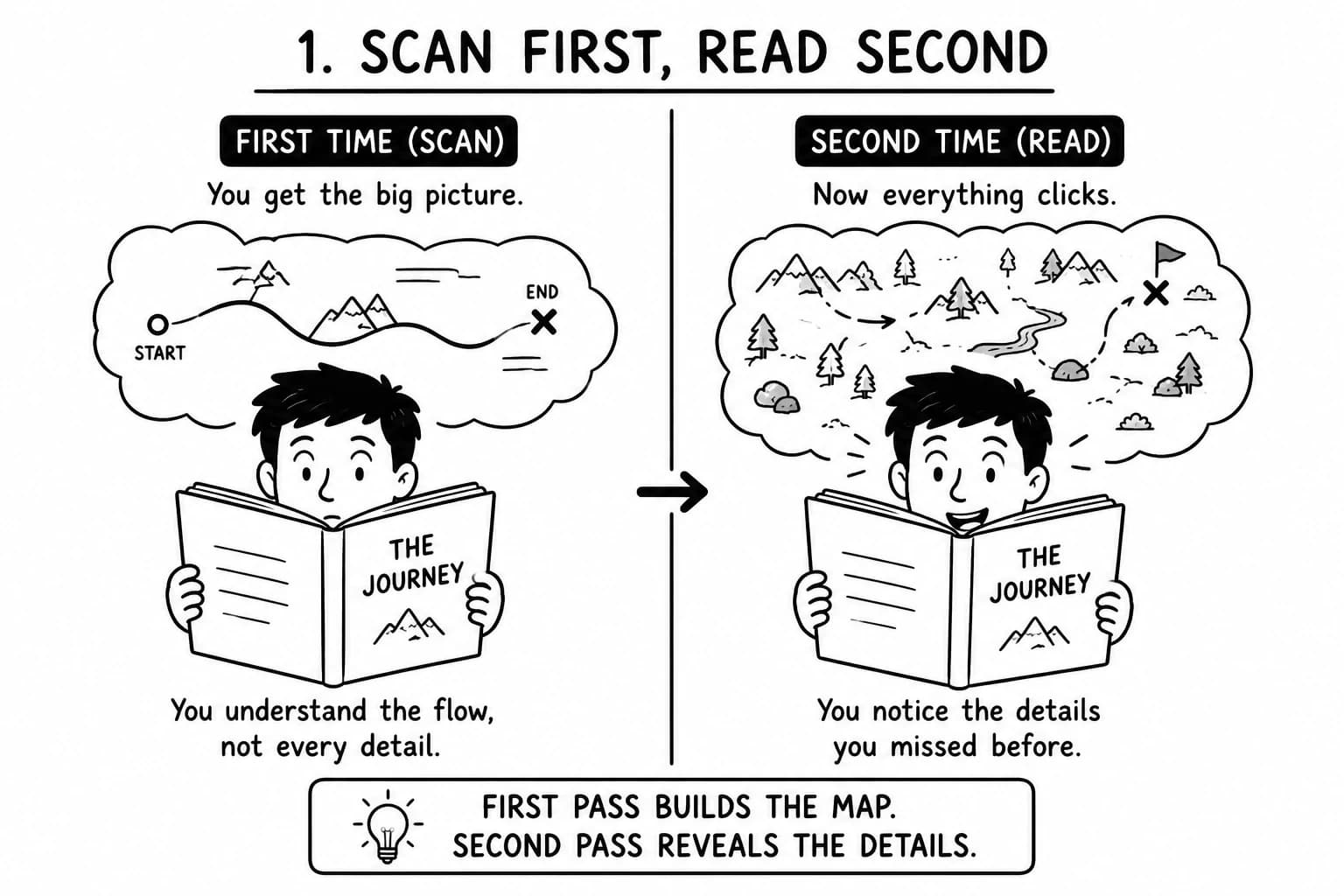
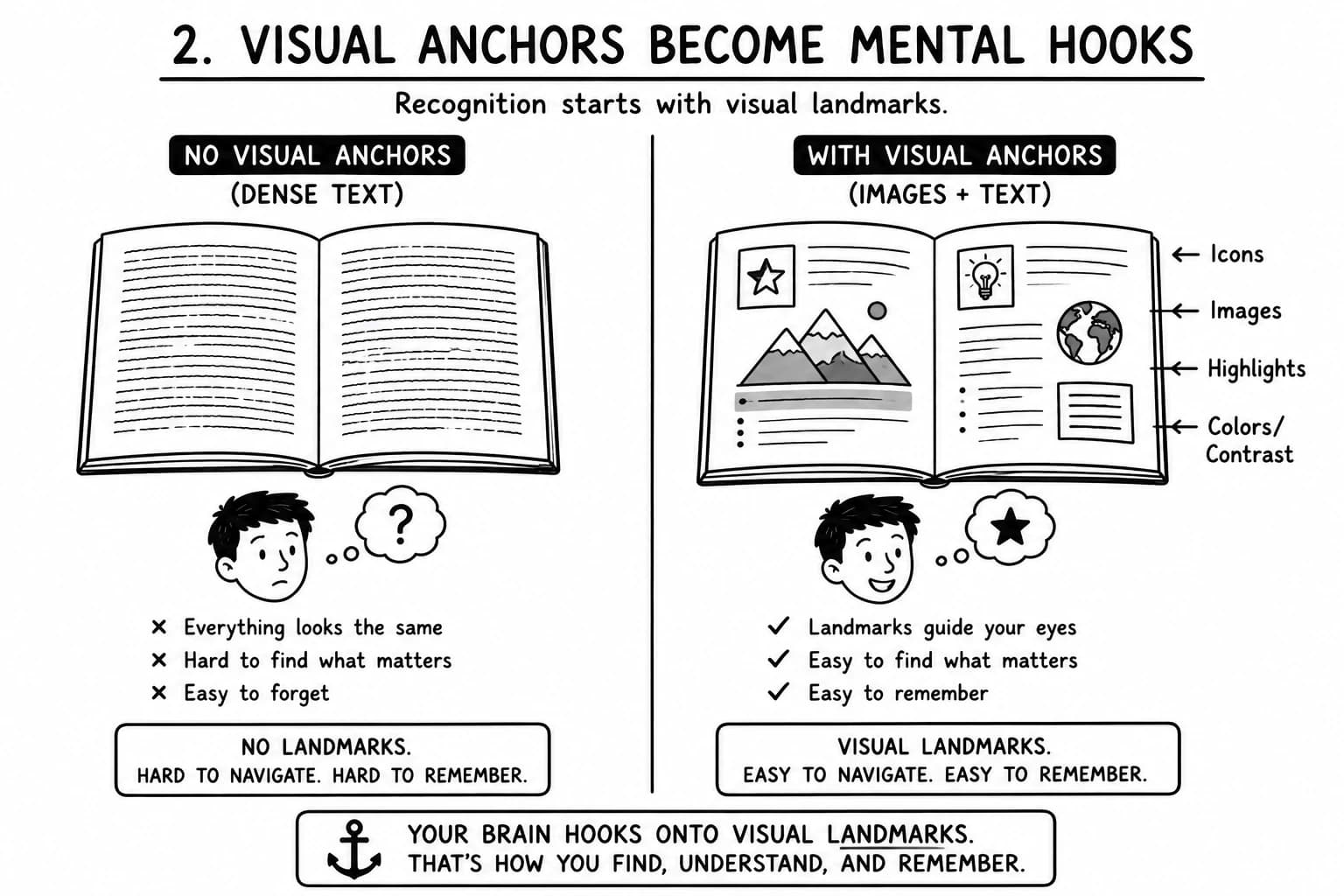
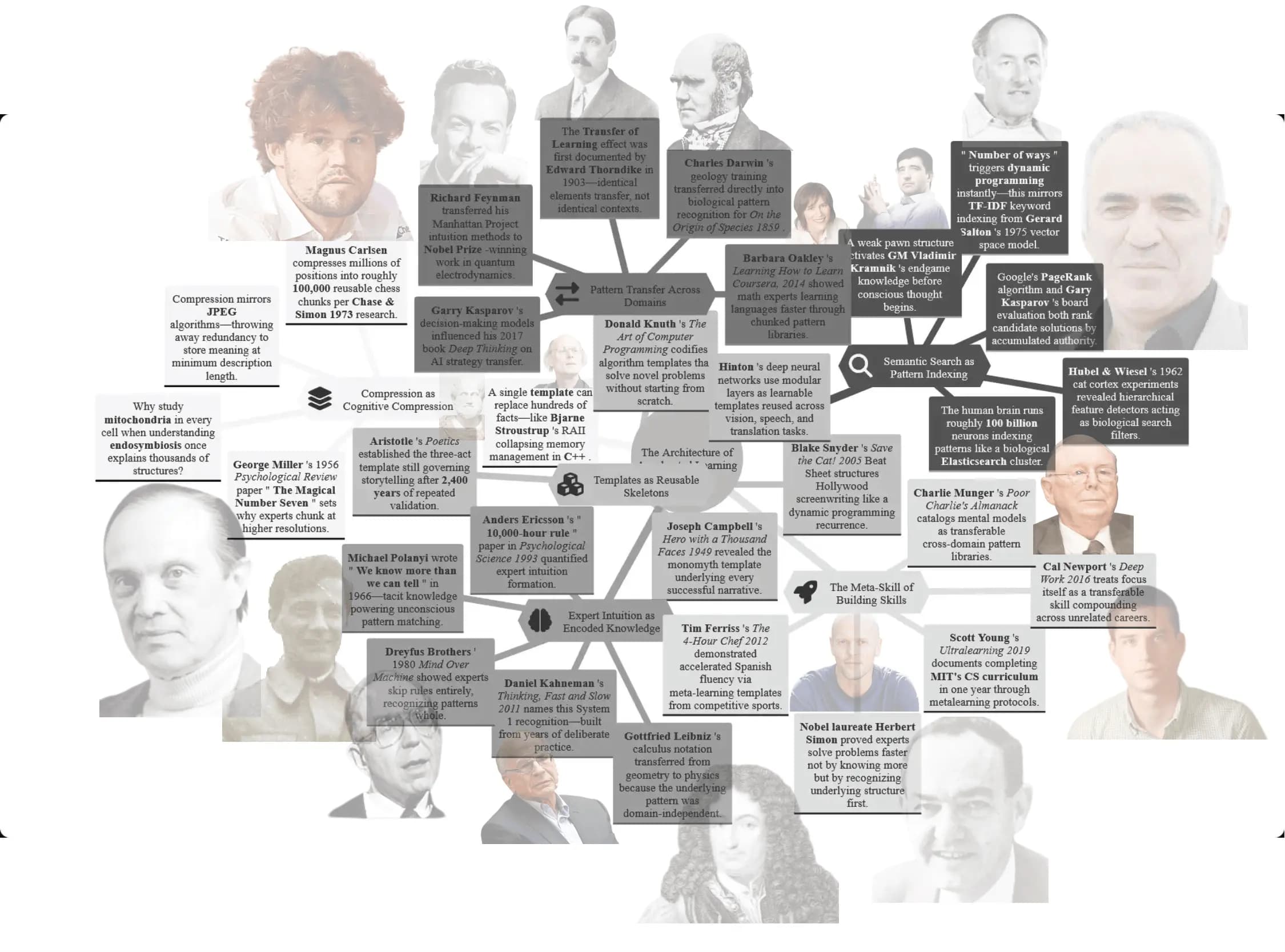
Most learning products promise interaction, but few progress beyond movement. A learner watches a summary, clicks through a mind map, expands a knowledge graph, hovers over definitions, and leaves feeling productive despite never constructing a new idea. The ICAP Framework explains why. Navigation changes behavior from Passive to Active, yet durable learning begins only when learners generate explanations, predictions, questions, or analogies that extend beyond the material itself. For AI tutors, ChatGPT for education, adaptive learning systems, and instructional design, the engineering objective is not maximizing clicks but steadily moving learners up the ICAP hierarchy—from Passive consumption, through Active manipulation, into Constructive generation, and ultimately Interactive co-construction. In this workflow, AI provides the scaffold, the learner builds the understanding, feedback repairs misconceptions, and learning analytics measure progression by the quality of thinking rather than the quantity of interactions.
ICAP Lesson Plan Template for Teachers and LMS: Moodle, Canvas and SCORM Guide
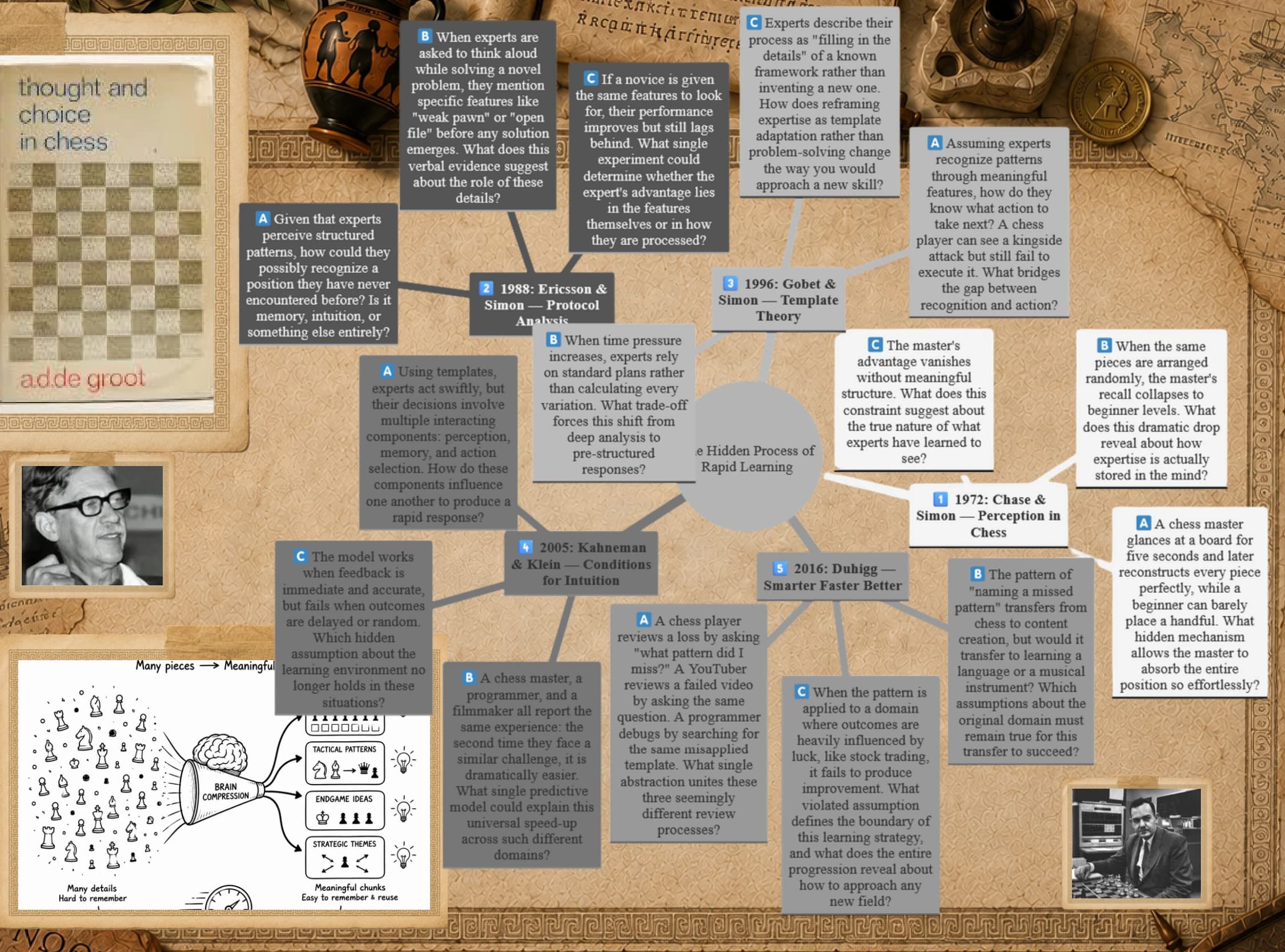
Anique de Bruin, Remy Rikers and Henk Schmidt, psychologists at Erasmus University Rotterdam, tested first-year psychology students learning a rook-and-king chess endgame through observation, prediction, or prediction plus self-explanation in a 2007 peer-reviewed study. Self-explanation produced better application of endgame principles and more successful checkmates, while prediction alone did not differ from observation, supporting constructive generation as the critical escalation beyond exposure.
| Audience / Industry / Use Case | Research Finding → Your Next Rep |
|---|---|
| Secondary-school STEM teachers | Observation → prediction: learners who predicted chess moves showed no significant advantage over observers, demonstrating that Active engagement, prediction and retrieval cues alone can leave conceptual learning unchanged; measure success with prediction accuracy. |
| Corporate LMS designers | Prediction + self-explanation: learners who generated explanations applied endgame principles more accurately during learning, linking Constructive generation, self-explanation and principled understanding; encode LMS events around explanation submission and assess principle application. |
| SCORM/xAPI competency systems | Constructive → performance: the self-explanation group checkmated the opposing king more often than prediction and observation groups, connecting success criteria, generation and transfer to an observable competency outcome; log successful task completion. |
Advance Organizers and Vocabulary for ICAP: From Passive Glossaries to Constructive Learning
Johannes Gurlitt, Sebastian Dummel, Silvia Schuster and Matthias Nückles, researchers associated with the University of Freiburg, studied 48 psychology students and 53 mathematics students using differently structured advance organizers in two experiments published in 2012. Well-structured organizers produced stronger preliminary schemata and learning outcomes, with the mathematics experiment showing beneficial effects on both near and far transfer, demonstrating that organizer structure can actively construct useful preparation for instruction.
| Audience / Industry / Use Case | Research Finding → Your Next Rep |
|---|---|
| University psychology instructors | Structure → schema: among 48 psychology students, differently structured organizers produced different proto-schemata before text study and different subsequent learning, connecting advance organizers, schema activation and constructive preparation; assess the resulting schema through sorting and post-test performance. |
| University mathematics programs | Well-structured organizers → transfer: the second experiment with 53 mathematics students found strong benefits from well-structured organizers on near and far transfer, linking vocabulary dependencies, schema construction and transfer; evaluate unfamiliar as well as practiced problems. |
| Teacher-training and curriculum teams | Organizer → proto-schema construction: the combined experiments indicated that advance organizers can help generate proto-schemata rather than merely activate existing long-term-memory concepts, connecting previewing, prior knowledge and constructive encoding; assess whether learners can organize the subsequent material before instruction. |
Mind Maps vs Concept Maps with ICAP: Active Exploring to Constructive Transfer
Eva Erdosne Toth, Daniel Suthers and Alan Lesgold investigated technology-supported scientific inquiry in a 2002 Science Education study involving graphical evidence mapping, prose representation and reflective assessment; Toth was affiliated with Carnegie Mellon University, Suthers with the University of Hawaiʻi, and Lesgold with the University of Pittsburgh. Evidence mapping outperformed prose for representing empirical relations, while reflective assessment substantially strengthened the mapping advantage, showing how external representations can make relationships available for constructive reasoning.
| Audience / Industry / Use Case | Research Finding → Your Next Rep |
|---|---|
| Secondary-school science teachers | Evidence mapping → relational reasoning: students using graphical evidence maps represented empirical relations more effectively than students using prose, connecting concept maps, relational encoding and scientific reasoning; assess the quantity and quality of evidence-based inferences in the resulting artifact. |
| Inquiry-based university courses | Mapping → discrepant evidence: classroom analyses found graphical-map users recorded more inferences and attended to more discrepant evidence than text-editor users, connecting causal links, evidence evaluation and constructive inquiry; score attention to confirming and disconfirming evidence. |
| Digital learning-platform designers | Mapping + reflection → stronger artifacts: reflective assessment enhanced the advantage of evidence mapping, connecting representational guidance, self-reflection and knowledge construction; embed criteria for evaluating evidence relationships and compare artifact quality before and after reflection. |
Are AI Summaries Bad for Learning? Turn Passive Summaries into Personal Knowledge Graphs
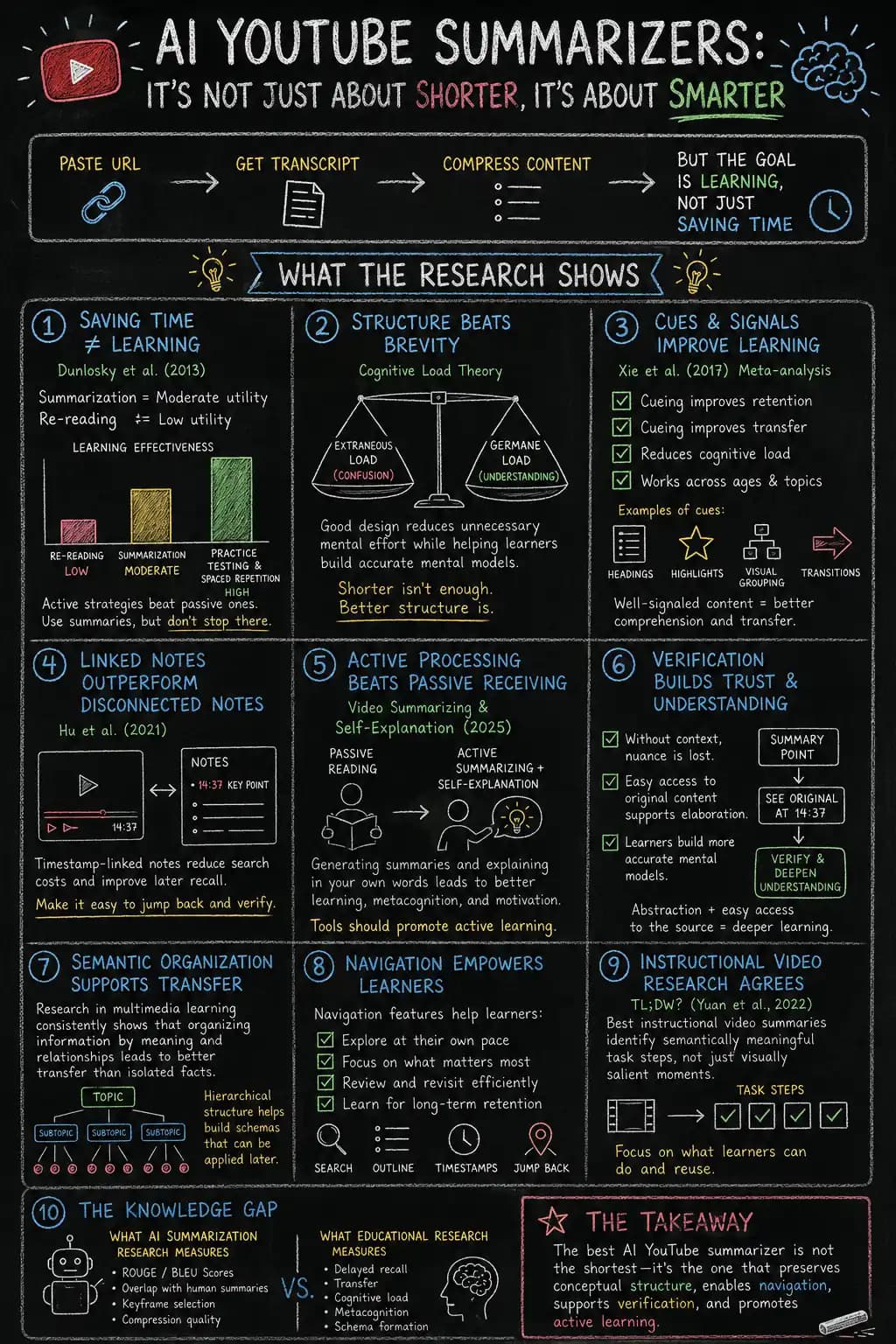
Ayşe Candan Şimşek, Gerrit Anders, Jonathan Göth, Luisa Specht and Markus Huff, researchers at the Leibniz-Institut für Wissensmedien and Eberhard-Karls-Universität Tübingen, conducted two experiments in 2025 with 101 and 215 participants who received AI summaries, transcripts or AI-generated reflective prompts during an educational video. AI summaries produced no advantage over transcripts for retention or transfer, while AI reflective prompts likewise produced no advantage over summaries, although both experiments showed overall knowledge gains after viewing.
| Audience / Industry / Use Case | Research Finding → Your Next Rep |
|---|---|
| Corporate AI-learning platforms | AI summary ≈ transcript: in Experiment 1, GPT-generated summaries produced no significant retention or transfer advantage over transcript segments, linking AI scaffolding, passive exposure and generative learning; evaluate learning through retention and transfer. |
| Higher-education instructional designers | Summary ≈ reflective prompt: in Experiment 2, AI summaries and AI-generated open-ended questions produced statistically similar retention and transfer outcomes, connecting constructive prompts, generative activity and transfer boundaries; compare actual learner-generated responses with passive AI consumption. |
| Educational AI product teams | Knowledge gain without condition advantage: both experiments produced significant pre-to-post knowledge gains while the experimental conditions did not differ, linking human-in-the-loop learning, AI explainability and assessment validity; measure the learner's reconstructed knowledge. |
How to Remember What You Learn? ICAP Retrieval Practice and Spacing for Long-Term Retention
Iman YeckehZaare of MIT's Center for Collective Intelligence and Paul Resnick of the University of Michigan tested a spacing incentive in two randomized controlled experiments involving 143 programming students and 71 instructors in 2025. Counting practice days produced higher final-exam performance through greater spacing, with especially strong benefits for lower-GPA students, demonstrating that retrieval becomes more durable when practice is distributed across time.
| Audience / Industry / Use Case | Research Finding → Your Next Rep |
|---|---|
| Introductory programming courses | Spacing → retention: the 143-student experiment produced mean final-exam scores of 85.3% under Counting Days versus 81.7% under Counting Questions, with practice distributed across substantially more days; connect retrieval practice, spacing and durable retention through final-exam performance. |
| LMS adaptive-learning systems | Distributed retrieval → performance: Counting Days students practiced on 38.5 days versus 17.3 days while answering only slightly more questions, showing that spacing effect, retrieval and practice distribution explain the performance difference more strongly than raw question volume; track practice days alongside attempts. |
| Access and remediation programs | Spacing → reduced achievement dependence: the treatment weakened the relationship between prior GPA and course-exam performance, with the spacing effect especially beneficial for lower-GPA learners; use desirable difficulty, forgetting and retrieval scheduling while evaluating achievement gaps across prior-performance bands. |
How to Find and Fix Misconceptions Faster? Knowledge Gap Analysis Guide
Misconceptions remain hidden until assessment. Use ICAP coding to distinguish Passive viewing, Active manipulation, Constructive inference errors and Interactive reasoning failures, enabling adaptive AI feedback instead of generic remediation. Uses formative, summative, authentic and performance assessment with rubrics, competency-based education, learning outcomes mapping, feedback loops and assessment for, as and of learning, plus Deep Knowledge Tracing and behavioral analytics.
| Upskill Step | Diagnose | Remediate |
|---|---|---|
| Code behavior | Rescue with retrieval: transcript plus event logging reveals gaps; practiced recall owns misconception, don't just glance at dashboard — force reconstruction. | Targeted prompt, not generic reteach, via recall |
| Feedback loop | Preserve with retrieval: AI feedback generation plus AI-generated rubrics must trigger recall, not prevent errors; glance trades comfort. | Teacher review, explainability after retrieval attempt |
| Track | Track ownership: student modeling, predictive analytics dashboard shows who recalls vs recognizes for schools and EdTech. | Earlier intervention for schools and EdTech with recall checks |